
Explore identity, intimacy, understand your sexuality, and learn to live authentically.
A personal welcome and overview of this playbook from Zack.
What Is Sexuality?
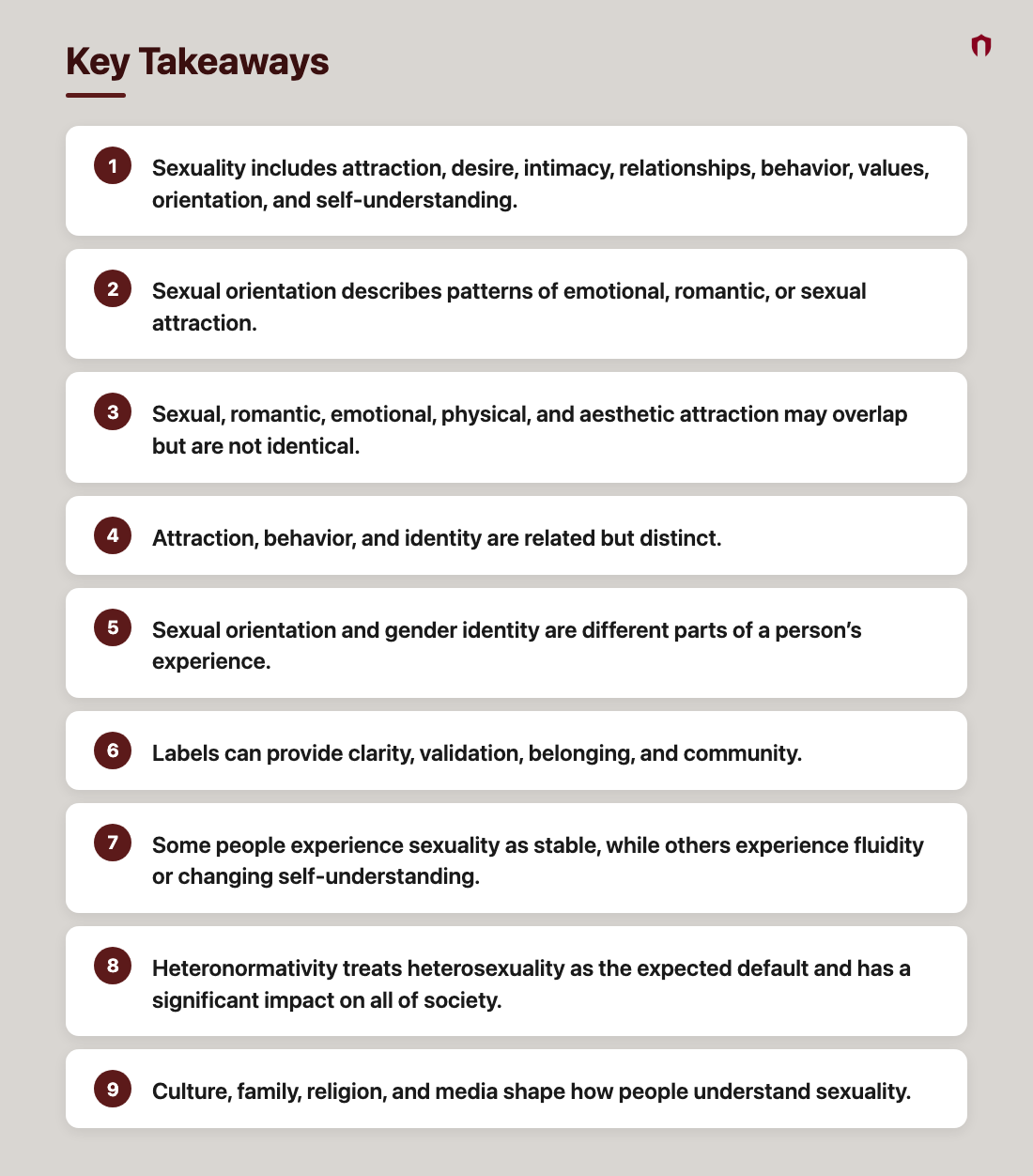
Sexuality is broadly how people experience and understand attraction, intimacy, relationships, and sexual expression.
It may include:
Someone might experience attraction without wanting a relationship. Someone might desire romantic intimacy without experiencing much sexual attraction. Another might experience sexual attraction but decide not to act on it because of personal values, safety, religion, relationship commitments, or life circumstances.
Sexuality isn’t always just what someone does, it includes what they feel, how they connect, what they value, and how they understand those experiences.
What Is Sexual Orientation?
Sexual orientation refers to someone’s romantic and sexual attraction toward people of a particular sex/gender.
Common orientation labels include:
Heterosexual or straight
A person who is primarily attracted to people of the opposite sex/gender.
Gay
A person who is primarily attracted to others of the same sex/gender.
Lesbian
A woman who is primarily attracted to women.
Bisexual
A person who experiences attraction to more than one sex/gender.
Bisexuality doesn’t mean equal attraction to each sex/gender. Attraction may differ in intensity, frequency, or form.
Pansexual
A person whose attraction is not limited by sex/gender – someone who doesn’t find sex/gender as a primary factor in attraction.
Asexual
A person who experiences little or no sexual attraction.
Asexual people can still experience romantic attraction, emotional intimacy, physical affection, or a desire for relationships.
Queer
A broad term some people use when their sexuality doesn’t fit heterosexual expectations or when they prefer not to use a more specific label. Some people embrace this term, while others struggle with its historic use as a slur.
These terms are useful, but they shouldn’t be treated like diagnostic categories. People may understand or use them somewhat differently based on their culture, generation, community, or personal experience.
Attraction Is Not One Single Experience
Attraction can take several forms.
Sexual Attraction
Sexual attraction involves feeling sexually drawn to another person or desiring sexual contact with them. It’s different from simply recognizing that someone is physically attractive. You may find someone aesthetically appealing without wanting sexual intimacy with them.
Romantic Attraction
Romantic attraction may involve wanting:
Sexual and romantic attraction often occur together, but they don’t have to.
Emotional Attraction
Emotional attraction involves feeling drawn to someone’s personality, character, intelligence, humor, or emotional presence. It can contribute to friendship, romance, or sexual intimacy.
Recognizing these differences can help people understand why their feelings don’t always fit a simple formula.
You may feel emotionally close to someone without wanting sex. You could experience sexual attraction without imagining a relationship. You can want affection without experiencing either romantic or sexual attraction.
None of these experiences automatically invalidate or require the others.
Sexual Orientation, Behavior, and Identity
One of the most important distinctions in understanding sexuality is the difference between:
These three areas often overlap, but they’re not identical.
Attraction
Attraction refers to the feelings a person experiences.
Behavior
Behavior refers to what someone has or has not done.
Identity
Identity refers to the language someone uses to understand and describe their sexuality.
For example:
Dating and sexual history don’t always tell the whole story. People may make relationship choices because of:
Sexuality vs. Gender Identity
Sexual orientation and gender identity are related concepts, but they’re not the same.
Gender identity is a person’s internal understanding of their gender, while sexual orientation refers to patterns of attraction.
Both cisgender and transgender people can be straight, gay, lesbian, bisexual, pansexual, asexual, or use another orientation label. Someone’s gender identity does not determine who they’re attracted to.
Understanding this distinction prevents sexuality and gender from being treated as interchangeable.
Labels Can Be Helpful
Sexuality labels can provide:
For someone who has spent years feeling different or alone, finding a word that reflects their experience can be powerful.
A label may communicate:
“There are other people like me.”
“My experience has a name.”
Labels can help people find communities, resources, relationships, and role models.
Using a label doesn’t mean allowing it to define every aspect of your life. Sexuality can be important without becoming the only important thing about you.
Stability, Fluidity, and Change
Some people experience their sexuality as consistent throughout life.
Others notice changes in:
Saying that sexuality can be fluid doesn’t mean that everyone’s orientation changes. It also doesn’t mean that sexual orientation can be deliberately changed through pressure, treatment, or willpower.
Some people experience genuine fluidity. Others experience strong stability. A changed label over time doesn’t necessarily mean attraction has changed, more often it’s simply an increase in understanding of feelings that have always been there.
For example, someone may initially identify as straight because heterosexuality was the only possibility they had considered. Later, they may recognize attractions that had previously been minimized, misunderstood, or ignored.
Heteronormativity
Heteronormativity is society’s assumption that heterosexuality is the default, expected, or most natural orientation.
It may appear in subtle ways:
Growing up, we absorb and internalize these assumptions before understanding our own sexuality. As a result, an LGB person might initially assume they are or should be straight, misinterpret or feel shame about their same-sex attractions, and try to make themselves fit into society’s expected boxes.
Heteronormativity isn’t always intentional prejudice. It describes a social environment where one orientation is treated as standard and others are treated as exceptions.
Culture, Family, Religion, and Media
Sexuality develops within a social environment.
Family, culture, religion, and media may shape beliefs about:
These influences aren’t automatically harmful. They can provide meaning, values, community, and guidance. However, conflict may develop when a person’s sexuality doesn’t fit the expectations of people who are important to them.
Someone may feel forced to choose between:
These conflicts rarely have simple solutions. Working with clients in these situations involves helping the person examine which beliefs they hold, which were imposed, and whether different parts of their life can coexist without rejecting authentic aspects of themselves.
Key Takeaways
🧠 Your Mental Playbook
One Thing to Remember
Your sexuality doesn’t need to fit a stereotype, follow a timeline, or be proven through experience to be valid.
Reflect
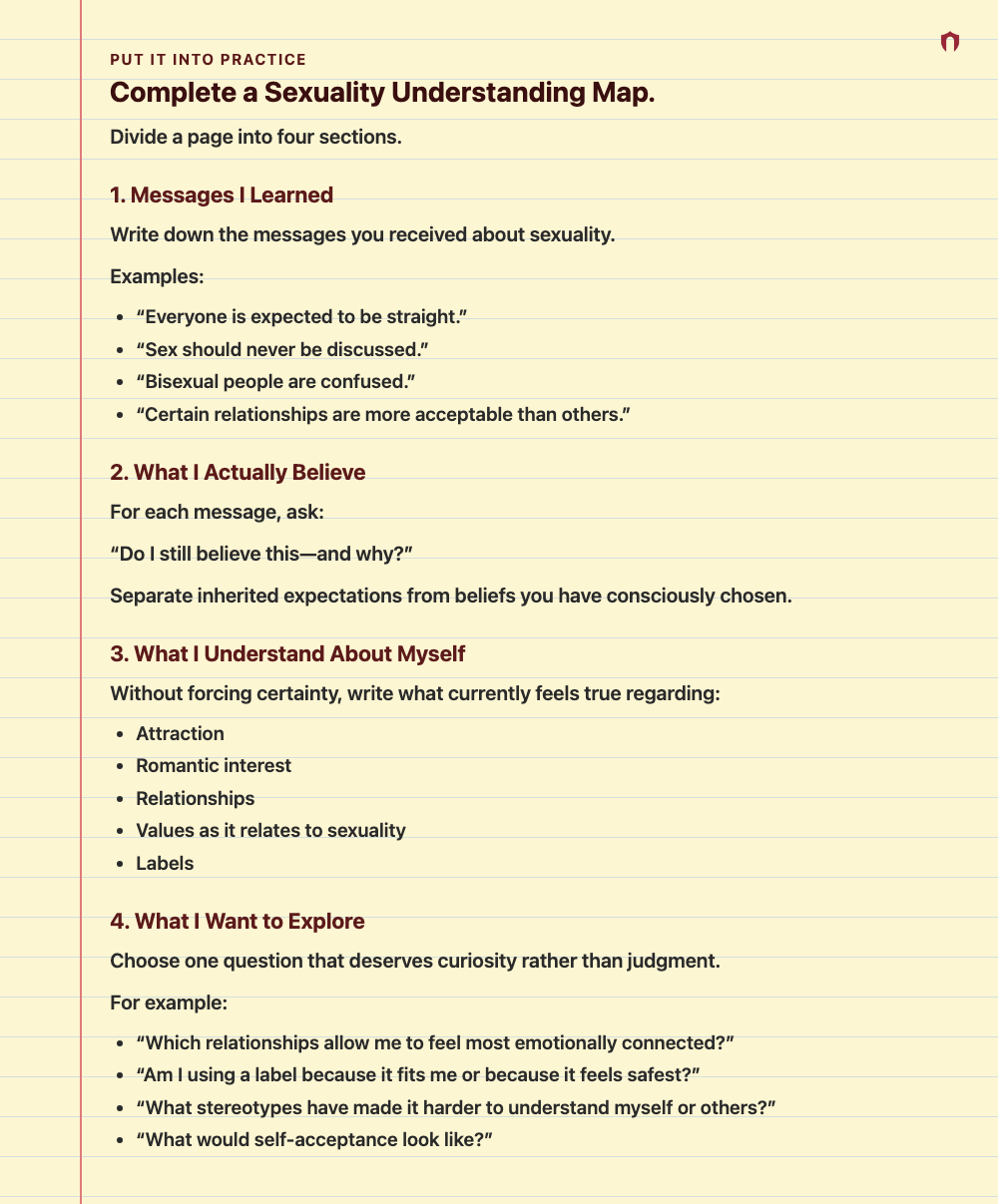
Consider how you developed your understanding of sexuality.
Ask yourself:
What messages did I receive growing up about attraction, relationships, and sexual orientation?
Was heterosexuality presented as one possibility or as the only expected possibility?
Which sexual orientations were represented positively?
Which were stereotyped, ignored, or criticized?
Do I confuse someone’s behavior with the totality of their orientation?
How have family, religion, culture, or media influenced my beliefs?
Which beliefs reflect my current values, and which have I never examined?
Put It Into Practice
“The privilege of a lifetime is to become who you truly are.” — Carl Jung
Note: Many concepts that apply to LGB relationships would apply to heterosexual couples as well. Refer to the Relationships Playbook for a deep dive into relationships in general.
Intimacy Is More Than Sex
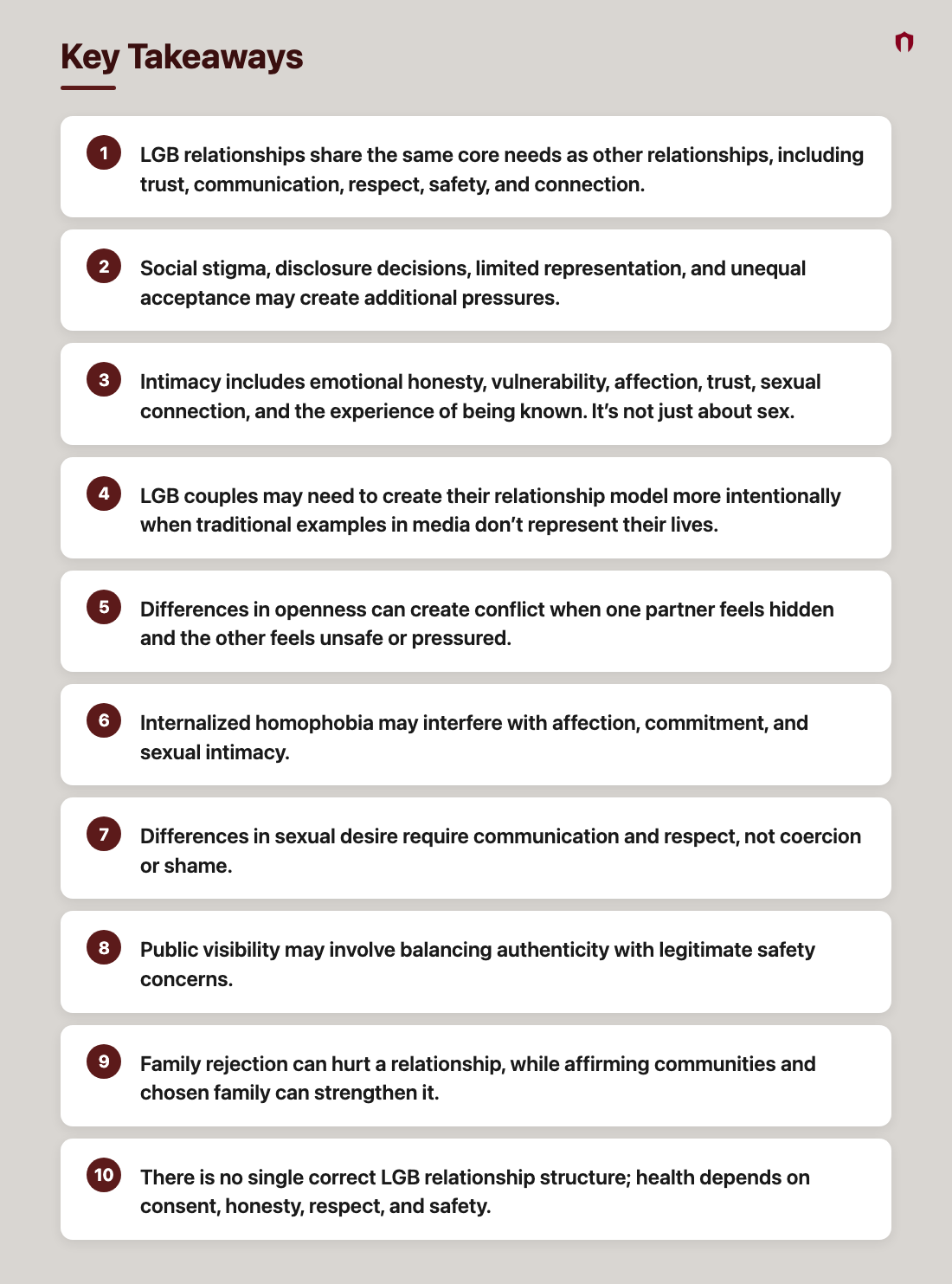
Intimacy and sexual connection are often used interchangeably, but that’s not necessarily accurate. Sexual connection is a form of intimacy, but intimacy can also include:
Someone could feel sexually connected to someone without feeling emotionally safe. They may also experience deep emotional intimacy in a relationship where sex is infrequent or absent.
Platonic friends who don’t have sex can develop deep levels of intimacy, while people who have sex could develop none. Healthy intimacy doesn’t require one universal combination.
Learning Relationships Without Seeing Yourself Represented
We learn about relationships before entering one ourselves.
We observe parents, relatives, friends, what we see on TV, in movies, in books, in school, on social media, and throughout religion.
These examples help form our beliefs about dating, commitment, gender roles, marriage, sex, and family life.
LGB people grow up seeing very few positive representations of relationships that reflect their sexuality. A huge majority of songs, movies, shows, etc. are about love and sex between a man and woman. When same-sex relationships are shown, they’re often portrayed as tragic, secretive, overly sexual, or socially rejected.
This can leave people without a clear model for questions such as:
One positive: without automatically inheriting traditional gender roles, LGB couples may have greater opportunity to decide for themselves how responsibilities, affection, finances, caregiving, decision-making, etc. will be shared.
Ultimately the goal in any relationship is to have it reflect the values and needs of the people actually living in it.
Coming Out Within Dating and Relationships
Coming out is often discussed as though it happens once. In reality, disclosure may have to occur repeatedly throughout life.
An LGB person may need to decide whether to come out to friends, family, coworkers, their doctors, neighbors, people they’ve recently met, etc.
Dating can make these decisions more complicated because one person’s level of openness affects the other. One partner may be comfortable being publicly affectionate, discussing the relationship at work, or posting pictures online. The other may be more private, jaded by past experiences, afraid of rejection, or concerned about safety.
Neither person’s feelings should automatically be treated as wrong, but differences in openness can create pain.
The more open partner may feel:
The less open partner may feel:
A healthy conversation separates privacy, secrecy, and shame.
Privacy means choosing who has access to personal information. Secrecy often means actively concealing a relationship in ways that may prevent it from being fully acknowledged. Shame means believing the relationship or sexuality is fundamentally wrong or embarrassing.
No one should be forced to come out before they are ready or safe. At the same time, the emotional impact of concealment on a partner should not be dismissed.
The couple may need to discuss:
Vulnerability and Fear of Rejection
All intimacy involves risk.
To become emotionally close to others, we must reveal feelings, needs, hopes, insecurities, and parts of our history that another person could misunderstand or reject.
For some LGB people, vulnerability may feel especially dangerous because they’ve likely experienced rejection related to sexuality.
They may have learned:
“Being fully known is unsafe.”
“People may love me until they know the truth about me.”
“I should protect myself before someone else hurts me.”
These beliefs may lead to:
These patterns are understandable attempts at protection, but strategies that reduce the risk of rejection also reduce the possibility of genuine intimacy with another.
Vulnerability doesn’t mean disclosing everything immediately or ignoring warning signs. It means gradually allowing trust to develop through mutual honesty, consistency, and respect.
Internalized Shame and Relationships
People may intellectually accept LGB sexuality while still carrying emotional shame learned earlier in life.
They may believe consciously:
“There is nothing wrong with being gay, lesbian, or bisexual.”
Yet still feel uncomfortable with:
This is called internalized homophobia.
It doesn’t mean the person consciously hates themselves or others (although that could be the case). But what it really means is that negative social messages may have become embedded in their emotional responses.
Internalized shame can affect relationships by creating:
Recognizing internalized homophobia allows someone to connect how societal norms and expectations are influencing current beliefs and emotional responses.
Gender Roles in Same-Sex Relationships
Heterosexual relationships are often surrounded by traditional expectations about who should lead, provide, care for the home, express emotion, initiate sex, or make decisions.
Same-sex relationships may struggle to identify expectations of roles. This can create flexibility, but people may still feel pressure to assign one partner a traditionally masculine role and the other a traditionally feminine one.
Questions such as:
“Who is the man in the relationship?”
inaccurately assume that every couple must reproduce heterosexual gender roles.
Healthy couples decide responsibilities according to:
Equality does not always mean dividing every task exactly in half. It means that both people’s needs, contributions, and voices matter.
One partner may earn more while the other contributes more household labor. One may take the emotional angle into consideration while the other handles practical planning. The relevant question is whether the arrangement is discussed, respected, and experienced as fair.
Bisexuality Within Relationships
Bisexual people also tend to face assumptions in dating and relationships.
They may be stereotyped as:
These beliefs can produce bisexual erasure.
A bisexual person in a different-sex relationship may be assumed to be straight. A bisexual person in a same-sex relationship may be assumed to be gay or lesbian.
But their current partner doesn’t just erase their orientation. Bisexuality also doesn’t mean equal attraction to every sex/gender or imply a need to date multiple people.
Monogamy and nonmonogamy are relationship structures, not sexual orientations. A bisexual person can choose monogamy just as anyone else can. Being capable of attraction to more than one sex/gender doesn’t mean being incapable of commitment.
Healthy relationships require partners to discuss behavior, boundaries, and expectations rather than treating stereotypes as evidence for what the relationship should look like.
Sexual Communication and Consent
Sexual intimacy is healthiest when people can communicate about what they want to experience, comfort and points of discomfort, boundaries, and consent without shame.
All sexual consent should be:
Being in a relationship does not create permanent consent, and past sexual activity doesn’t obligate someone to repeat it. A person can change their mind at any point.
People may avoid these conversations because they fear embarrassment, rejection, or ruining spontaneity. In reality, communication often makes intimacy safer and more connected.
No partner should be expected to read another person’s mind. Communication is key when it comes to sexual intimacy.
Sexual Compatibility
Partners don’t always experience the same level, timing, or form of sexual desire. One person may want sex more frequently. Another may need emotional connection, privacy, rest, or a sense of safety before desire appears.
Compatibility doesn’t require identical desire, but there does need to be enough openness to discuss differences without coercion, humiliation, avoidance, or blame.
Some differences can be negotiated. Others may reveal an important incompatibility.
For LGB relationships, discussion about roles and preferences for sex is commonly addressed earlier on in the relationship, as there may be functional differences compared to sex in a heterosexual relationship. Needing to navigate expected roles for sex is an example of when LGBs may feel pressured to discuss intimate topics before the establishment of trust and connection first.
Public Affection and Safety
Many heterosexual couples can discuss a partner, hold hands, or show affection publicly without first assessing whether doing so is safe.
LGB couples may need to make situational decisions.
They may consider:
These calculations can create chronic stress. Another anxiety-producing consideration that exists in the world of being LGB.
One partner may interpret avoiding affection as rejection. The other may view it as necessary protection. Neither response should automatically be dismissed.
Couples would benefit from discussing public visibility issues before entering situations where they may have different expectations.
They can ask:
Authenticity and safety are both legitimate needs. The balance and decisions couples make may change depending on the environment.
Family Acceptance and Chosen Family
Family support absolutely strengthens the individual and can certainly make relationships feel safer and more fulfilling.
Acceptance may allow partners to participate openly in holidays, celebrations, caregiving, and everyday family life. Rejection can create painful choices.
An LGB person may feel caught between:
A partner may tolerate discomfort temporarily while hoping the family will adjust. But repeated exclusion, mislabeling, hostility, or denial can damage both the individual and the relationship.
Boundaries may be necessary.
For example:
“You don’t need to fully understand our relationship, but you do need to treat my partner with respect.”
The unfortunate reality is not all parents and families will adapt and change their views. This is one reason chosen family can become especially important within LGB communities.
Chosen family refers to people who provide the acceptance, commitment, support, and belonging that biological relatives may not provide.
Ideally, chosen families don’t need to replace the biological family - they can supplement it, coexist with it, or become the person’s primary support system.
Healthy relationships rarely thrive in total isolation. Couples benefit from communities where their relationship is recognized rather than merely tolerated.
Key Takeaways
🧠 Your Mental Playbook
One Thing to Remember
A healthy relationship does not require you to hide who you are, abandon your boundaries, or prove your love through self-sacrifice.
Intimacy grows when two people can be seen honestly while remaining emotionally and physically safe.
Reflect
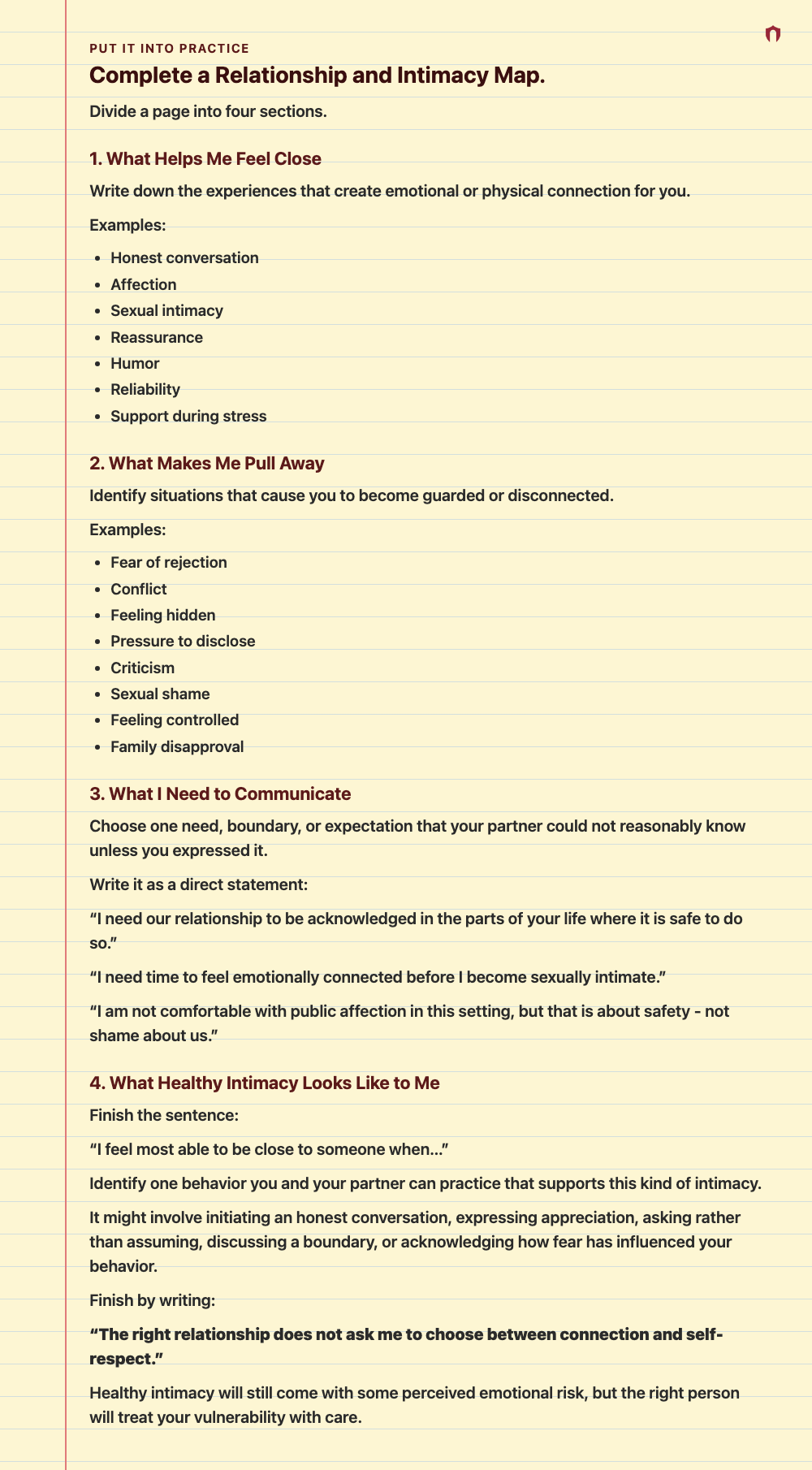
Consider how sexuality and social expectations may influence your approach to relationships.
Ask yourself:
What relationship models did I see growing up and did I feel represented in what I saw?
Do I feel safe being seen and known fully by a partner?
Do I confuse practical privacy with shame or secrecy?
What level of openness do I need in a relationship?
Do I communicate needs directly, or expect a partner to recognize them without discussion?
Can I discuss boundaries, desires, and consent without embarrassment or fear?
How do my family and community affect my relationships?
Which parts of a healthy relationship matter most to me?
Put It Into Practice
“To be fully seen by somebody, then, and be loved anyhow—this is a human offering that can border on miraculous.” — Elizabeth Gilbert
Introduction
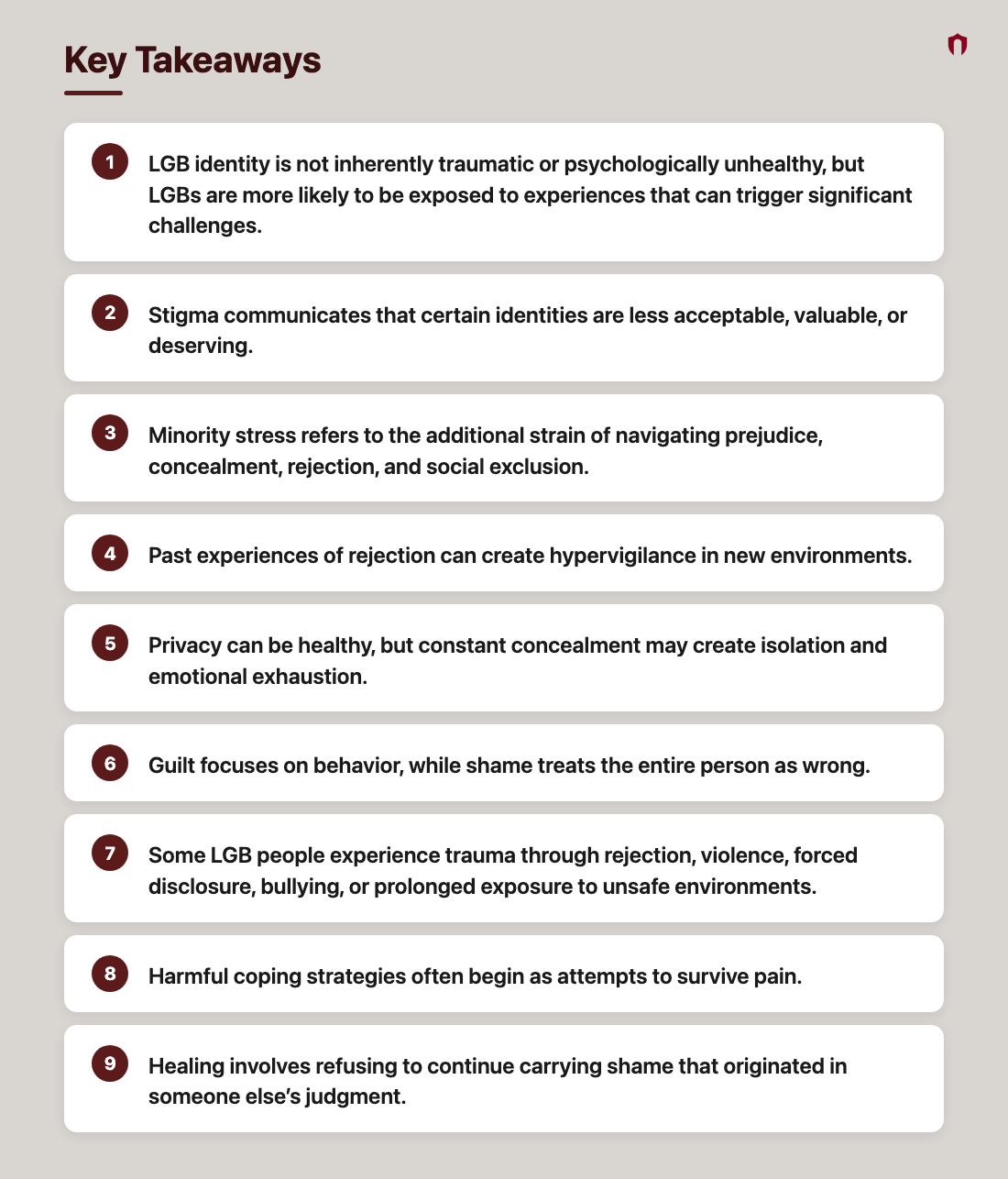
Lesbian, gay, and bisexual people are not inherently more psychologically fragile than heterosexual people.
Sexual orientation itself is not a mental illness, a defect, or a source of trauma. However, living in an environment that rejects, stereotypes, threatens, or erases an important part of who you are can create real psychological pain.
An LGB person may repeatedly have to consider:
Even if no single event appears traumatic, repeatedly anticipating rejection can affect the mind and body.
LGBs might learn to monitor their speech, relationships, appearance, and behavior. They often hide important parts of their life, prepare for negative reactions, or attempt to prove that they are of value.
Over time, external stigma can become internal shame. The person may begin treating society’s judgment as evidence about their own worth.
Understanding this process is important because the goal is not simply to tell people to “ignore what others think.” Rejection from family, community, institutions, and society has serious emotional and practical consequences.
At the same time, resilience can develop through self-understanding, supportive relationships, affirming communities, and the gradual rejection of shame that never belonged to the person in the first place.
Understanding Stigma
Stigma occurs when a trait or identity is socially devalued or openly rejected.
It communicates that a person is less acceptable, less deserving, less trustworthy, less worthy of love, and someone who should hide or change.
Stigma can be direct. It may appear through:
It can also be subtle. A person may notice:
Subtle stigma can be difficult to name because each individual interaction may appear minor. But repeated messages accumulate.
The person may begin to understand that acceptance is conditional:
“You can belong as long as this part of you remains invisible.”
Anticipating Rejection
Growing up, most kids want to fit in and be accepted by their peers. As LGB teenagers enter the most self-conscious, need for approval years of their life, they are strapped with the grave concern that who they are fundamentally will lead to rejection and social consequences.
As they get older, even if their current circumstance has improved, the mind uses past experiences to anticipate future harm (see Anxiety Playbook).
Someone who has been mocked, threatened, excluded, or rejected may enter new situations expecting that it could happen again (and they’re not wrong).
They may become highly attentive to:
This state of heightened monitoring is sometimes called hypervigilance.
Hypervigilance is designed by the brain to be protective. It helps the person notice potential danger. But remaining continuously alert is exhausting, and has mental and physical health consequences.
The person may struggle to relax even in supportive environments because the mind has learned:
“Safety can disappear quickly.”
They may misinterpret neutral interactions as rejection and therefore require repeated reassurance. This doesn’t mean the fear is irrational. It very likely developed from real experiences.
Healing involves learning to distinguish present danger from the expectation created by past danger.
Minority Stress
Minority stress refers to the additional strain in life experienced by people who belong to stigmatized social groups.
Everyone experiences ordinary stress involving work, finances, health, family, relationships, and uncertainty. But an LGB person may experience those same pressures while also navigating stress related to sexual orientation.
This may include:
Those who struggle with minority stress may be negatively impacted by needing to repeatedly adapt to an environment that may not offer equal safety or acceptance.
Imagine entering a room and needing to evaluate whether ordinary information about your life is safe to share. A heterosexual person may casually mention a spouse or date. An LGB person may first consider who is listening, how they may respond, and whether disclosure could create consequences.
Each decision may seem small, but the repeated need to make decisions at all takes a significant toll.
Concealment and the Cost of Hiding
Not everyone can be open about their sexuality in every setting.
There are legitimate reasons to remain private, including:
No one should be pressured to disclose their sexuality before they feel ready or safe. Privacy can be healthy. However, concealment may become psychologically costly when a person must continually edit their life.
They may:
The person may receive approval from someone but immediately wonder:
“Would they still accept me if they knew?”
This can make acceptance feel incomplete because it appears directed toward a carefully managed version of themself.
The solution may involve building at least one environment where the person can exist without constant self-monitoring.
From External Stigma to Internal Shame
Stigma comes from the outside.
Shame is what may happen when those messages move inward.
A person may repeatedly hear that their sexuality is:
Eventually, they may begin thinking:
“There is something wrong with me.”
“I am disappointing everyone.”
“I don’t deserve happiness.”
“People would reject me if they truly knew me.”
“My life will never be normal.”
This is internalized stigma. The person begins applying society’s negative beliefs to themselves or other LGB people.
Internalized stigma can exist even when someone openly identifies as lesbian, gay, or bisexual. Intellectual acceptance and emotional acceptance do not always develop at the same pace.
A person may say:
“I know there is nothing wrong with being gay.”
while still feeling ashamed when holding a partner’s hand.
They may support other LGB people while struggling to extend the same acceptance toward themselves.
Shame is rarely removed by logic because it wasn’t learned through logic in the first place. It may have been reinforced through years of emotion, relational trauma, fear, and need for belonging.
Healing often requires new emotional experiences - not just new information.
The Difference Between Guilt and Shame
Guilt and shame are related, but they are not the same.
Guilt says:
“I did something wrong.”
Shame says:
“I am wrong.”
Healthy guilt may help someone recognize harmful behavior, take responsibility, apologize, and make a different choice.
Shame attacks the entire self. It doesn’t focus on a specific action. It communicates that the person is fundamentally unacceptable.
This distinction matters because sexual orientation is not a harmful behavior requiring correction. A person can make healthy or unhealthy choices within any orientation. They can act honestly or dishonestly, respectfully or disrespectfully, safely or recklessly. Their basic capacity for same-sex or multiple-sex attraction is not a moral failure.
Trauma and Sexuality
Not every LGB person experiences trauma. It’s important not to describe LGB identity as automatically traumatic or assume that every person has been deeply harmed.
However, many (a large majority) experience events or environments that make it difficult to feel safe.
These may include:
Trauma can be the result of one severe event or from ongoing exposure to threat, rejection, and powerlessness.
What may be traumatic to one person may not be traumatic to someone else. And even so, everyone responds to trauma differently. So to compare experiences and responses is often a useless task. Trauma is shaped by many factors, including age, support, prior experiences, the severity and duration of the event, and what happened afterward.
Family Rejection
Family rejection can be particularly painful because family is often expected to provide safety, belonging, and unconditional care.
An LGB person may fear losing:
Rejection may be direct:
“You are no longer welcome here.”
It may also be conditional:
“We love you, but we do not accept this part of you.”
“You can come home, but your partner cannot.”
“Don’t discuss this around your younger sibling(s).”
Conditional acceptance can create mental confusion because love and rejection are occurring at the same time. The person may continue seeking approval, hoping that enough patience, achievement, or silence will eventually create acceptance.
Some families do grow and change, others don’t.
Resilience may require grieving the family response someone hoped to receive while building relationships with people who can offer genuine recognition.
To put it plainly, being rejected by your family or friends for being who you are, and because of aspects of you that are entirely out of your control, is as painful of an experience as a human can endure.
The Mental Health Effects of Chronic Stigma
Long-term exposure to stigma, concealment, rejection, or fear can contribute to psychological distress.
This may include:
These outcomes should not be interpreted as evidence that LGB identity is psychologically unhealthy.
The more accurate distinction is:
Sexual orientation is not the injury. Rejection, shame, discrimination, and isolation may cause the injury, and those who have a non-heterosexual orientation are more inclined to experience those triggers.
This distinction matters because if sexual orientation is believed to be the injury itself, LGBs may attempt to solve distress by rejecting themselves rather than addressing the environment, beliefs, and experiences that created the distress.
Support systems are critical to help reduce shame, increase safety, process painful experiences, strengthen relationships, and build a life in which the person does not need to disappear to belong.
When Coping Becomes Harmful
People often develop coping strategies that make sense in the context in which they began, but sometimes the mechanism used for coping develops into a separate, at times larger issue than the original pain it was meant to cure.
Someone may use alcohol to feel less self-conscious in social settings. Another person may pursue casual sex to feel wanted. Someone may avoid relationships so they can’t be rejected. Another may overachieve in an attempt to prove their worth.
These strategies may provide:
But they may also create additional problems.
Examples include:
The purpose of recognizing unhealthy coping is to ask:
“What pain was this strategy helping me survive?”
and:
“Is there now a safer way to meet that need?”
Almost all coping strategies are fundamentally understandable, but when they start doing more harm than good, it may require a change in approach.
What Resilience Really Means
Resilience is sometimes described as the ability to remain strong no matter what happens.
That definition can create pressure to hide pain.
Resilience does not mean:
Resilience is the capacity to adapt, recover, seek support, protect yourself, and continue building a meaningful life.
It may look like:
Resilience helps prevent what happened from having permanent authority over what comes next.
Affirming Relationships
Supportive relationships are among the strongest sources of resilience.
An affirming person does more than tolerate someone’s sexuality.
They communicate:
One supportive relationship can challenge the belief that rejection is inevitable. Multiple affirming relationships can create a new experience of belonging.
Support can’t undo every injury, but it can help the person experience what stigma denied: safety while being seen and known.
Key Takeaways
🧠 Your Mental Playbook
One Thing to Remember
The shame you learned is not proof that there’s something wrong with you. It’s evidence that you were taught to see yourself through someone else’s fear, prejudice, or expectations.
Those messages may have shaped how you think, what you hide, and what you believe you deserve. But learned shame can be questioned, unlearned, and replaced with a more compassionate understanding of yourself.
Reflect
Consider how external messages may have shaped your internal beliefs.
Ask yourself:
Have I experienced acceptance that felt conditional?
Where do I still monitor or edit myself?
Do I expect rejection even in supportive environments?
Which parts of myself have I hidden to preserve belonging?
How has shame influenced my relationships or intimacy?
Which coping strategies helped me survive but now create additional problems?
Who allows me to feel safe while being known?
Put It Into Practice
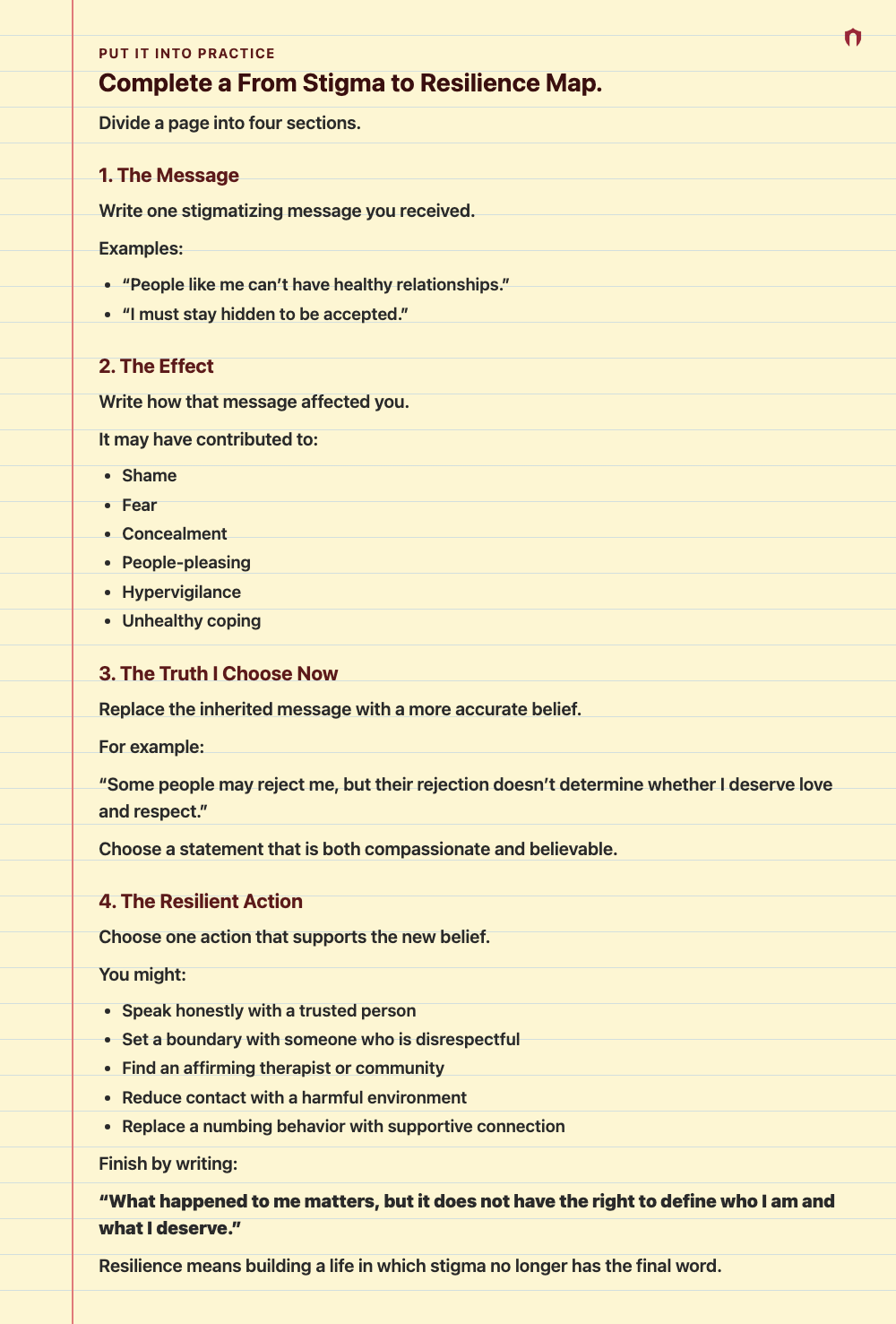
“Owning our story and loving ourselves through that process is the bravest thing that we will ever do.” — Brené Brown
Introduction
Living authentically is often described as simply “being yourself.”
But for many lesbian, gay, and bisexual people, authenticity is more complicated than openly expressing every part of themselves in every setting.
A person may need to consider:
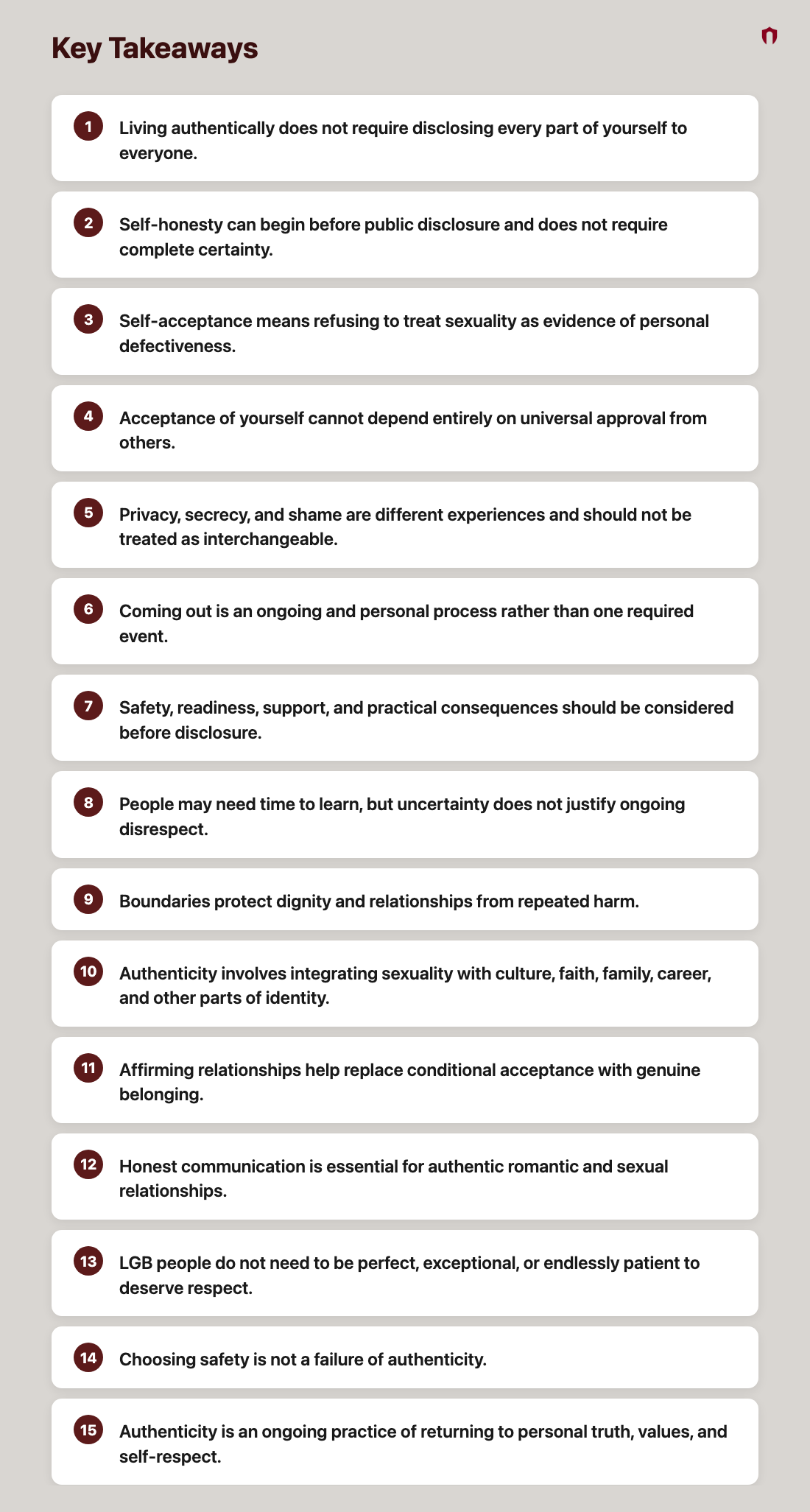
Authenticity does not require complete openness with everyone.
It does not mean sharing personal information before you are ready, placing yourself in danger, or turning sexuality into the center of every interaction.
Authenticity means building a life that reflects who you are without requiring you to continually reject, disguise, or apologize for yourself.
For some people, that may involve coming out publicly. For others, it may involve confiding in a few trusted people, acknowledging their sexuality privately, building affirming relationships, or gradually separating their own beliefs from those imposed by others.
There is no single performance of authenticity.
The central question is:
“Can I live in a way that honors who I am without abandoning my safety, values, and well-being?”
Authenticity Begins With Self-Honesty
Before someone can live authentically around others, they must become increasingly honest with themselves.
Self-honesty does not require immediate certainty.
It may begin with acknowledging:
People sometimes avoid this honesty because recognition creates difficult questions.
You may think:
“What will this mean for my family?”
“Will I have to change my life?”
“What if I lose people?”
“What if I am wrong?”
“Can I accept this without telling anyone?”
Acknowledging your sexuality does not obligate you to take every possible action immediately.
Self-awareness and public disclosure are different decisions.
You can begin telling yourself the truth while taking time to determine how that truth should be expressed in your life.
Acceptance Is Different From Approval
Self-acceptance does not mean celebrating every feeling you have or never experiencing conflict again.
It means no longer treating your sexuality as evidence that you are defective, undeserving, or required to change.
You may still have unresolved questions involving:
Self-acceptance allows you to examine those questions without beginning from the assumption that your existence is the problem.
It says:
“I can think carefully about how I want to live without treating myself as fundamentally wrong.”
Self-acceptance also does not depend on universal approval.
Some people may misunderstand, disagree, or refuse to accept you. Their response can be painful and may carry real consequences.
But living entirely through other people’s approval creates an impossible task. There will always be someone whose expectations you cannot satisfy without betraying another part of yourself.
Approval asks:
“Will they permit me to be this person?”
Acceptance asks:
“Can I recognize my own dignity even when someone else refuses to?”
Authenticity Is Not the Same as Disclosure
A person can be authentic without telling everyone everything.
Disclosure refers to sharing information about your sexuality with another person.
Authenticity refers to the broader experience of living in alignment with yourself.
Someone may choose not to disclose because of:
That decision is not automatically dishonest.
Everyone has the right to determine who receives personal information.
However, concealment can become painful when it requires someone to repeatedly deny important parts of life, hide meaningful relationships, or maintain separate versions of themselves.
The relevant question is not:
“Am I out to everyone?”
It is:
“Does the way I am living allow enough honesty, connection, and self-respect?”
A person may be private and authentic.
They may also be publicly open while still carrying significant internal shame.
Visibility alone does not determine self-acceptance.
Privacy, Secrecy, and Shame
Privacy, secrecy, and shame can appear similar from the outside, but they are psychologically different.
Privacy
Privacy means intentionally deciding who has access to personal information.
It may reflect healthy boundaries.
“This part of my life is personal, and I choose to share it only with people I trust.”
Secrecy
Secrecy involves actively concealing information, often because disclosure is expected to produce consequences.
It may be necessary for safety, but maintaining it can become emotionally exhausting.
“I must make sure no one discovers this.”
Shame
Shame involves believing the information must be hidden because it reveals something unacceptable about you.
“If people knew, they would see that something is wrong with me.”
A person may experience all three at different times.
The goal is not to eliminate privacy. It is to notice whether choices are guided by values and safety—or controlled primarily by shame.
Coming Out Is a Personal Process
Coming out is often portrayed as a single dramatic announcement.
In reality, it can be a lifelong and repeated process.
An LGB person may come out to:
Each disclosure involves a different level of trust, risk, and emotional importance.
There is no universal timeline.
Some people recognize and disclose their sexuality early. Others come out later after years of relationships, marriage, parenting, religious involvement, or attempts to live according to heterosexual expectations.
Coming out later does not mean someone was cowardly or dishonest.
They may have lacked:
No one should be pressured to disclose before they are ready.
At the same time, fear can continue expanding when every disclosure is postponed indefinitely. A person may benefit from considering whether the danger is present and realistic, or whether an old expectation of rejection is controlling a currently safer situation.
Readiness does not mean having no fear.
It means having enough safety, support, and personal choice to move forward despite some uncertainty.
Deciding Whether to Disclose
Before telling someone, it may help to consider:
You cannot completely control another person’s reaction.
You can prepare for it.
A disclosure plan may include:
Coming out does not create an obligation to debate your humanity.
You may offer information without accepting interrogation.
When Acceptance Takes Time
Some people respond supportively immediately.
Others may feel surprised, confused, afraid, or uncertain because the information challenges their assumptions.
A delayed understanding is not always the same as rejection.
Someone may need time to:
However, needing time should not become an indefinite excuse for disrespect.
There is a difference between:
“I am still learning, but I love you and want to understand.”
and:
“I will only treat you well if you hide this part of yourself.”
Growth may be gradual, but respect can begin immediately.
You are allowed to decide how much access someone receives while they work through their response.
Setting Boundaries With Unaccepting People
Authenticity may require boundaries with people who refuse to treat you or your relationships respectfully.
Boundaries may include:
A boundary communicates what you will do—not how you will force another person to think.
For example:
“You are allowed to have your beliefs. I will not remain in conversations where my relationship is insulted.”
“I will not attend family events where my partner is deliberately excluded.”
“I am willing to talk when the conversation is respectful. I am not willing to defend my right to exist.”
Boundaries can involve grief.
You may wish a relationship could continue without limits. But maintaining closeness at the cost of repeated self-rejection is not genuine connection.
Integrating Sexuality With Other Parts of Identity
Living authentically does not mean sexuality must become someone’s entire identity.
A person may also deeply value:
The goal is integration.
Integration means allowing sexuality to exist alongside other important parts of the self without requiring one identity to erase another.
For some people, this may involve finding an affirming religious community. For others, it may mean developing a personal spirituality outside an institution. Someone may preserve cultural traditions while setting limits around harmful expectations.
Integration does not always produce a perfect resolution.
Some tensions may remain.
Authenticity can include saying:
“These are both important parts of me, even if other people insist they cannot coexist.”
A full life does not require reducing yourself to one category.
It requires enough internal room for the different parts of you to belong to the same person.
Building Affirming Relationships
Self-acceptance is deeply personal, but it rarely develops entirely in isolation.
People often learn how to see themselves through relationships.
An affirming person communicates:
Affirming relationships may include:
Belonging should not require performing a particular version of sexuality.
LGB communities are diverse. Not everyone shares the same personality, politics, interests, appearance, relationship preferences, or degree of openness.
Authenticity means finding spaces where you can belong without exchanging one rigid stereotype for another.
Living Authentically in Relationships
Authenticity also influences romantic and sexual relationships.
A person may struggle to be honest about:
Fear of losing a relationship can lead someone to agree to arrangements that do not reflect their values.
They may remain hidden indefinitely, tolerate disrespect, avoid discussing commitment, or participate in sexual experiences they do not genuinely want.
Authenticity in relationships means communicating honestly enough for both people to make informed choices.
It does not guarantee compatibility.
In fact, honesty may reveal that two people want different things.
But a relationship built on ongoing self-abandonment is not made healthy simply because it continues.
Moving Beyond Proving Yourself
LGB people may feel pressure to prove that their lives and relationships are respectable.
They may believe they must be:
This pressure can turn authenticity into another performance.
You do not need to become exceptional to justify your dignity.
You are allowed to:
Equality does not mean proving that every LGB person is flawless.
It means recognizing that dignity was never supposed to depend on perfection.
Authenticity and Safety
Advice about authenticity can become harmful when it ignores safety.
Being open may involve real risks depending on a person’s:
Authenticity should not be measured by how much danger someone is willing to tolerate.
Choosing safety is not cowardice.
At the same time, a life organized entirely around avoiding every possible rejection can become increasingly small.
The balance may involve gradual steps:
You may not be able to live as openly as you want today.
You can still begin creating the conditions that make greater freedom possible later.
Authenticity as an Ongoing Practice
Living authentically is not a one-time achievement.
New relationships, workplaces, communities, and life stages may bring new decisions.
There may be periods when you feel confident and others when old shame returns.
Authenticity requires repeatedly asking:
The answers may change.
That does not mean you have failed.
Authenticity is not perfect consistency. It is the willingness to keep returning to yourself.
Key Takeaways
🧠 Your Mental Playbook
One Thing to Remember
Authenticity does not mean giving everyone access to you. It means no longer abandoning yourself to keep their approval.
You are allowed to protect your privacy, consider your safety, and decide when disclosure is appropriate.
But belonging that requires you to continually deny or condemn yourself comes at too high a cost.
The goal is not to tell everyone everything.
It is to build enough honesty into your life that you no longer feel absent from it.
Reflect
Consider where you currently experience authenticity, privacy, and pressure.
Ask yourself:
What have I acknowledged privately that I still struggle to accept emotionally?
Which people allow me to feel known without feeling judged?
Where am I practicing healthy privacy?
Where am I hiding primarily because of shame?
Which risks related to disclosure are realistic?
Which fears come from earlier experiences but may not reflect my current environment?
Do I depend on someone else’s approval to believe I am acceptable?
What boundaries would protect my dignity?
Are there relationships where I must continually edit myself?
Which parts of my identity feel difficult to integrate?
What would a more authentic life look like without requiring total openness?
What is one step toward that life that feels both meaningful and safe?
Authenticity does not begin with a public announcement.
It begins with refusing to make yourself the enemy.
Put It Into Practice
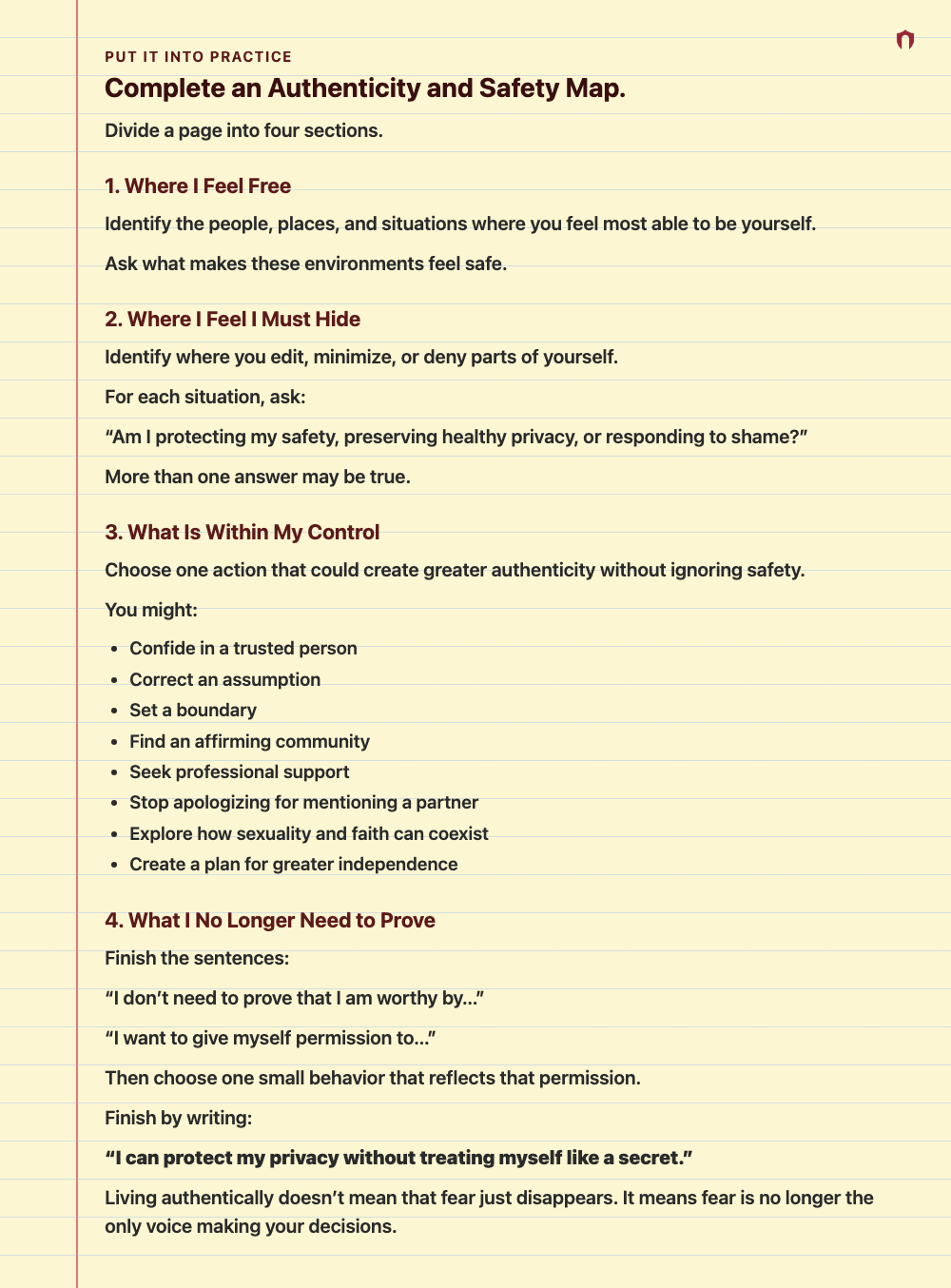
“The strongest force in the universe is a human being living consistently with his or her identity.” — Tony Robbins
Work one-on-one with Zack to build a plan tailored to your situation.