
Understand the grieving process and find healthy, personal ways to cope with loss.
A personal welcome and overview of this playbook from Zack.
Grief Is a Response to Change
Loss creates a gap between the life you expected or became accustomed to and the life that now exists.
Your mind may still expect the person to walk through the door, call your phone, sit in their usual chair, or be present at an important event. You may automatically reach for your phone to contact them before remembering that you cannot.
This can make grief feel disorienting.
Part of you understands what happened intellectually, while another part has not fully adjusted emotionally. This is why grief can feel surreal, especially soon after a loss. People may describe feeling numb, detached, or as though they are watching their life from the outside.
Numbness can be the mind’s way of protecting itself from absorbing more pain than it can process at once.
Grief is not simply an emotional reaction. It is the mind and body learning how to exist in a reality that no longer includes something important.
Grief is a significant response to a huge, permanent life change. Every emotion is valid and on the table.
The Many Emotions of Grief
Grief is often portrayed as overwhelming sadness, but the emotional experience is usually more complicated.
You may experience:
Sadness, of course
Sadness may reflect longing, loneliness, and recognition of what has been lost.
Anger
You may feel angry at the person who died, medical professionals, family members, yourself, a higher power, or life itself.
Anger may also emerge because the loss feels unfair or because you had no control over what happened.
Guilt
You may replay past conversations or decisions:
“I should have called more.”
“I wish our last conversation had been different.”
“Why am I still here when they are not?”
Some guilt reflects genuine regret, but grief can also create an exaggerated sense of responsibility for events that were never really within your control.
Anxiety
Loss can make the world feel less predictable.
After something painful happens, you may become more afraid that another loss will occur. You may worry excessively about your health, the safety of loved ones, or your ability to cope with future challenges.
Relief
Relief can occur after a long illness, caregiving burden, painful relationship, or prolonged period of uncertainty.
Feeling relief doesn’t mean you didn’t love and care for the person or value the relationship. Multiple emotions can exist at the same time.
Numbness
Some people feel very little at first. Others move between intense emotion and emotional emptiness.
There is no required emotional response that proves the loss mattered. No emotion is right or wrong. Again, every emotion is valid and on the table.
Grief Can Affect the Body Physically
Grief is not experienced only through thoughts and feelings. It can produce physical symptoms similar to anxiety such as:
People sometimes worry that they are becoming physically ill or losing control of themselves.
Like anxiety, while physical symptoms should be evaluated when they are severe, persistent, or concerning, many bodily changes can occur because grief activates the stress response and disrupts normal routines.
Like depression, basic tasks may temporarily require much more effort, and a general heaviness and sadness can feel consuming.
Remember, your mind and body are using significant energy to process a major change.
There Is No Universal Grief Timeline (It takes what it takes)
People often want to know:
“How long will this last?”
But there is no universal answer.
The intensity and duration of grief can be influenced by:
Because of all the factors, people can and will experience the same loss very differently. Members of the same family will grieve in different ways. One person may want to talk constantly, while another becomes quiet and wants to be left alone. One may return to work quickly, while another struggles to function. One may cry frequently, while another doesn’t outwardly express emotions.
Grieving differently than another person doesn’t mean you loved or cared about who you lost more or less than they did. Comparing your grief with someone else’s creates unnecessary shame and conflict at a time that demands compassion and connection.
The Misunderstanding of the Five Stages
Some of you may be familiar with the five stages commonly associated with grief:
These ideas can help describe some common reactions to loss, but they are often misunderstood as a fixed sequence that everyone must complete.
Grief rarely works that neatly.
You may experience several reactions in the same day. You may feel accepting one week and deeply angry the next. You may never strongly identify with one or more of the stages. It’s all on the table. It’s all valid. There’s no order, rhyme, or reason to it.
A more accurate way to think of grief is a collection of emotional experiences that may appear, disappear, overlap, and return over time.
Acceptance also does not mean approval, or believing the loss was fair. It just means gradually recognizing that the loss has objectively occurred, that there’s nothing you can do about it, and learning how to live within that reality.
Grief Comes in Waves
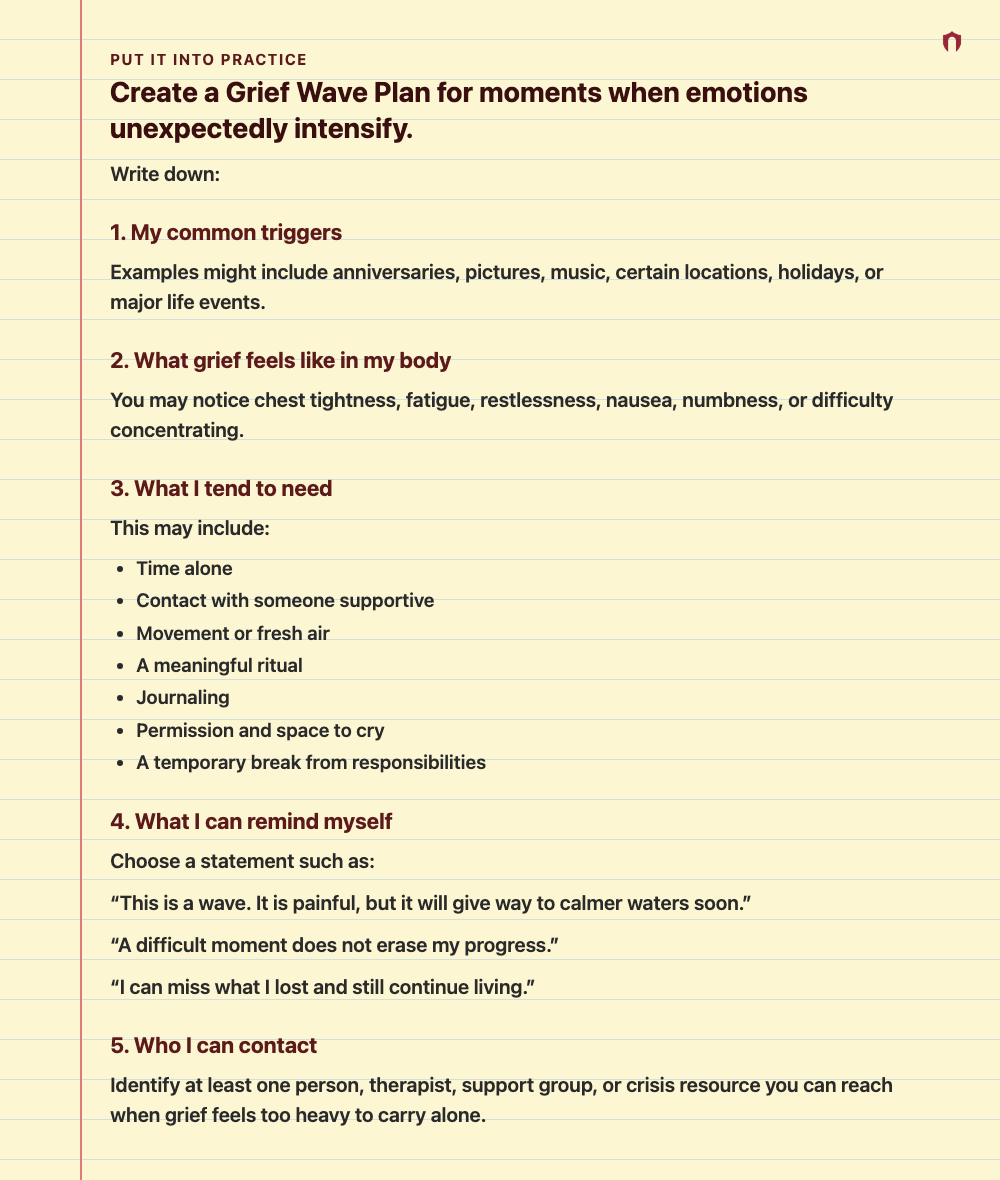
Early grief may feel constant. Over time, it often begins to arrive and leave in waves.
A person may feel relatively stable and then suddenly become triggered and overwhelmed by:
These experiences can be surprising and discouraging.
You may think:
“I thought I was doing better.”
But a difficult moment does not erase previous progress. Healing is not a straight line in which each day feels slightly better than the day before.
A more useful way to evaluate progress (with grief and with almost all mental health treatment) is to observe whether painful emotional waves are gradually changing in:
Frequency
Are they happening less often?
Severity
Are they becoming less overwhelming when they occur?
Duration
Are you recovering more quickly afterward?
You may still have extremely difficult days. The larger question is whether, over time, the grief is allowing more room for other experiences.
Different Types of Grief
Understanding the form a loss takes can help explain why some experiences are especially difficult.
Anticipatory Grief
Anticipatory grief occurs when someone begins grieving before the loss fully happens.
This may occur during terminal illness, progressive disease, declining independence, or an expected separation.
The person may grieve:
Anticipatory grief doesn’t eliminate grief after the loss, but it may prepare someone in certain ways for what’s to come.
Ambiguous Loss
Ambiguous loss occurs when there is no clear or complete ending.
Examples may include:
Ambiguous loss can be especially difficult because the mind does not receive a clear conclusion. Hope, grief, uncertainty, and confusion may coexist.
Disenfranchised Grief
Disenfranchised grief occurs when a loss is not fully known by, recognized, or supported by others.
Examples may include:
When other people minimize the loss, the grieving person may feel isolated or believe they are not entitled to their emotions.
A loss does not have to be widely understood to be psychologically significant.
Grief Is Not the Same as Depression
Grief and depression can share symptoms, including sadness, disrupted sleep, low motivation, difficulty concentrating, and reduced interest in life. But they are not always the same experience.
Grief often comes in waves and is closely connected to thoughts or reminders of the loss. Even during grief, a person may still experience moments of connection, humor, affection, or hope.
Depression may create a more persistent sense of emptiness, worthlessness, hopelessness, or disconnection that extends beyond the loss itself.
Grief can also contribute to depression, especially when symptoms are severe, prolonged, or significantly impair functioning.
Additional support may be needed when someone experiences:
Seeking support does not mean someone is grieving incorrectly. It means the pain deserves care.
Final Thoughts
Grief is not a problem to solve as quickly as possible. It’s a normal, understandable human response to the loss of someone, something, or some version of life that mattered to you.
You may not be able to control when grief appears or how strongly it affects you. But understanding the grieving process can reduce the fear that something is wrong with you.
Grief can be unpredictable. It can involve contradictory emotions. It can affect the mind and body. It may return during important moments years later.
None of this means you are failing to heal. The goal is to gradually learn how to carry the loss while allowing life to grow around it.
Key Takeaways
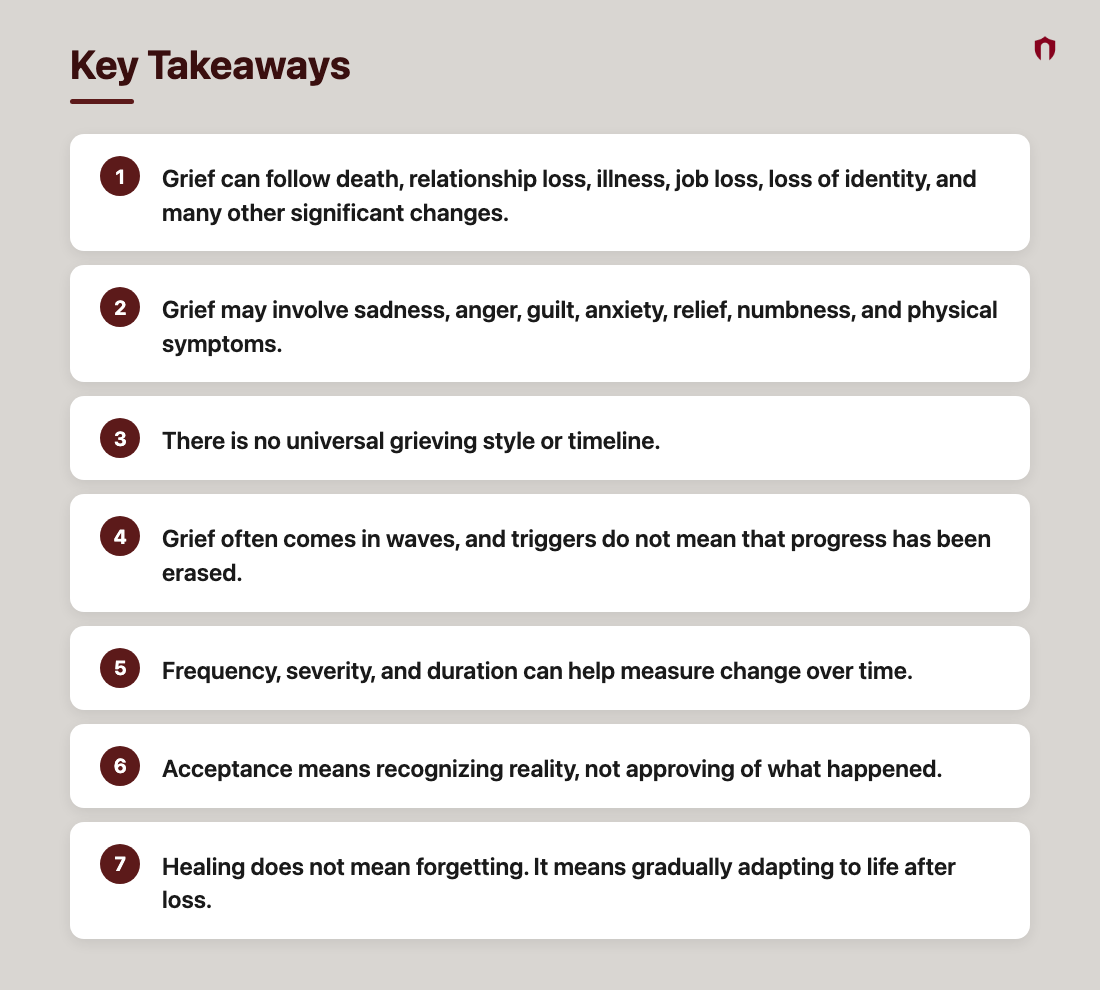
🧠 Your Mental Playbook
One Thing to Remember
Grief is not a sequence you complete, it’s a process of adapting to a reality that you didn’t choose and learning to find meaning and purpose in your life after the loss.
You are not failing because your emotions are unpredictable, because a reminder affects you unexpectedly, or because your grief looks different from someone else’s.
Reflect
Take a moment to consider your experience of loss.
Ask yourself:
What have I actually lost beyond the person or event itself?
Have I been judging my grief because it does not look the way I expected?
Am I comparing my grieving process with someone else’s?
What situations, dates, or reminders tend to trigger stronger emotional waves?
Over time, have those waves changed in frequency, severity, or duration?
The purpose is to understand what your grief is asking you to acknowledge.
Put It Into Practice
“Grief is the price of having had someone matter enough that their absence changes the shape of your life.” — Zack Etter/Mental Fitness Lounge
Why the Mind Searches for Answers
As discussed extensively in the Anxiety Playbook, the human brain is uncomfortable with uncertainty.
When something significant happens, the mind tries to identify a cause:
This process in everyday life is often useful. We want to learn from mistakes, apply new perspective, and get a better outcome next time.
But grief often turns reflection into rumination. Instead of producing useful insight, the same questions repeat:
“What if I had called?”
“What if we had gone to another doctor?”
“Should I have called more?”
The mind may believe that if it reviews the situation enough times, it will eventually discover the explanation that makes everything feel better. Rumination can create the feeling that you are solving the loss while actually keeping you emotionally trapped inside it.
Sometimes there are no answers. And even if there were, what would they change?
The Search for Control
Many grief-related questions are attempts to recover a sense of control.
If you can identify exactly why something happened, you may feel more capable of preventing another painful event. If you can find the mistake, you may feel that the world is still understandable.
This is one reason self-blame can become so powerful after loss. Strangely, blaming yourself may sometimes feel less frightening than accepting that certain events were unpredictable or beyond your control.
The belief:
“I should have prevented this”
can create enormous guilt. But it may also preserve the illusion that terrible outcomes are preventable.
Recognizing the limits of your control can be painful because it means acknowledging that love, effort, attention, and good intentions cannot protect us from every loss.
Guilt and the Benefit of Hindsight
After a loss, people often review the past using information they didn’t have at the time. This is called hindsight bias.
Once you know the outcome, earlier moments may suddenly appear obvious:
“I should have known.”
“The signs were right there.”
“I should have made a different decision.”
But the situation wasn’t clear while it was happening. You were making decisions based on:
A useful question is:
“Am I judging my past self using information that only became clear afterward?”
You can acknowledge genuine regret without assuming complete responsibility for everything that occurred.
Real Guilt vs. Grief Guilt
Not all guilt is the same. Sometimes people regret something they actually said, did, or failed to do. Honest accountability can be part of healing. You may wish you had apologized, spent more time with someone, handled a conflict differently, or been more emotionally present.
This can be thought of as real guilt: regret connected to a specific behavior that you recognize did not align with your values.
Grief can also produce guilt that exceeds your actual responsibility.
Examples include:
This is often grief guilt: the mind’s attempt to explain the loss, maintain a connection, or find control in a situation where control was limited or impossible.
Both forms of guilt deserve compassion.
Unfinished Conversations
Loss can leave people with thoughts and emotions they never had the opportunity to express.
You may wish you had said:
The relationship may have ended suddenly, or it may have been complicated long before the loss occurred.
People sometimes assume that grief should be easier when the relationship was difficult. In reality, complicated relationships may create more unanswered questions because the opportunity for repair is gone.
You may be grieving both:
Closure does not always require a final conversation with the person. Realistically, you may need other ways to express what remains unsaid through:
These practices can’t change the past, but they can help give unfinished thoughts and emotions somewhere to go.
When There Is No Satisfying Explanation
Some losses remain forever unclear.
A death may occur without warning. A medical outcome may have been highly unlikely or difficult to explain. Someone may leave without saying goodbye or providing a reason. A loved one may die by suicide or overdose, leaving family members with gut-wrenching questions about what they knew, felt, or intended.
Even when an official explanation exists, it may not answer the emotional question:
“Why did this have to happen?”
This is one of the hardest realities of grief:
An explanation does not necessarily lead to emotional peace.
You may receive answers that create new questions. You may hear an explanation that’s not good enough, and still feel that it’s unfair, incomplete, or impossible to accept.
Healing may require accepting not the loss itself, but the possibility that some questions will remain unanswered.
The Difference Between Answers and Meaning
Answers attempt to explain the past. Meaning helps us decide how to live in the future.
An answer asks:
“Why did this happen?”
Meaning asks:
“How will I carry this experience forward?”
Meaning doesn’t require believing that the loss happened for a good reason. Statements such as “everything happens for a reason” can be painful and invalidating, particularly after traumatic or preventable loss.
Some events are tragic, unfair, and should never have happened. Creating meaning doesn’t mean justifying the loss. It means choosing what you will do with the life and love that remain.
Meaning might involve:
Meaning isn’t found in the suffering itself. It can be created through how you respond to it.
Continuing Bonds
Older ideas about grief sometimes suggested that people needed to detach from those who we’ve lost in order to move forward. Today, many people understand the importance of continuing bonds.
You may continue the bond by:
This is not the same as denying that the loss occurred or living in denial. It’s recognizing that someone can remain meaningful even though they are no longer physically present.
This is simply finding a way for the relationship to exist within your new reality.
Faith, Spirituality, and Meaning
Loss can strengthen, challenge, or completely change a person’s spiritual beliefs.
Some people find comfort in prayer, faith communities, rituals, beliefs about an afterlife, or the idea that the person remains spiritually present. Others feel angry, betrayed, or abandoned by their faith.
They may ask:
“How could God have allowed this to happen?”
“Why weren’t my prayers answered?”
There is no required spiritual response to grief. Doubt does not make you disloyal. Anger does not mean your faith has disappeared. And finding comfort in your faith does not mean the loss hurts less or that you’re taking the easy way out.
Spiritual questions may take time, and they tend not to end in certainty. A compassionate spiritual leader, therapist, or trusted community may help someone explore these questions without forcing simple explanations onto a complicated loss.
Key Takeaways
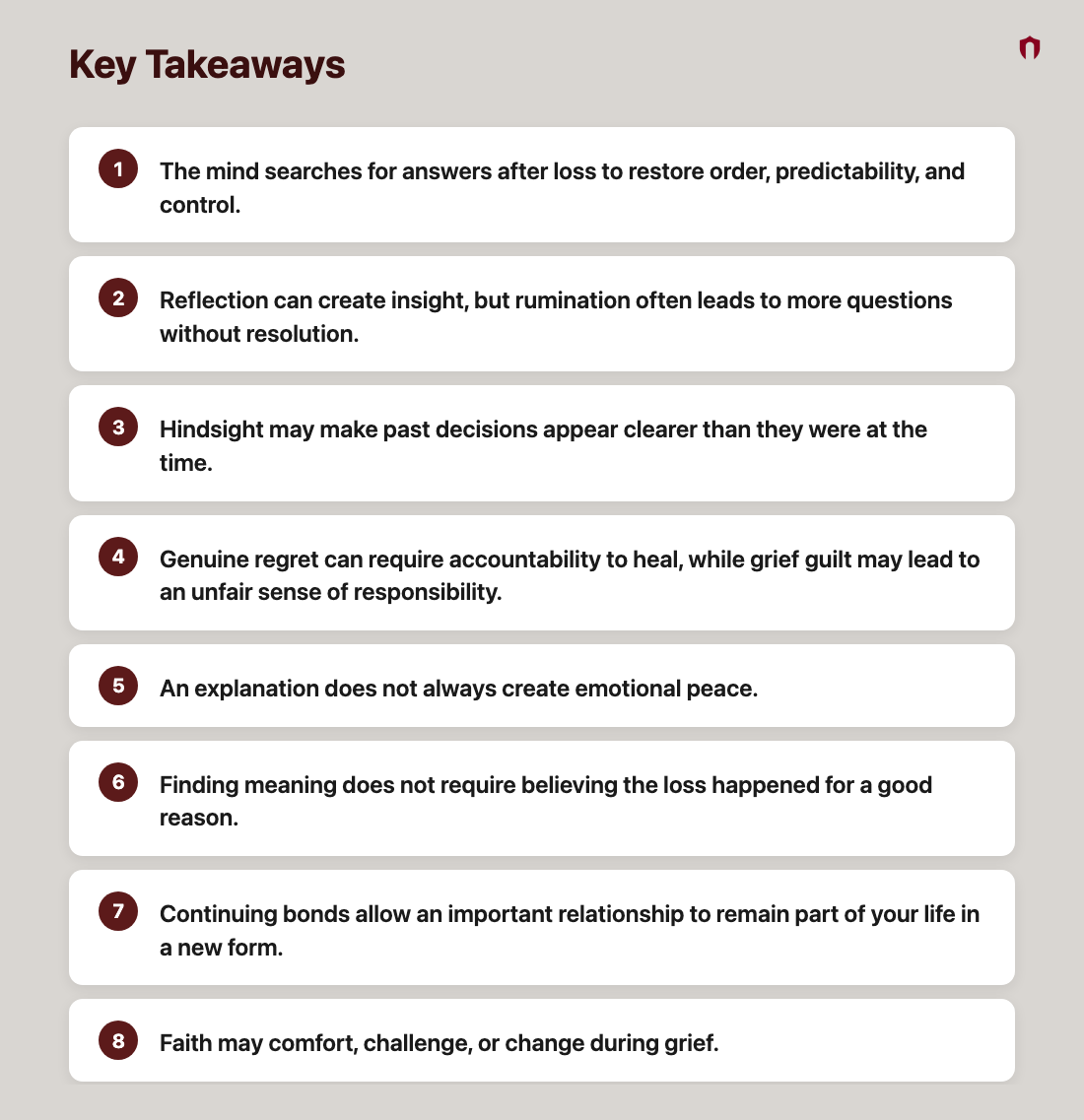
🧠 Your Mental Playbook
One Thing to Remember
Even if you could get them, reasons and explanations would likely not be enough, and wouldn’t change the outcome. But you can eventually decide what the loss will mean in the life you continue to live.
Unanswered questions do not have to control the rest of your story.
Reflect
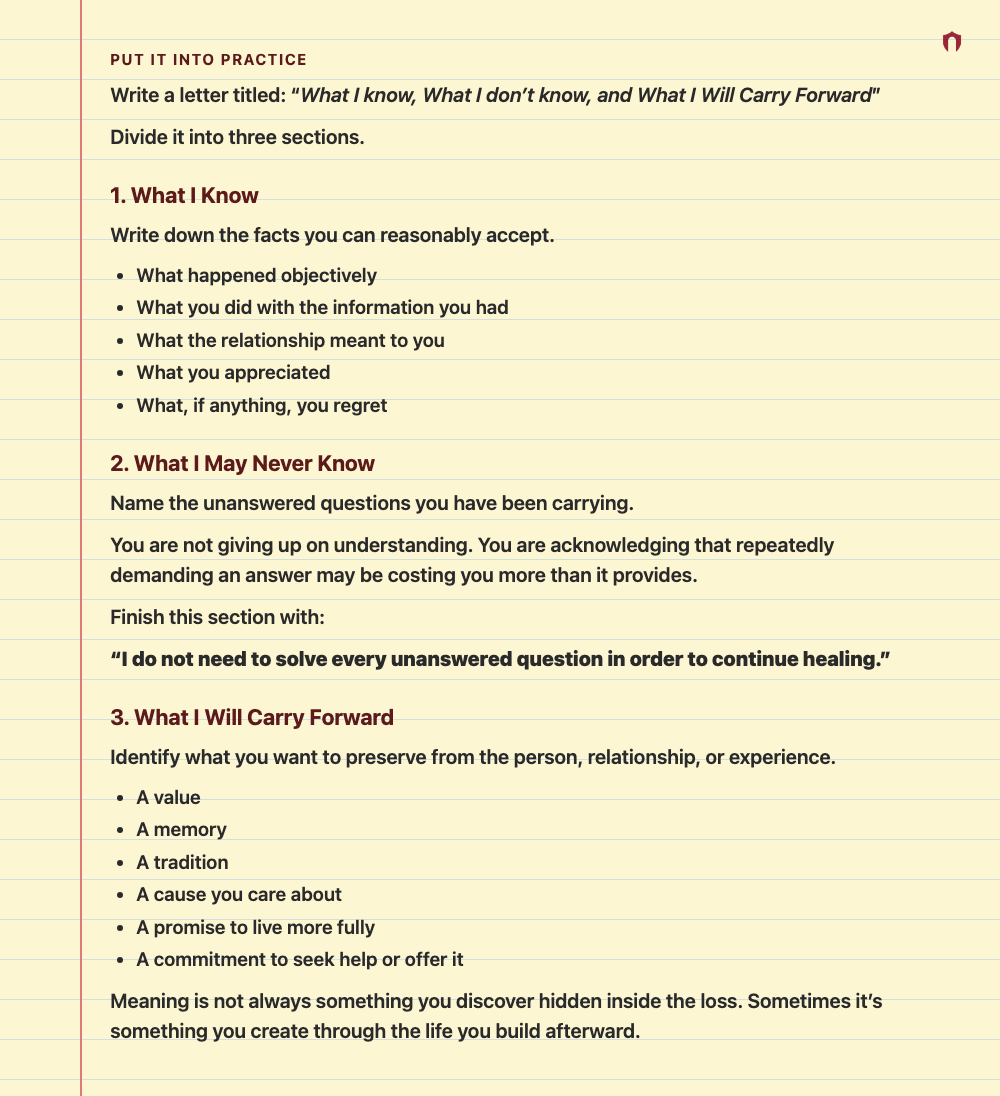
Consider the questions you have been carrying since the loss.
Ask yourself:
Is this question helping me understand something, or keeping me trapped in the same moment?
Am I judging myself with information I did not have at the time?
What responsibility was truly mine, and what was outside my control?
Have I been pressuring myself to find a lesson or purpose before I am ready?
What values, memories, or qualities from this relationship do I want to carry forward?
You don’t need to answer everything today. Sometimes healing begins by asking whether a question can be answered, not by demanding that it must be.
Put It Into Practice
“When we are no longer able to change a situation, we are challenged to change ourselves.” — Viktor E. Frankl
The Assumptive World
Everyone carries beliefs about how life is supposed to work. You may not consciously think about them all the time, but they influence how you move through your life.
Common assumptions include:
Psychologists sometimes refer to this collection of beliefs as the assumptive world - the framework we use to understand life, safety, identity, and the future.
Loss can shatter parts of that framework.
A sudden death may challenge your belief that life is predictable. An illness may change your sense of safety in your own body. A miscarriage may disrupt the future you had already begun imagining. The death of a parent may change your understanding of family, adulthood, or where you belong. The loss of a partner may affect not only your daily life, but also the way you imagined growing older together.
Grief is not limited to missing what was lost. It may also require rebuilding the beliefs that once helped life make sense.
When the World No Longer Feels Safe
After a significant loss, your awareness of danger may increase.
You may become more worried about:
This response is understandable. Your brain has learned that something devastating can happen. Now, it may try to protect you by anticipating every possible threat. You may begin checking on loved ones excessively, interpreting minor symptoms as serious illness, avoiding risks, or mentally preparing for the next tragedy.
Constant vigilance is exhausting. The goal is not to convince yourself that nothing bad will ever happen again. A more realistic sense of safety sounds like: “Life contains uncertainty, but I can still experience connection, stability, and trust within it.”
Safety after loss is rebuilt by gradually trusting that you can respond to life even when you cannot completely control it.
Identity After Loss
Important relationships and life roles become part of our identity.
You may know yourself as a spouse, parent, child, sibling, friend, professional, a healthy person, or a member of a community.
When a major loss occurs, the role may change or disappear. This can create the painful question:
“Who am I now?”
A person who spent years caregiving may feel lost when those responsibilities end. Someone whose spouse dies may continue feeling married emotionally while being treated as single socially. A parent grieving a child does not stop being that child’s parent, even though the relationship has changed. A person who loses health or physical ability may grieve an identity built around independence, athleticism, work, or service to others.
Rebuilding identity does not require abandoning the role or relationship that mattered. It means recognizing that you are both:
You don’t need to rush to answer who you are now. Identity will rebuild gradually through routines, relationships, responsibilities, values, and new experiences.
Everyone Seems Different Now
Loss can change how you relate to others who have had important roles in your life thus far. Some may provide extraordinary support, while others may disappoint you.
Some people may avoid mentioning the loss because they feel uncomfortable. They may offer clichés, minimize your pain, pressure you to move forward, or disappear after the initial period of support.
Social conversations may feel superficial. People’s concerns and problems may seem small compared with what you’ve experienced. You may resent people who complain about things you would now give anything to have.
Even though this isn’t necessarily you being “unfair” to others, prolonged disconnection can increase isolation. Others will not always understand perfectly. Some will say the wrong thing while genuinely trying to help. Part of rebuilding connection may involve telling trusted people what you need:
“I don’t need advice. I just need you to listen.”
“I want to talk about them rather than pretend they never existed.”
“I’m having a difficult day and could use company.”
Healthy support doesn’t require someone to fully understand your grief. Give people a chance to show up for you in the ways that you need them to.
Changed Priorities
Loss can make previous priorities feel less important. You may become less interested in:
At the same time, you may place greater value on:
These changes can be healthy, but major decisions should still be approached carefully during acute grief.
A renewed awareness that life is short can clarify what matters. It can also create urgency to change everything immediately. You may feel tempted to quit a job, move, end relationships, spend impulsively, or completely reinvent your life. Some changes may ultimately be right, but grief can temporarily affect concentration, judgment, and emotional regulation.
Whenever possible, refrain from making big decisions while enduring grief.
Growth Without Romanticizing the Loss
Some people experience meaningful growth after loss.
However, growth should never be used to minimize suffering. The loss did not need to happen for you to become a better person. You don’t need to call the experience a gift. You don’t owe anyone an inspiring transformation.
Some losses remain painful even when growth occurs alongside them.
A person can truthfully say:
“I have grown because of how I responded.”
while also saying:
“I still wish this had never happened.”
Growth and grief are not opposites. They can, and often do coexist.
Allowing Joy Back Into Your Life
When moments of happiness begin to return, they can create guilt. You may laugh and then suddenly think: “How can I enjoy myself after what happened?”
You may worry that feeling better means you are forgetting the person, minimizing the loss, or leaving them behind. But pain is not the only evidence of love.
You don’t need to remain miserable to prove that someone mattered. You can miss someone and still laugh. You can honor the past and still make future plans. You can carry sadness and experience gratitude at the same time.
Allowing life to become meaningful again is not a betrayal. It’s absolutely necessary to continue on.
Rebuilding Your Worldview
Rebuilding your worldview often requires replacing beliefs you held before the loss that no longer fit.
Maybe you don’t believe that life is fair anymore, but you could gradually develop beliefs that are more realistic and still hopeful:
A rebuilt worldview may feel less innocent than the one you had before. But it also might leave you with a deeper, more intentional connection to what truly matters.
Key Takeaways
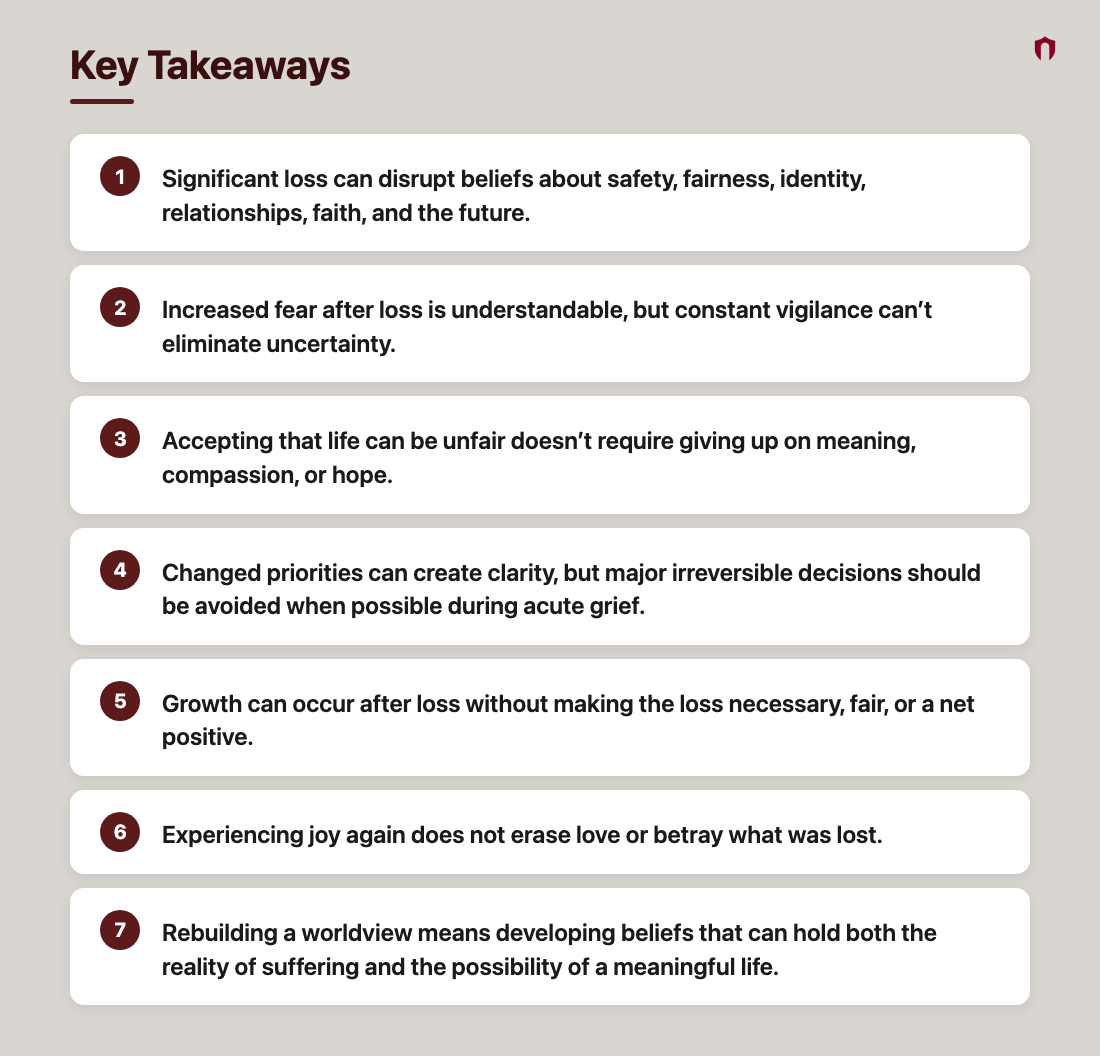
🧠 Your Mental Playbook
One Thing to Remember
Loss may change the way you see the world, but it does not have to take away your ability to find meaning within it.
You may never return to the exact beliefs you held before the loss.
The goal is not to force yourself back into the old version of life, it’s to gradually build a perspective that can acknowledge uncertainty, pain, and unfairness while still making room for love, connection, purpose, and hope.
Reflect
Consider how the loss has changed your view of life.
Ask yourself:
Which beliefs about safety, fairness, or the future have been challenged?
Have I become more fearful of becoming attached or experiencing another loss?
What feels less important to me now? What matters more?
What beliefs would help me live authentically without denying either the pain or the possibility of hope?
Begin by identifying what has changed.
Put It Into Practice
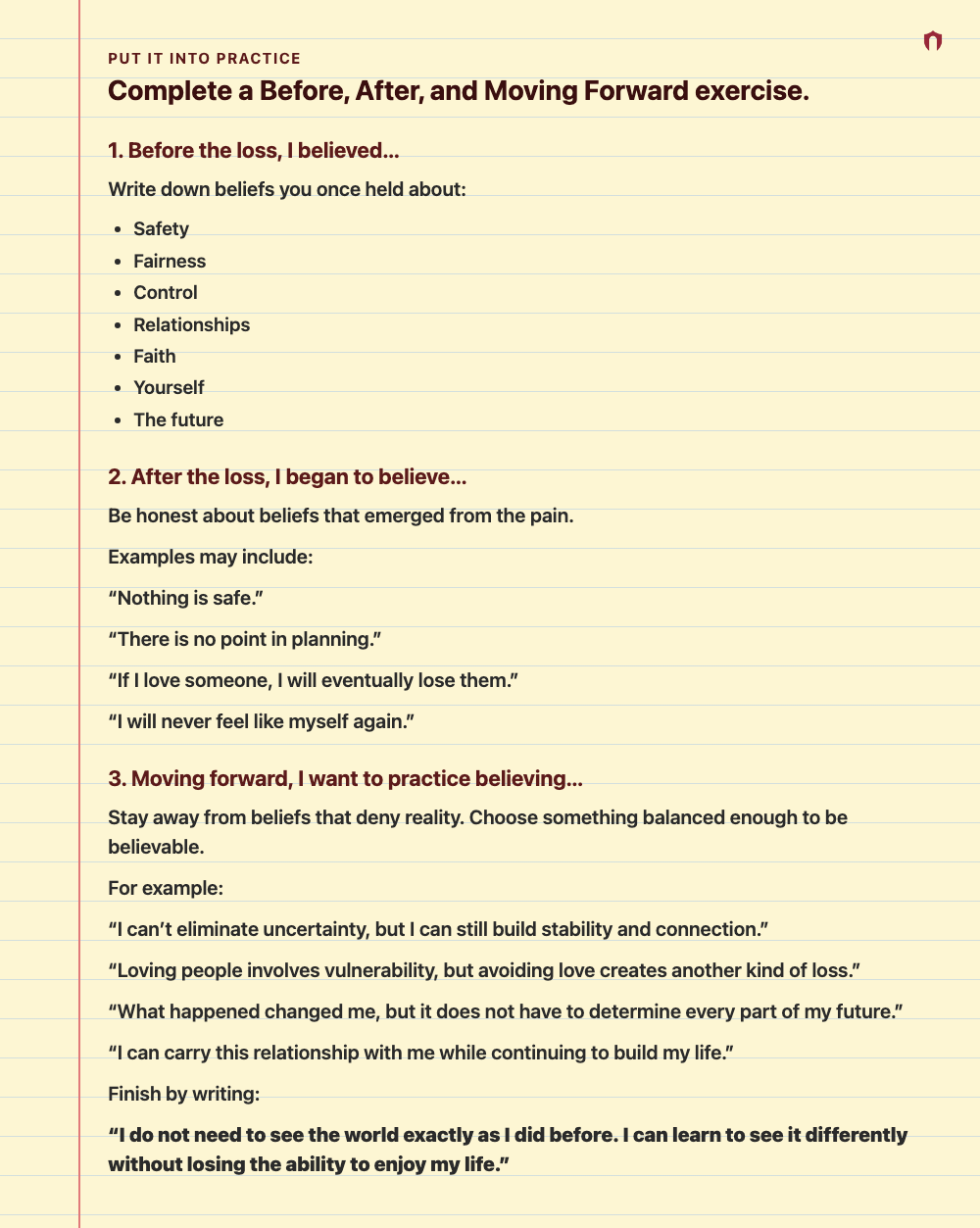
“We are changed by what we survive, but we are not only what has happened to us.” — Zack Etter/Mental Fitness Lounge
What Healing Actually Looks Like
A misconception about healing from loss is the belief that to be healed means that grief is over. This is certainly not true, and could be a hindrance to progress due to unrealistic expectations.
In reality, healing may look like:
None of these changes mean the loss matters less. They mean your life is slowly becoming large enough to hold both the sadness of your loss and other meaningful experiences at the same time.
Allowing Grief Without Living Inside It
Avoiding every painful emotion can interfere with healing. At the same time, thinking about the loss every moment of the day can become emotionally exhausting.
Healthy grieving involves moving between two needs:
You may spend time crying, journaling, remembering, attending therapy, or talking with someone you trust. Later, you may watch a movie, exercise, complete a task, or spend time with friends.
Taking a break from grief is not denial. Your mind and body cannot remain in intense emotional pain continuously. Moments of distraction, rest, and enjoyment can provide the energy needed to continue processing what happened.
Rebuilding Basic Structure
Grief can disrupt sleep, appetite, concentration, motivation, and daily routines. When life feels overwhelming, basic structure can provide stability.
This may include:
These actions may feel small compared with the size of the loss, but recovery is often built through ordinary routines.
As discussed in several Playbooks in the Mental Fitness Lounge, motivation will almost definitely not come before the actions needed to feel better. The action comes first, and emotional momentum follows.
When Coping Becomes Avoidance
Grief can feel unbearable, so people naturally search for relief.
Some coping behaviors provide temporary comfort without creating significant harm. Others begin as understandable attempts to escape pain but eventually create additional problems.
Examples may include:
Working, exercising, dating, watching television, or spending time alone can all be reasonable. The concern is when a behavior becomes your primary way of avoiding emotion, becomes difficult to control, creates functional problems in different domains of your life, and requires increasing intensity or severity to provide the same relief.
The cycle often looks like:
Pain → Escape → Temporary relief → Consequences or shame → More pain
Recognizing this pattern can help you identify when a coping strategy may be adding suffering to an already painful experience.
Replacing Escape With Support
Simply removing an unhealthy coping mechanism isn’t usually enough. The behavior was serving a purpose. It may have offered relief, numbness, connection, stimulation, or control.
A healthier replacement should address the underlying need.
The idea is to build forms of comfort that do not create a second crisis.
Maintaining a Continuing Bond
Moving forward doesn’t require ending your emotional connection to someone you lost or abandoning an important part of your past.
A continuing bond may involve:
These practices can help the relationship take a new form as you move forward.
Allowing Joy Without Guilt
As life begins to expand again, happiness may feel uncomfortable.
You may laugh and then feel guilty. You may enjoy an event and wonder how you could feel good after such a significant loss. You may worry that moving forward means forgetting or betraying someone.
But suffering isn’t the only way to prove that love was real.
A person who mattered to you isn’t honored by the permanent destruction of your well-being. You can miss someone and still experience joy. You can remember the past and become excited about the future. You can grieve what was lost and appreciate what remains.
Joy does not replace grief. It begins to exist alongside it.
Anniversaries, Milestones, and Unexpected Triggers
Grief may intensify around:
These moments may emphasize the person’s absence or the future you expected to share.
Preparing in advance can help.
There is no correct way to handle an anniversary. You may want to honor it publicly, recognize it privately, create a new tradition, or treat it like an ordinary day.
A difficult anniversary does not mean healing has stopped. It reflects the significance of the connection.
When Professional Support May Be Needed
There is no single timeline that determines when grief has become a mental health concern. However, additional support may be important when grief is intensely debilitating or coping behaviors create serious consequences.
Warning signs may include:
Therapy can help provide a safe place to process emotions, address guilt or trauma, interrupt harmful coping patterns, and rebuild life gradually.
In the United States, call or text 988 if you are experiencing suicidal thoughts or a mental health crisis. If there is immediate danger, contact emergency services or go to the nearest emergency department.
Key Takeaways
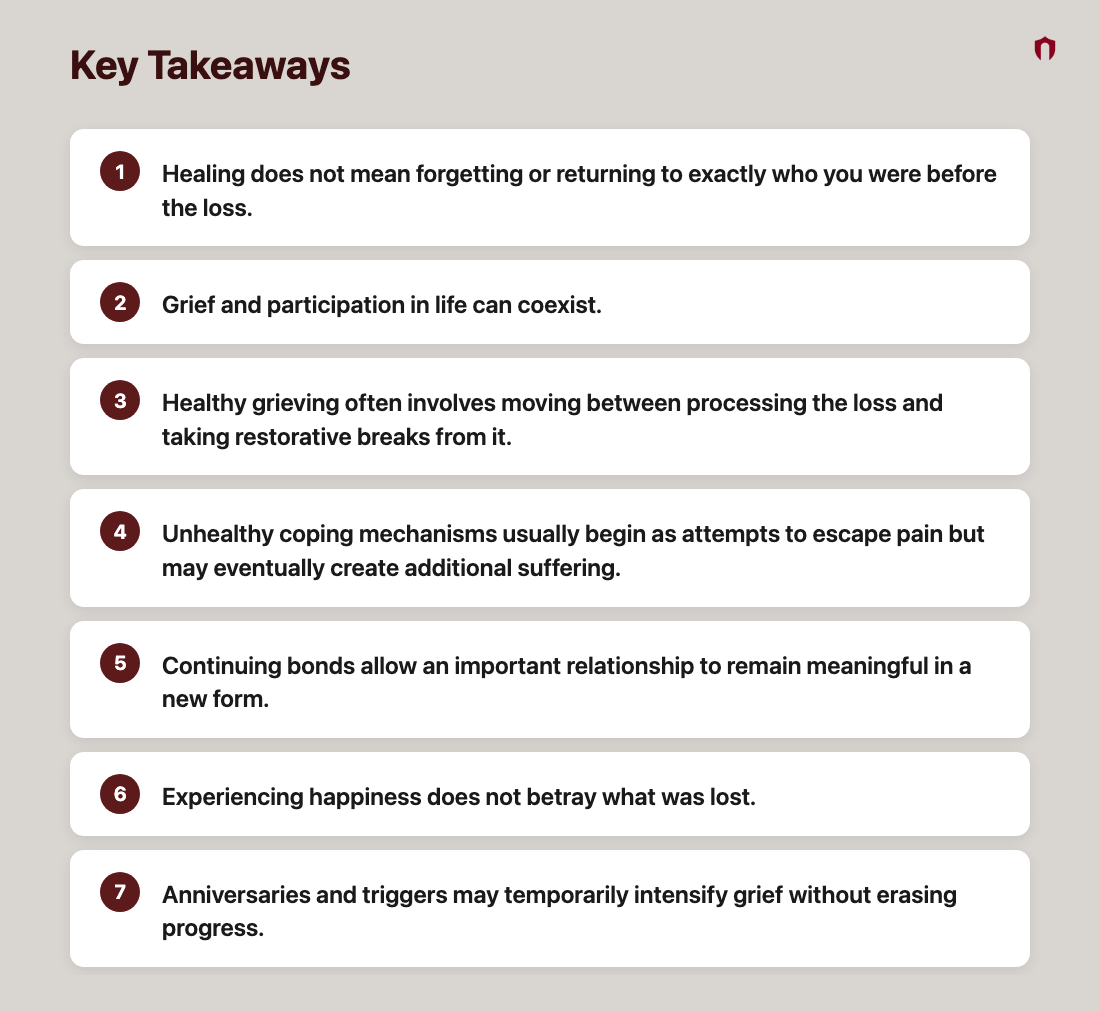
🧠 Your Mental Playbook
One Thing to Remember
Moving forward doesn’t mean leaving what you lost behind. It means learning to carry it without allowing it to control your entire life.
Healing is not measured by how rarely you remember, it’s measured by whether your life is gradually making room for connection, purpose, joy, and hope alongside the grief.
Reflect
Consider how you have been coping with the loss.
Ask yourself:
Which parts of my life have I stopped participating in?
When grief becomes intense, do I process it, take a temporary break, or try to escape it completely?
Is any coping behavior creating new problems?
How might I maintain a meaningful connection with what I lost?
What is one part of life I may be ready to reenter gradually?
Put It Into Practice
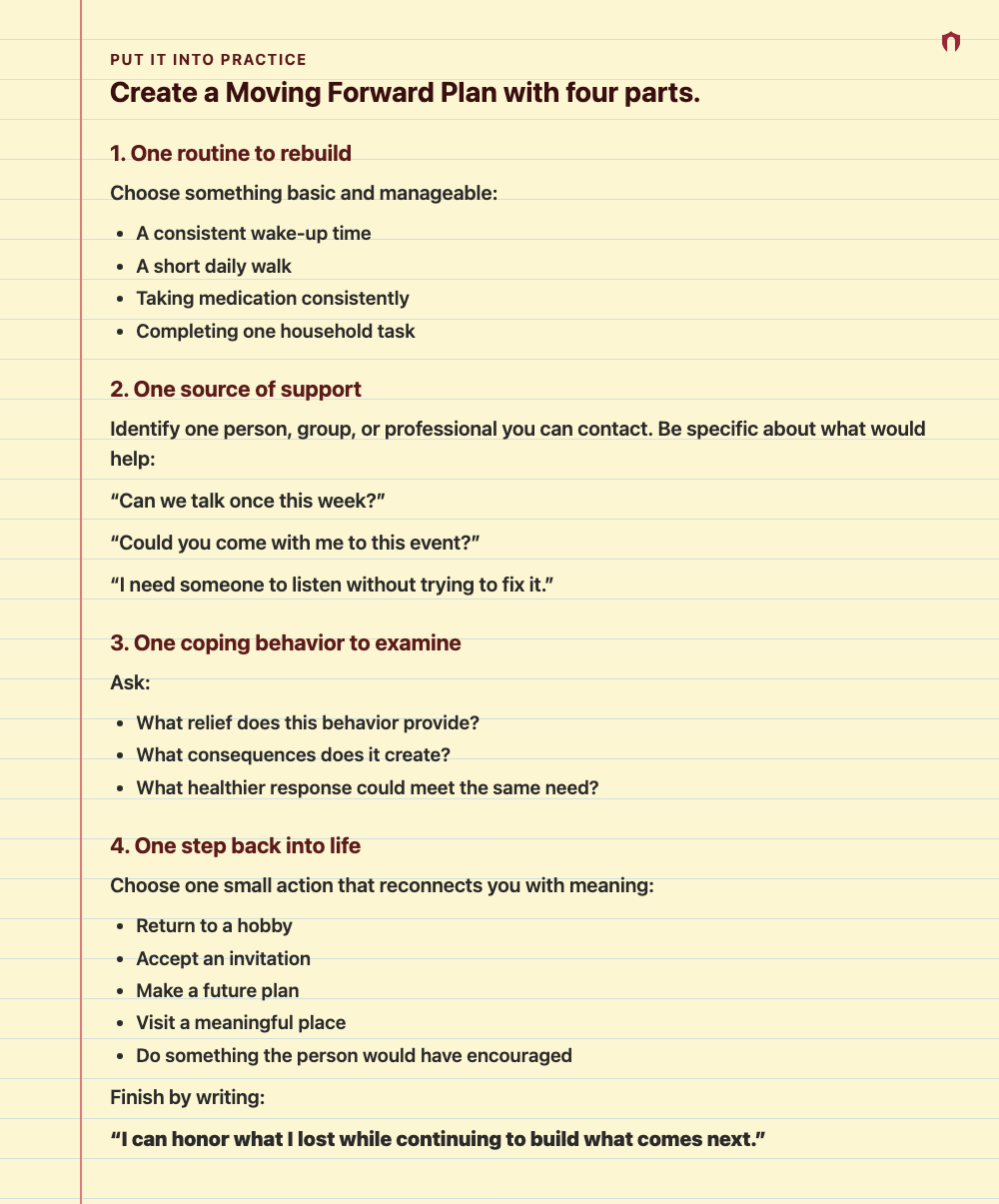
“No one ever told me that grief felt so like fear.” — C. S. Lewis
Work one-on-one with Zack to build a plan tailored to your situation.