
Set meaningful goals, build momentum, and follow through with clarity and confidence.
A personal welcome and overview of this playbook from Zack.
Introduction
Many people approach goals through a pattern that sounds logical:
Once I have something, I will do things differently, and then I will become the person I want to be.
For example:
This is the Have-Do-Be mindset.
It places the result first and personal change last.
The problem is that the qualities needed to create the result (discipline, patience, courage, consistency, and responsibility) are postponed, making it extremely difficult to achieve the result.
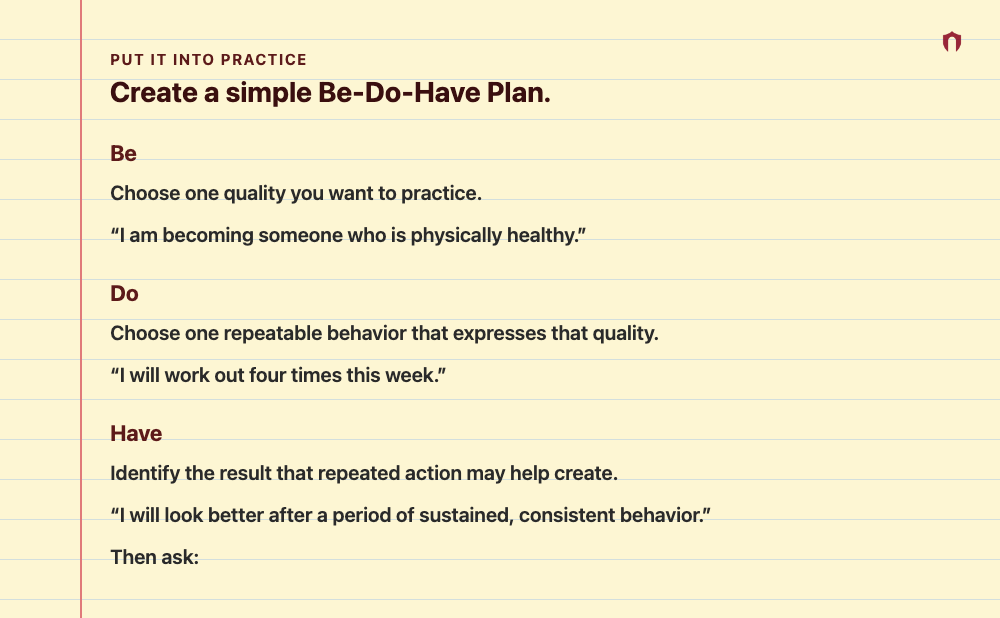
The Be-Do-Have mindset reverses that order:
Decide who you want to become. Practice the actions that reflect that identity. Allow the results to grow from those repeated actions.
The Have-Do-Be Trap
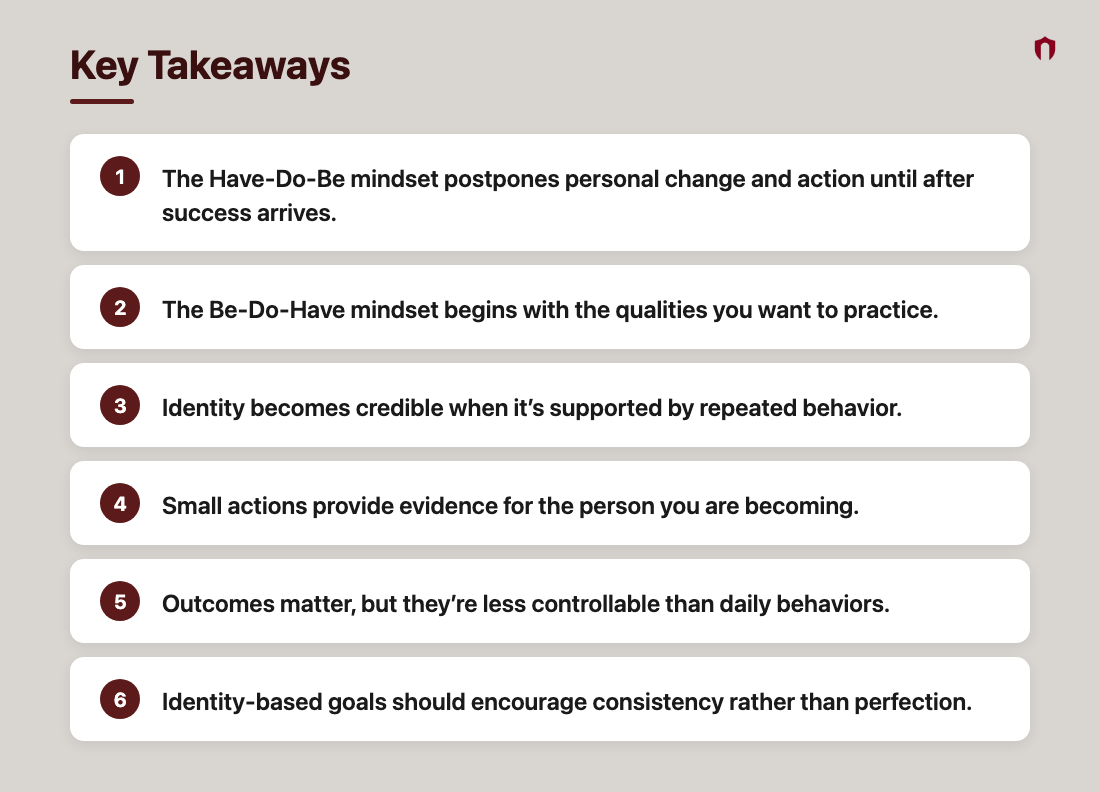
The Have-Do-Be mindset makes identity dependent on achievement.
It sounds like:
“I will believe in myself once I succeed.”
“I will become disciplined once life becomes less stressful.”
“I will feel confident once other people approve of me.”
“I will act like a writer once I publish something.”
This creates a waiting period, and it places your identity in results that aren’t necessarily in your control.
You wait for confidence before taking risks, motivation before beginning, or success before seeing yourself differently. But the desired result usually heavily depends on the very behaviors you are postponing.
The Have-Do-Be mindset says:
“The result will change me.”
The Be-Do-Have mindset asks:
“What changes can I begin practicing that make the result more likely?”
What “Be” Really Means
The word be can sound abstract.
It doesn’t mean just repeating positive statements while ignoring reality.
Saying:
“I am already successful.”
doesn’t create success by itself.
In this framework, being means choosing the qualities and standards you want your behavior to represent.
You might decide to be:
These qualities then guide your decisions.
Instead of asking:
“What do I feel like doing?”
you ask:
“What would a person who has this quality do next?”
Someone practicing consistency may complete a small workout rather than skipping just because they can’t complete a perfect one.
Someone practicing financial responsibility may review their spending even though the numbers feel uncomfortable.
Someone practicing courage may send the text even though they’re anxious about the response.
Being the person you want to be won’t eliminate discomfort, it gives your actions a direction when emotions are unreliable or unhelpful.
“Do” Turns Identity Into Evidence
An identity becomes meaningful and impacts the real world when behavior supports it.
You don’t become disciplined because you declare yourself disciplined. You develop discipline by repeatedly completing actions that require it.
Every action becomes a small piece of evidence.
One action doesn’t permanently define you in either positive or negative ways. But repeated actions shape what you believe about yourself.
This creates a helpful cycle:
Identity guides action → action creates evidence → evidence strengthens identity
“Have” Is the Result, Not the Starting Point
The have represents the outcome:
Results matter. Goal setting would be incomplete without them. But outcomes are not always fully within your control, and focusing on the outcomes is often the worst way to get them.
You can control whether you study, but not every question on the exam. You can control the quality of an application, but not the employer’s decision. You can control your training, but not the exact rate at which your body changes and responds.
This is why the Be-Do-Have mindset places greater attention on identity and behavior.
It shifts the daily question from:
“Do I have the result yet?”
to:
“Did I practice the behavior that moves me toward it?”
That change makes progress available before the final outcome arrives – improving motivation and confidence.
Avoid Turning Identity Into Perfectionism
Identity-based goals can become unhealthy when people create rigid rules.
Someone may think:
“A disciplined person never misses a workout.”
“A successful person never doubts themselves.”
“A healthy person never eats poorly.”
These are both untrue and not sustainable for identity. It’s perfectionism disguised as personal growth.
A better standard is:
“A disciplined person returns after disruption.”
“A courageous person acts while doubt is present.”
“A health-conscious person makes supportive choices consistently, not perfectly.”
Your identity should guide behavior without becoming another weapon for self-criticism.
Key Takeaways
🧠 Your Mental Playbook
One Thing to Remember
Don’t wait for the result to tell you who you are. Let your next action provide evidence of who you are becoming.
Reflect
Choose one goal and ask yourself:
How do I imagine I will feel or behave once I achieve my goal?
Who do I need to be (identity) in order to get what I want?
What action would provide evidence for that identity?
Complete this sentence:
“I want to become someone who…”
Then identify what that person would do next today.
Put It Into Practice
“Every action you take is a vote for the type of person you wish to become.” — James Clear
Introduction
People assume that failing to reach a goal means they lacked discipline, commitment, or ability.
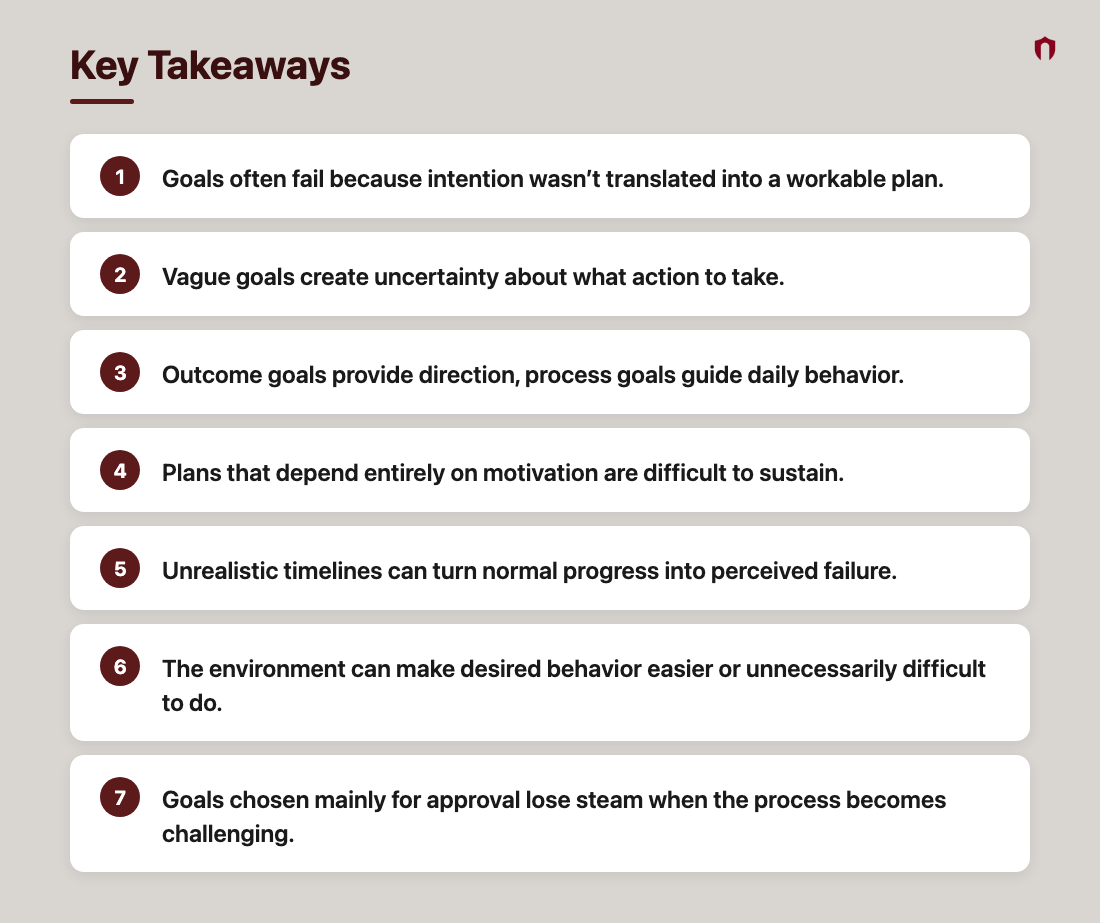
Sometimes effort is part of the problem, but many goals fail before the real work even begins because they were not translated into a realistic plan.
A person may genuinely want to:
But wanting a result is not the same as creating a system that can produce it.
Goals commonly fail when they’re vague, overwhelming, require significant behavior change immediately, depend on motivation, or are unable to survive setbacks.
This creates an important distinction:
A failed goal doesn’t automatically mean you’re a failure. It may mean the goal was not designed to support consistent action.
Understanding why goals fail helps you respond with adjustment rather than shame.
The Goal Is Too Vague
Goals such as:
While these may express a meaningful desire, actually accomplishing them requires more than just identifying something you want.
A vague goal requires you to repeatedly decide:
That uncertainty creates friction. And friction leads to failure over time.
A clearer goal turns a general intention into something observable:
“I will walk for twenty minutes after work three days this week.”
Clarity doesn’t guarantee action, but it makes action easier to identify.
The Goal Focuses Only on the Outcome
Outcome goals identify what you want to achieve:
Outcomes provide direction, but are limiting to focus on solely. You can influence an outcome through your behavior, but you can’t control every factor affecting the final result.
Goals are more useful when outcomes are connected to repeatable actions you can focus on.
For example:
Outcome: Publish a book.
Process: Write for thirty minutes four days per week.
The outcome tells you where you are going.
The process tells you what to do next and how to measure progress.
When people focus only on the destination, they may feel unsuccessful throughout most of the journey because the final result hasn’t arrived yet. The impatience builds and motivation dips, leading the goal to not be met.
The Goal Is Too Large
Ambitious goals can feel inspiring when imagined and overwhelming when attempted.
In difficult moments, you begin to think about the time, effort, skills, uncertainty, and bumps along the way it’ll take if you were to accomplish the goal.
The size of the goal can make the first action feel insignificant.
But large goals are rarely completed through one dramatic effort. They are usually built through actions that appear unimpressive in isolation.
A goal becomes easier to approach when it is divided into:
The Goal Depends on Motivation
Motivation changes. It rises with excitement, progress, confidence, energy, and novelty. It falls with stress, boredom, exhaustion, distraction, and disappointment.
A plan that works only when motivation is high will eventually break down.
Consistency requires a plan for ordinary days - the days when the goal still matters but doesn’t feel as exciting. Goals need structure strong enough to survive changes in mood.
The Goal Tries to Change Too Much at Once
People often become highly ambitious during moments of inspiration.
They decide to:
Each goal may be reasonable by itself, but together they may require a complete restructuring of daily life.
When several changes fail at once, the person may conclude:
“I never follow through.”
The problem may not be an inability to change. It may be that too many changes were competing for the same limited time, energy, and attention. Focusing on fewer priorities allows repetition to become more stable before another demand is added.
The Timeline Is Unrealistic
Deadlines create urgency, but unrealistic timelines create discouragement.
People often underestimate:
When reality doesn’t match the original timeline, you may believe the goal is failing.
But a missed deadline doesn’t always mean the goal isn’t right, it might just mean the timeline requires adjustment.
Flexibility with the original timeline doesn’t mean lowering the standard, it often just means updating the plan when new information becomes available.
Perfectionism Turns Setbacks Into Surrender
A common goal pattern looks like this:
Start strongly → miss one action → feel disappointed → abandon the goal
The person may think:
“I already ruined it.”
“I can’t follow through.”
This is all-or-nothing thinking, a type of faulty thinking that hurts confidence and motivation (see Confidence Playbook).
One missed workout becomes evidence that the fitness plan has failed. One unplanned purchase becomes a reason to stop budgeting. One unproductive day becomes proof that the entire routine is broken.
Successful goal pursuit doesn’t require uninterrupted performance.
It requires returning after mishaps.
A strong plan assumes that life will interfere at some point and includes a way back.
The Environment Supports the Wrong Behavior
People often rely on willpower and motivation while leaving distractions and negative influences unchanged.
A goal becomes harder when:
A well-designed environment makes helpful behavior easier and unhelpful behavior less automatic. Simple: Increase friction on unwanted behaviors while making desired actions as easy as possible.
The Goal Is Not Personally Meaningful
Some goals are pursued primarily because of ego, expectations, or social rewards.
You may want the approval attached to the result more than the result itself.
Ask:
“Would I still want this if no one knew I achieved it?”
Not every responsibility needs to feel deeply meaningful. Some goals are necessary because they protect health, stability, family, or future opportunities.
But goals built mainly around comparison or approval become difficult to sustain once the initial excitement fades. External motivation such as seeking reward or avoiding consequences falls apart under distress because there’s no meaningful purpose attached to it.
A workable goal needs a reason strong enough to remain relevant when the process becomes inconvenient.
Key Takeaways
🧠 Your Mental Playbook
One Thing to Remember
A goal alone is not a plan. Wanting the result tells you where you hope to go; a workable system tells you how you will get there.
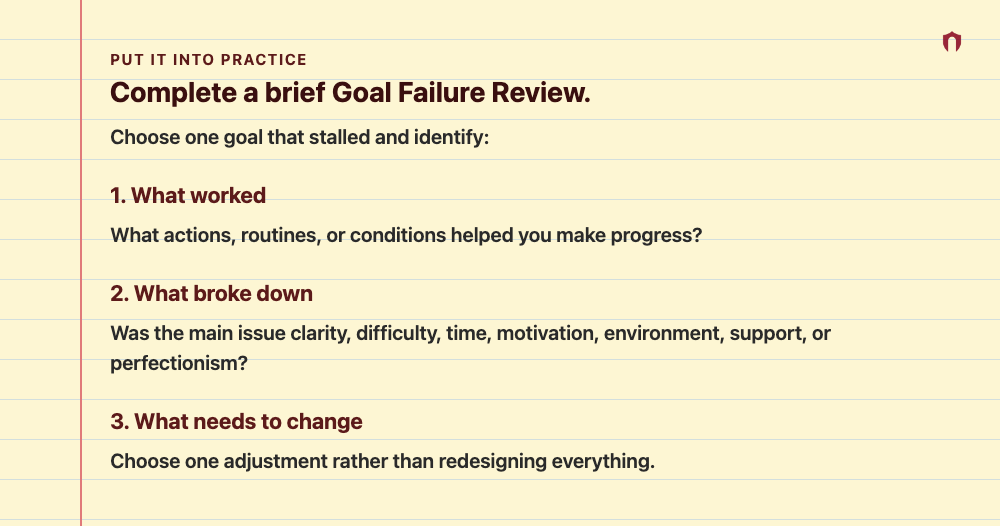
When a goal fails, examine the design.
The goal may need more clarity, a smaller next step, a longer timeline, better support, or a plan for returning after setbacks.
Reflect
Choose one goal you have struggled to reach.
Ask yourself:
Was the goal specific enough to guide action?
Was the first step manageable?
Did I attempt too many changes at once?
Was the timeline realistic?
What happened after I missed a day or experienced a setback?
Did my environment support or hurt the desired behavior?
Put It Into Practice
“You don’t rise to the level of your goals. You fall to the level of your systems.” — James Clear
"A goal without a plan is just a wish." — Antoine de Saint-Exupéry
Work one-on-one with Zack to build a plan tailored to your situation.