
Learn how burnout affects your mood and thoughts, identify harmful patterns, and create more sustainable ones.
A personal welcome and overview of this playbook from Zack.
What Is Burnout?
Burnout is a state of physical, emotional, and/or mental depletion due to prolonged stress, especially when a person feels unable to recover or improve the conditions causing it.
It generally involves three interconnected experiences:
Exhaustion
You feel emotionally or physically depleted and have less energy available to meet ongoing demands.
Detachment or Cynicism
You begin distancing yourself emotionally from your work, responsibilities, coworkers, clients, friends, etc.
Reduced Effectiveness
You feel less capable, motivated, productive, or confident in your ability to perform successfully.
These experiences often reinforce one another. Exhaustion makes it harder to perform well. Reduced performance may create self-doubt and additional pressure. To protect yourself from constant stress, you may become emotionally detached. That detachment can then reduce meaning and motivation, making work and life feel even more draining.
Burnout is not just one isolated symptom. It’s a pattern that develops across energy, attitude, and effectiveness.
Common Conditions That Contribute to Burnout
Burnout results from an accumulation of stressors rather than one difficult day.
Common contributing conditions include:
Excessive or Unmanageable Workload
The amount of work consistently exceeds the time, energy, or resources available.
The person may finish one task only to discover several more waiting, leaving no meaningful sense of completion.
Unclear or Conflicting Expectations
Burnout can develop when someone doesn’t know what success looks like. They may feel that no matter what they prioritize, they are disappointing someone, including potentially themselves. Someone who always wants more regardless of what they have or accomplished can get burnt out by the never-ending pursuit of a hypothetical outcome.
Limited Control
People are more vulnerable to burnout when they have significant responsibility but little influence over schedules, expectations, priorities, or decisions.
Being held accountable without having appropriate authority creates helplessness and frustration.
Lack of Support
People are more likely to become depleted when they feel isolated, ignored, or unable to ask for help. A demanding environment becomes harder to tolerate when someone believes they must handle everything alone.
Even more challenging may be working as part of a team that doesn’t function well together. If someone believes they often have to pick up the slack of others’ responsibilities while managing the relationships within the team, this can contribute to feeling burned out.
Inadequate Recognition or Reward
Reward for work doesn’t always just mean money. It can include appreciation, respect, advancement, feedback, flexibility, and the feeling that effort matters.
When someone continually gives more without receiving meaningful acknowledgment or a subjective sense of success, motivation may decline.
Conflict With Personal Values
Burnout may develop when people repeatedly act in ways that conflict with their professional standards or personal beliefs.
For example, if someone cares deeply about helping people but feels forced to prioritize speed, profit, or paperwork over quality. If success means going against a person’s values, over time it will take a mental toll.
Who Is Vulnerable to Burnout?
Burnout can affect anyone, but certain traits and circumstances may increase vulnerability.
People at greater risk may include those who:
Many of these qualities are valued in the professional world.
Conscientiousness, ambition, dependability, empathy, and dedication can contribute to success. But without limits, the same strengths can become pathways to burnout.
The Early Warning Signs
Burnout usually develops gradually. Because the changes occur over time, people often normalize them:
“This is just a busy season.”
“Things will calm down next month.”
“I just need to push through.”
Sometimes the pressure does decrease. But when the same signs persist or intensify, they deserve attention.
Early warning signs may include:
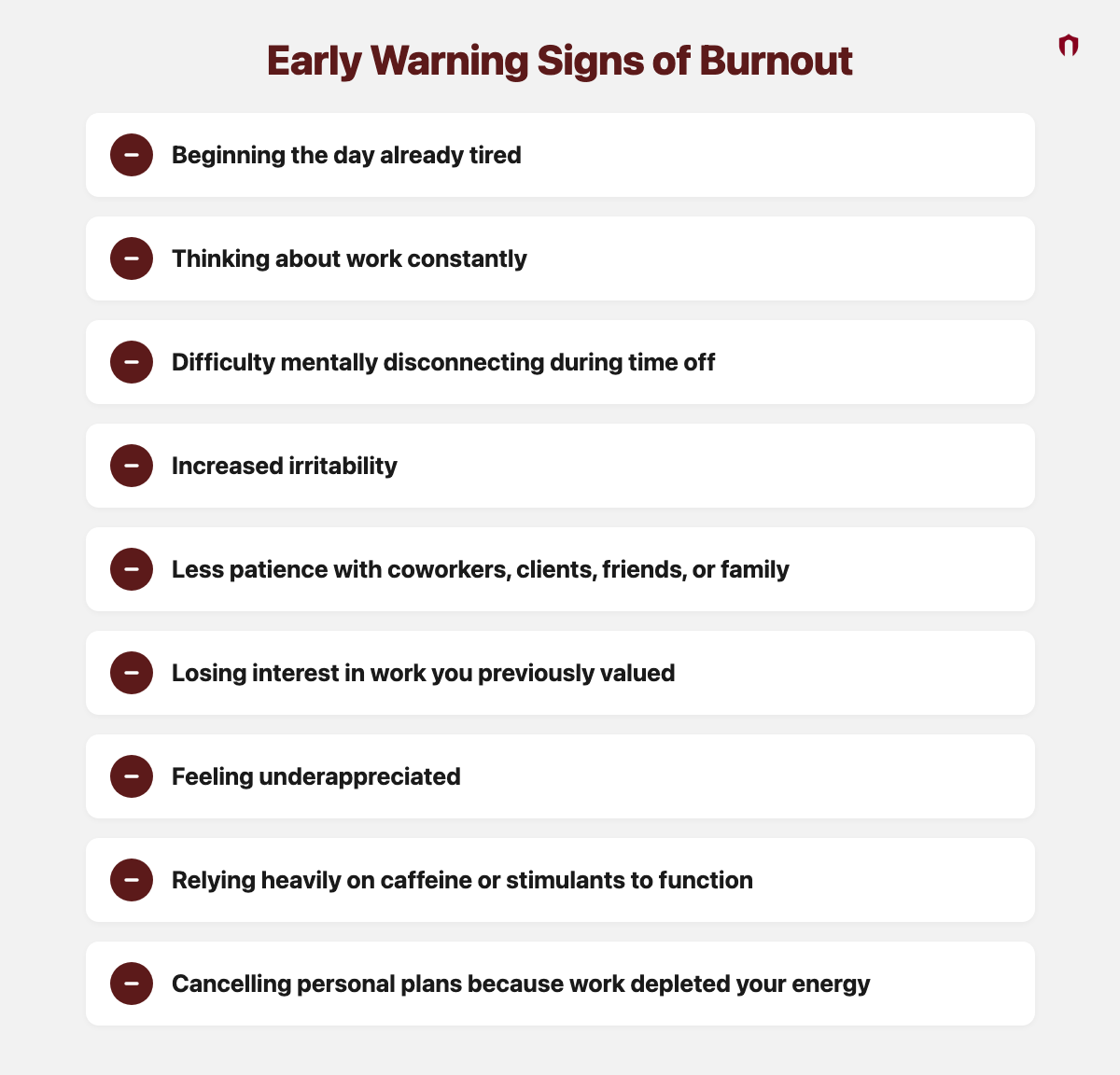
One sign alone does not prove burnout. The concern is the overall pattern: symptoms that persist, spread into multiple areas of life, and no longer improve with ordinary rest.
Exhaustion
Exhaustion is often the most noticeable part of burnout.
This is not simply feeling tired after a demanding day. It is a deeper sense that your emotional or physical reserves are no longer being replenished.
You may sleep but still wake up depleted. You may take a weekend off but begin Monday feeling as though you never stopped working. You may complete basic tasks but feel that they require far more effort than they should.
When exhaustion becomes chronic, people often attempt to compensate by pushing harder. They work longer, skip breaks, take work home, or criticize themselves for struggling.
This may preserve performance temporarily, but it often deepens the underlying depletion.
Reduced Effectiveness
Burnout can create a painful contradiction:
You may be putting in more effort while becoming less effective.
Common experiences include:
These changes can be especially distressing for high performers. Someone who has always viewed themselves as capable may interpret reduced effectiveness as evidence that they are failing. They may respond by increasing their effort, which further reduces opportunities for rest and recovery.
This is one of the central cycles that keeps burnout going.
Detachment and Cynicism
When emotionally overloaded, detachment may become a form of self-protection.
Someone who once felt invested may begin thinking:
“Do I even care about this?”
“Nothing is ever going to change.”
“These people are impossible.”
They may become impatient, sarcastic, emotionally numb, or increasingly negative.
Cynicism does not always mean someone has become uncaring. Sometimes it is exhaustion wearing emotional armor. Distancing reduces how much a person feels in the short term. However, it can also reduce the connection, meaning, and satisfaction that once made the work worthwhile.
Burnout, Stress, and Ordinary Fatigue
Burnout is related to stress, but the experiences are not identical.
Stress often involves feeling that there is too much: too many demands, too much pressure, too much urgency, and too much responsibility.
Burnout often involves feeling that there is not enough: not enough energy, not enough motivation, not enough emotional capacity, and not enough belief in what you’re doing.
Ordinary fatigue usually improves after sleep, rest, or a break.
Burnout may persist even after short periods away because the underlying conditions and patterns remain unchanged.
A vacation may provide temporary relief, but if someone returns to the same workload, lack of control, unclear expectations, poor boundaries, or challenging relationships, symptoms may quickly return.
Rest is necessary, but recovery often requires more than rest alone.
Burnout and Depression
Burnout and depression can overlap.
Both may involve:
Burnout is often strongly connected to work or another prolonged area of responsibility (like a caregiver, therapist, or even someone who feels a high degree of responsibility in their relationships). A person may feel depleted professionally but still experience enjoyment and motivation in other parts of life.
Depression tends to affect life more broadly. Feelings of hopelessness, worthlessness, or disconnection may remain present across work, relationships, hobbies, and time away.
However, burnout can contribute to depression, and the two may occur together.
Consider seeking professional support if symptoms include:
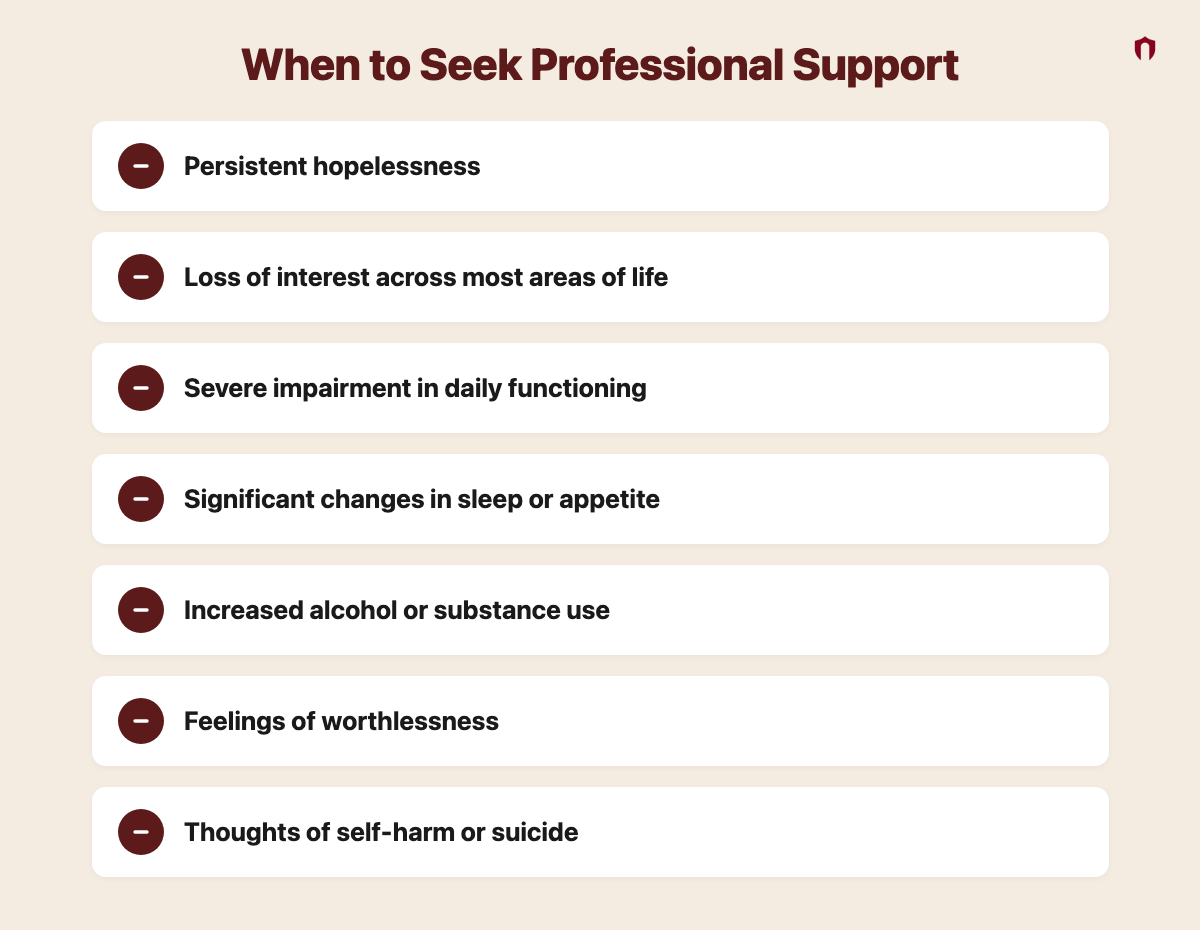
Understanding burnout should not become a reason to dismiss symptoms that require mental health care.
When Rest Does Not Feel Restful
One of the clearest signs of burnout is difficulty recovering during time away. You may technically stop working, but remain mentally connected to it.
You may:
This is not true recovery. Recovery requires more than being physically absent from the stressor. It requires periods in which the nervous system is no longer responding as though work is still happening.
The inability to disengage may reflect professional demands, personal beliefs, financial necessity, weak boundaries, or a combination of all four.
Recognizing the source is important because burnout is rarely solved by telling someone to relax when they don’t feel permitted or able to do so.
Key Takeaways
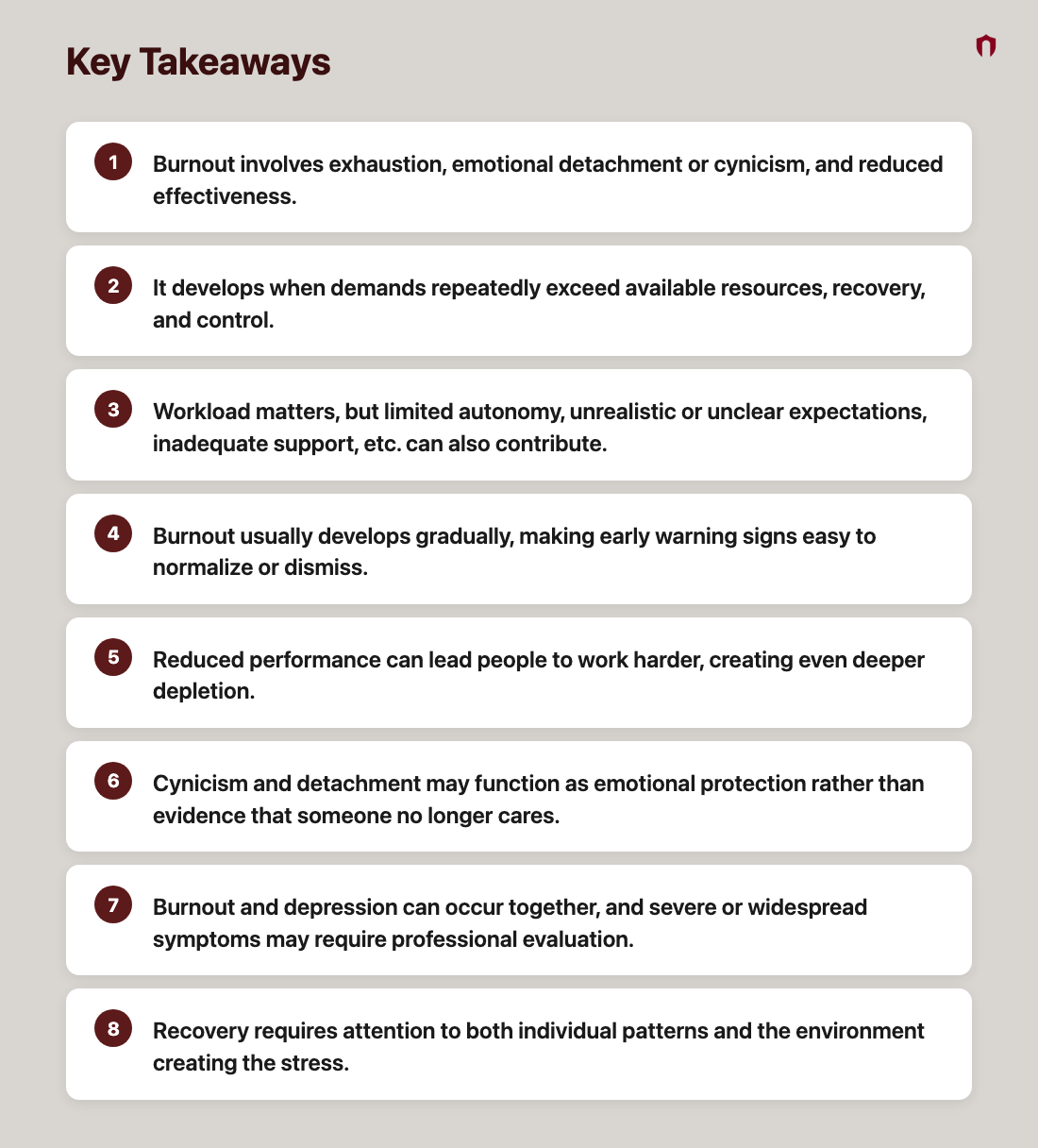
🧠 Your Mental Playbook
One Thing to Remember
Burnout is not simply the result of working hard. It develops when demands repeatedly exceed your resources, recovery, and sense of control.
Recognizing burnout is not admitting weakness, it’s acknowledging that the current way of functioning is no longer sustainable.
Reflect
Consider your current relationship with work and responsibility.
Ask yourself:
Do I feel restored after rest, or only slightly less exhausted?
Have I become more cynical, detached, or irritable?
Am I working longer while accomplishing less?
Do I feel supported, valued, and treated fairly with the team I work with?
Does my work still align with my values?
What demands have increased?
Which resources or opportunities for recovery have decreased?
The goal is to identify whether a repeated pattern has become unsustainable.
Put It Into Practice
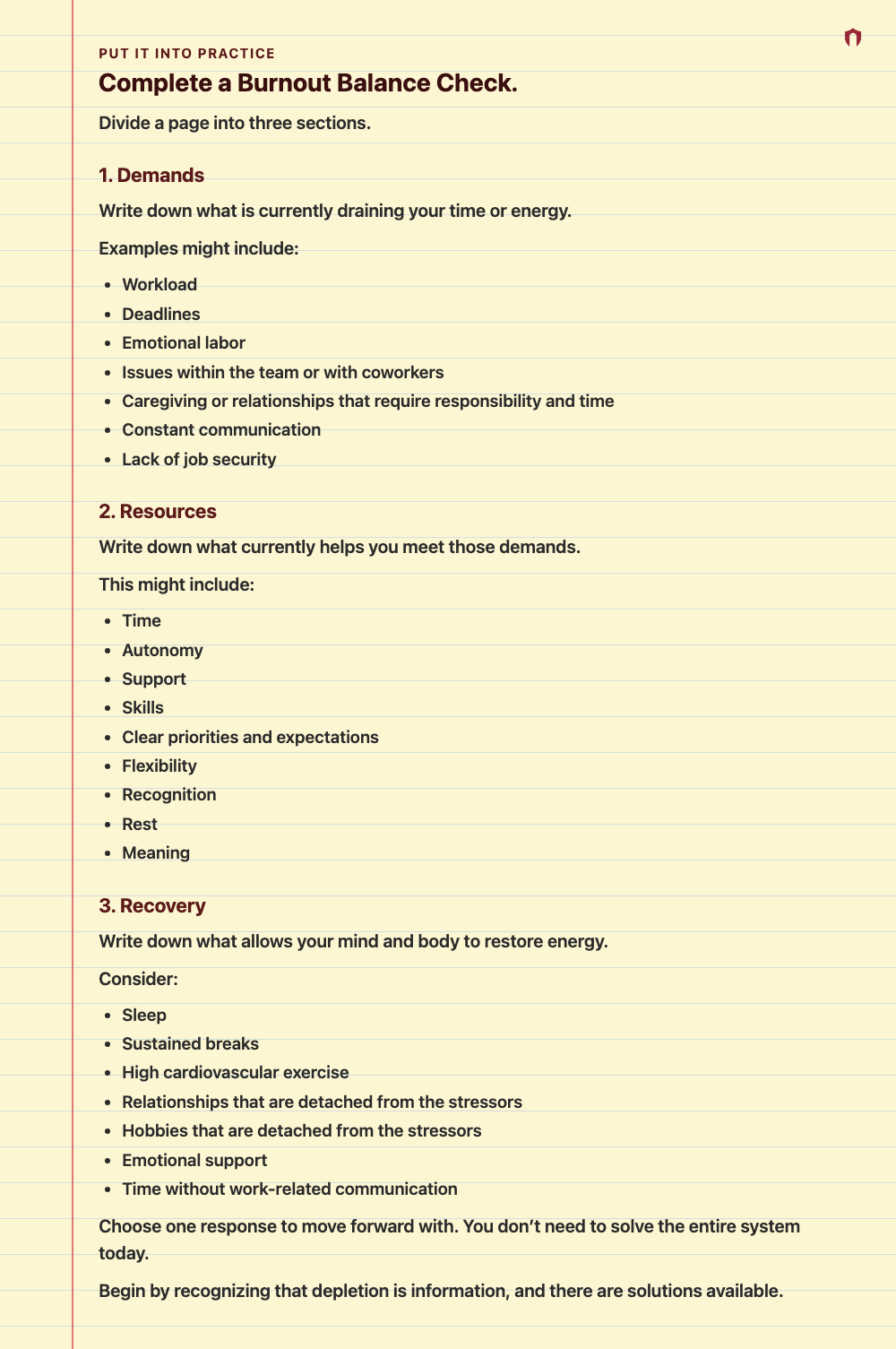
“You cannot pour from an empty cup.” — Unknown
Cognitive Overload
Your brain has a limited amount of attention and working memory available at any given time. When demands are manageable, you can prioritize, solve problems, remember information, and adjust when something unexpected happens.
When demands are excessive, more of your mental energy is used just trying to keep up.
You may be managing:
Eventually, the volume of information and demands can exceed your ability to process them effectively.
This is cognitive overload.
It may look like:
Your brain may simply have too many open tabs competing for limited mental space.
Brain Fog
People experiencing burnout often describe “brain fog.” Brain fog is not one specific medical diagnosis. It’s a way of describing difficulty thinking clearly.
You may feel:
Tasks that once felt automatic may require significant effort. This can lead to frustration and self-doubt.
A person may think:
“I used to be sharp. What happened to me?”
The problem is often made worse by trying to force concentration through longer hours, less sleep, more caffeine, and fewer breaks. That may temporarily increase output, but it also removes the recovery your brain needs.
The result can be a frustrating cycle:
Exhaustion → Reduced concentration → More mistakes or slower work → Increased effort → Deeper exhaustion
When your performance declines because of overload, pushing harder is not always the same as functioning better.
Decision Fatigue
Every decision uses mental energy.
Throughout the day, you may decide:
When decisions accumulate without enough rest, you may experience decision fatigue.
This may lead to:
Someone who makes complex decisions all day may then feel unable to choose what to eat for dinner or whether to attend a social event.
Reduced Creativity and Problem-Solving
Burnout can narrow attention. When your brain is focused on surviving the current workload, it may have less capacity for curiosity, creativity, and long-term thinking.
You may become more likely to:
This is especially difficult for entrepreneurs who tend to rely on their creativity and innovation for success, but may feel blunted and dulled by the sheer volume of work they have on their plate.
Creativity usually requires some degree of psychological space. When every moment feels urgent, that space disappears.
Emotional Reactivity
Burnout can reduce your emotional capacity. Small inconveniences may begin feeling disproportionately frustrating because you have fewer internal resources available to absorb them.
You may become irritated by:
You may understand intellectually that the situation is not serious while still reacting intensely.
Burnout does not excuse hurting others. You remain responsible for your behavior. But understanding the role of depletion can help you respond with accountability rather than only shame.
Emotional Numbness
In instances where burnout seems to overlap with symptoms of Depression, it may not always create stronger emotions. Sometimes it creates less feeling.
You may become emotionally flat, detached, or indifferent. Things that once brought satisfaction may no longer register. You may stop feeling excited about accomplishments, and have less interest in what you’re working on.
Emotional numbness can be a form of protection. If caring deeply has become painful or exhausting, your brain may reduce emotional involvement to preserve energy.
This can be particularly common in professions involving repeated exposure to distress, conflict, crisis, or human suffering.
The person may not consciously decide to stop caring, but they may simply feel that there is nothing left available to give.
Cynicism
Cynicism often develops when someone repeatedly invests effort without seeing improvement, recognition, fairness, or meaningful results.
You may begin thinking:
Some of these conclusions may reflect real problems. Burnout should not be used to dismiss legitimate concerns about poor leadership, unfair systems, or impossible expectations.
However, prolonged depletion can make negativity expand beyond the specific problem. You may begin expecting disappointment everywhere.
Cynicism can protect against hope because hope creates the possibility of being disappointed again. But it also removes the meaning, connection, and motivation that once made work tolerable.
A useful reframe is:
Cynicism is sometimes exhaustion wearing emotional armor.
Reduced Confidence
Burnout can make people doubt abilities they have demonstrated for years.
As concentration declines and mistakes increase, you may begin thinking:
“Maybe I’m not good at this anymore.”
“Everyone else is handling it better.”
“I should be able to do more.”
“I’m falling apart.”
These thoughts can become especially powerful for high achievers whose identity is tied to competence and reliability. The person may work even harder to prove that they are still capable. Unfortunately, this removes more time from sleep, relationships, and recovery, creating further decline.
Burnout often causes a performance problem and then convinces you that the performance problem is a character or competence problem.
They are not the same.
Burnout and Relationships
Burnout rarely remains contained within work hours.
When most of your energy is spent managing professional demands, little may remain for friends, partners, children, or family.
You may:
Loved ones may interpret this as rejection or lack of interest. They may not see the hours of emotional effort that occurred before you came home. At the same time, their experience matters. Burnout can place real strain on relationships even when the withdrawal is not intentional.
Helpful communication may sound like:
“I’ve noticed that I’m coming home depleted and shutting down. It isn’t because I don’t care about you.”
“I need a short period to decompress, but I don’t want to disappear for the entire evening.”
“I’m more irritable than usual, and I need to take responsibility for how that affects you.”
Recognition, ownership, and a plan to address the situation are what the relationships in your life may need.
Unhealthy Coping
Burned-out people often search for ways to quickly change how they feel.
Common coping behaviors may include:
These behaviors may provide temporary relief, stimulation, numbness, or escape.
The concern is when they create a second cycle:
Depletion → Escape → Short-term relief → Consequences → Greater depletion
Key Takeaways
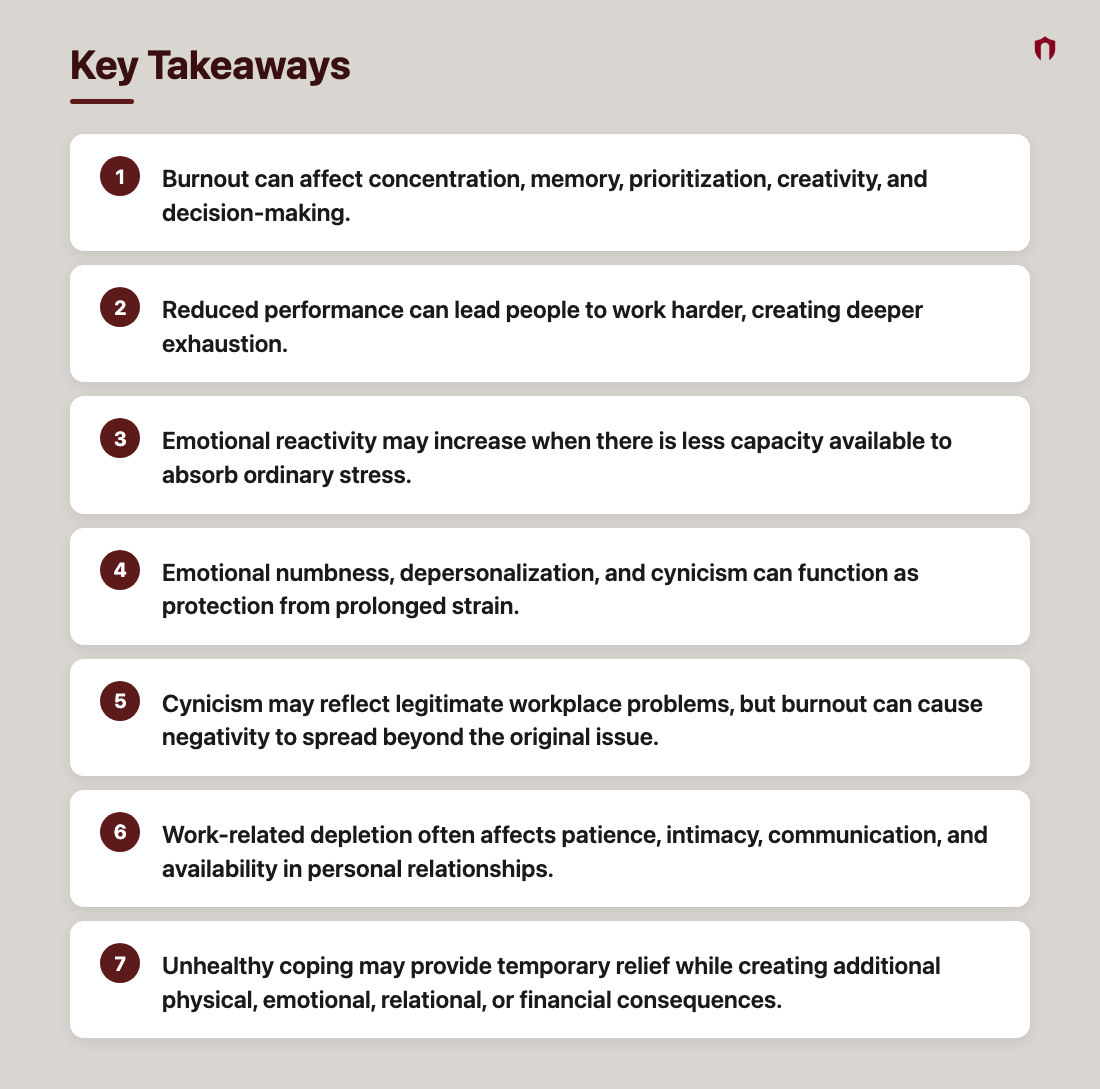
🧠 Your Mental Playbook
One Thing to Remember
Burnout may reduce your performance and effectiveness due to depletion of resources, but it doesn’t mean your competence, ability, character, and work ethic have been compromised. It’s simply a problem that requires a solution.
Reflect
Consider how prolonged stress may be affecting your functioning.
Ask yourself:
Have I noticed more forgetfulness, indecision, or difficulty concentrating?
Am I responding to reduced effectiveness by working even longer?
Have I become more irritable, numb, or cynical?
How is my stress affecting the people closest to me?
Which parts of life have I abandoned because work consumes my energy?
What do I currently use to escape or decompress?
Does that coping strategy restore me or create additional problems?
Try to separate two questions:
“What has burnout been doing to me?”
and:
“Who do I want to be in response?”
Put It Into Practice
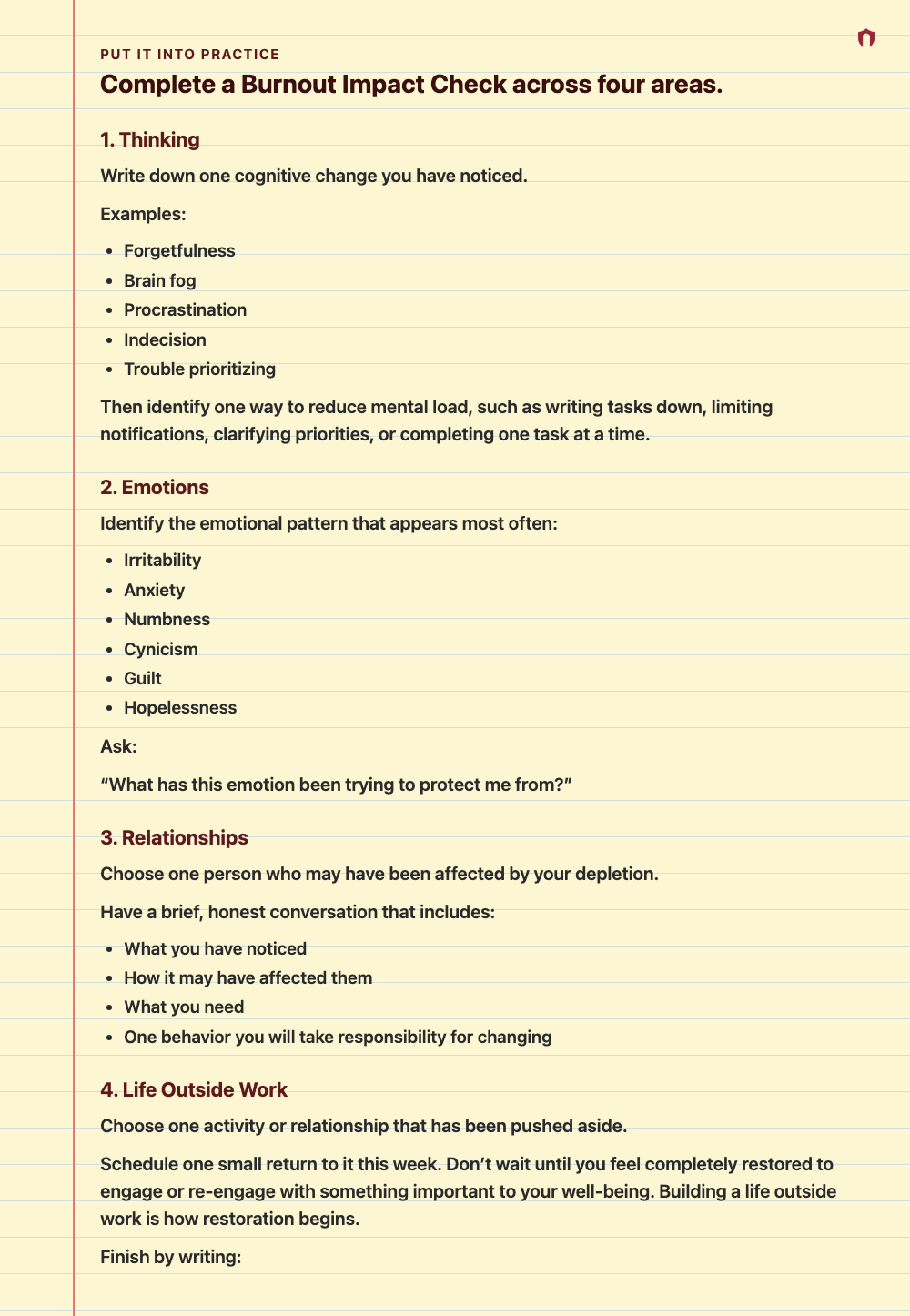
“Almost everything will work again if you unplug it for a few minutes - including you.” — Anne Lamott
Responding to Exhaustion by Working Harder
One of the most common patterns in burnout is using greater effort to compensate for reduced capacity. You may notice that you are slower, less focused, or making more mistakes. Instead of interpreting these changes as signs of depletion, you may conclude:
“I need to be more disciplined.”
“I have to catch up.”
“I can rest when this project is finished.”
You then work later, skip breaks, cancel plans, or sacrifice sleep.
This, for obvious reasons, simply compounds the problem. It may preserve your performance temporarily, but the cost is greater exhaustion. As your capacity continues to fall, you need even more effort to produce the same result.
Hard work is not inherently unhealthy. The problem is relying on effort to solve a condition caused primarily by insufficient recovery.
Perfectionism
Perfectionism can make ordinary responsibilities feel endless.
A perfectionistic person may:
Perfectionism says:
“Everything must receive my best effort.”
Sustainable performance recognizes:
“Not everything requires the same level of effort.”
When every task is treated as equally important, the person spends limited energy on details that may have little impact. Learning to distinguish excellent, good enough, and unnecessary is an important part of interrupting burnout.
Productivity-Based Self-Worth
Burnout becomes harder to address when productivity is connected to identity.
You may feel valuable when you are accomplishing a task, helping someone, earning recognition, or meeting high expectations. Rest may then feel emotionally uncomfortable because it removes the evidence that you are useful.
You may think:
“If I am not producing, I am wasting time.”
“Other people are doing more than I am.”
“I have not earned the right to relax.”
This creates a painful contradiction: the more your self-worth depends on performance, the harder it becomes to step back when performance begins harming your health. Your work may be meaningful and your accomplishments may matter. But no role, title, evaluation, or level of output can provide a stable foundation for human worth.
People-Pleasing and Fear of Disappointing Others
Some people become burned out because saying yes feels safer than saying no.
They may fear:
As a result, they accept additional tasks even when their capacity is already exceeded. They may volunteer before anyone asks, respond immediately to messages, or take responsibility for problems that do not belong entirely to them.
People-pleasing often provides short-term relief. Saying yes prevents an uncomfortable conversation and may produce appreciation or approval.
The long-term cost can include exhaustion, resentment, and commitments that cannot be sustained. It also sets a precedent that others can continue to depend on you in a way you’ve let them so far.
A boundary may disappoint someone temporarily, but chronic overextension often disappoints both you and others in the long term when your health, patience, or performance declines.
Difficulty Delegating
Delegation can feel risky.
You may believe:
“It will be faster if I do it myself.”
“No one else will do it correctly.”
“Explaining it will take too much time.”
Sometimes these concerns are legitimate. Other people may lack training, staffing may be inadequate, or the responsibility may truly belong to you. But consistently refusing to delegate hurts your ability to succeed at tasks you have a legitimate talent for.
Doing everything yourself may work temporarily. It also teaches others that you will continue absorbing additional work.
Delegation does not mean lowering your standard or abandoning responsibility. It means deciding which tasks genuinely require your involvement and which can be shared, taught, simplified, or removed.
A system that functions only because one person continually exceeds their capacity is not a sustainable, practical, or necessary system.
Guilt About Rest
Rest while feeling guilty for lack of productivity or ruminating about work isn’t really rest.
You may sit down but remain preoccupied with unfinished tasks. You may take a day off while repeatedly checking email. You may feel bad for enjoying yourself while responsibilities remain.
This prevents true recovery.
Rest is not just the absence of activity. It requires enough psychological distance for the mind and body to leave a state of constant demand from the stressors.
Common beliefs that interfere with rest include:
Rest is not a reward for completing every responsibility. There will almost always be more to do.
Rest is a necessity that allows you to continue functioning with attention, patience, and creativity.
Treating Everything as Urgent
Burnout environments often create constant urgency.
Every message feels like it requires an immediate response. Every task feels critical. Every request becomes another priority.
When everything is urgent, nothing can be prioritized effectively.
Constant urgency keeps the nervous system activated, leading to anxiety and exhaustion. You spend the day responding to what is loudest rather than what is most important.
Some tasks truly are urgent. Others feel urgent because your expectations are unhelpful or unclear.
A useful question is:
“What will realistically happen if this waits?”
That question helps separate genuine consequences from perceived pressure.
Technology and Constant Availability
Phones, email, messaging platforms, and remote work can make professional demands feel endless. The workday no longer has a clear ending, especially for entrepreneurs.
You may check messages:
Each interruption may seem small, but it prevents psychological detachment from work. Even when you don’t respond, seeing a message may reopen unfinished concerns and activate planning, worry, or guilt.
Someone who remains continuously reachable rarely receives uninterrupted recovery. Availability is not the same as dependability. It’s a matter of boundaries and agreed-upon expectations.
Being truly dependable requires preserving enough capacity to perform well when your involvement genuinely matters.
Workplace Systems That Reward Overextension
Some organizations reward people for ignoring their limits.
Employees may receive praise for:
This creates a culture where unsustainable behavior is interpreted as commitment and teamwork.
People who set reasonable limits may be viewed as less dedicated, while those who continually overextend themselves receive additional responsibilities.
The organization benefits from their workers’ self-neglect - at least temporarily.
This is why burnout can’t always be solved through individual mindset changes. A person could improve sleep, exercise, attend therapy, and practice mindfulness while returning each day to conditions that remain fundamentally unsustainable.
Personal strategies can increase resilience, but they can’t always make up for an unhealthy environment.
Financial Pressure and Limited Choice
Not everyone can reduce hours, take leave, refuse assignments, or leave an unhealthy workplace.
People may remain in burnout-producing conditions because they need:
This reality matters.
Advice such as “just quit” or “set better boundaries” can ignore the risks some people face.
While your choices may be limited, it doesn’t mean there are no possible changes that can be made. It may mean that recovery requires smaller and more strategic adjustments.
These might include documenting workload, clarifying priorities, using available benefits, seeking outside support, developing an exit plan, or protecting limited recovery time outside work.
Key Takeaways
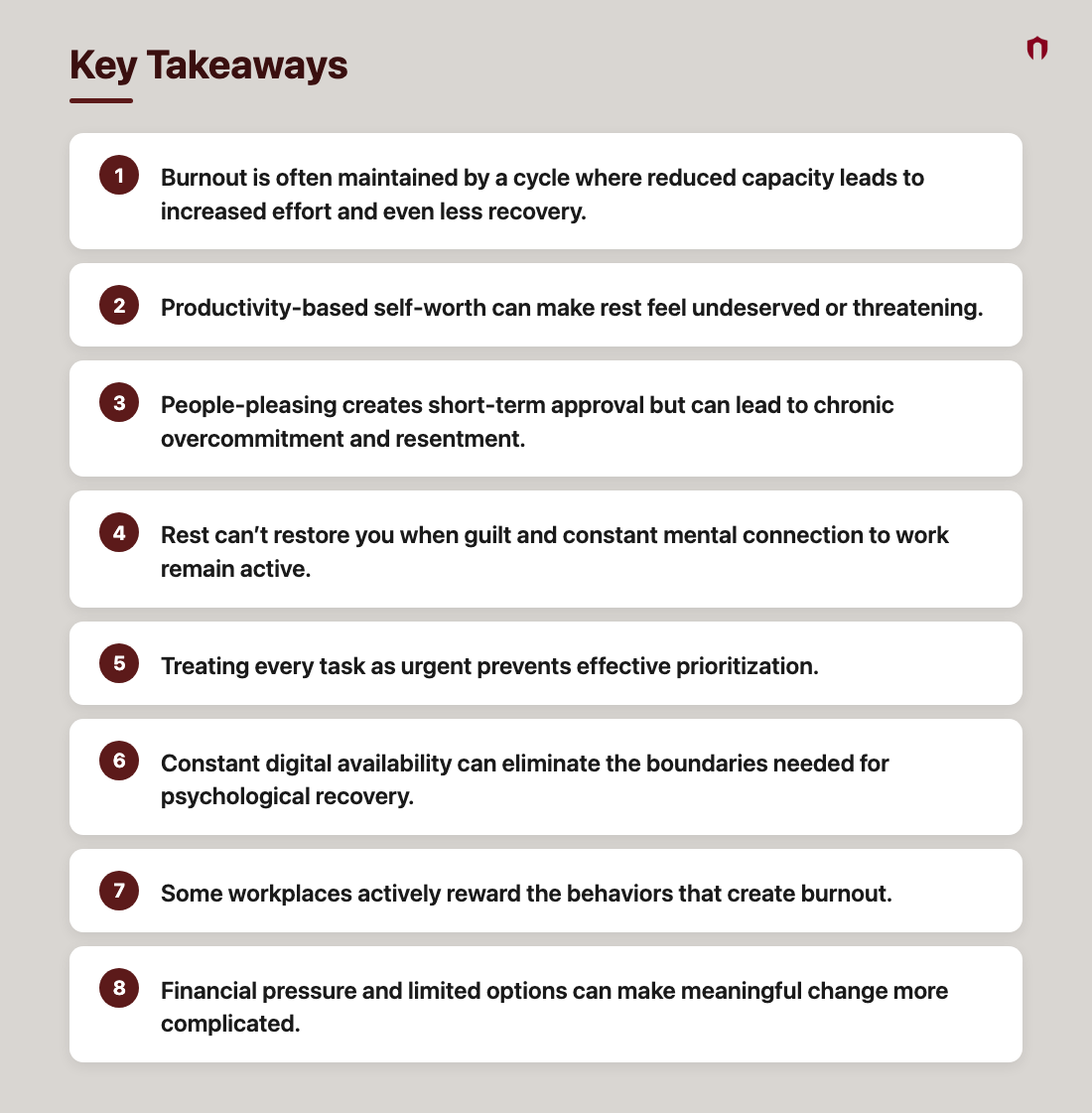
🧠 Your Mental Playbook
One Thing to Remember
Burnout continues when the strategies you use to keep up prevent you from recovering.
Working longer, saying yes, remaining constantly available, and ignoring exhaustion may help you survive the immediate demand, but a strategy that protects today’s performance by reducing tomorrow’s capacity is not sustainable.
Reflect
Consider the patterns that may be keeping your burnout cycle going.
Ask yourself:
When my performance declines, do I respond by working harder or examining my capacity?
Which tasks do I approach with standards higher than the situation requires?
Is my self-worth connected to being productive, useful, or needed?
Which responsibilities could be delegated, simplified, delayed, or removed?
Do I allow myself to rest without guilt or work-related interruptions?
What coping strategies help me recover, and which only help me escape?
Awareness can help you identify which parts of the cycle may be available for change.
Put It Into Practice
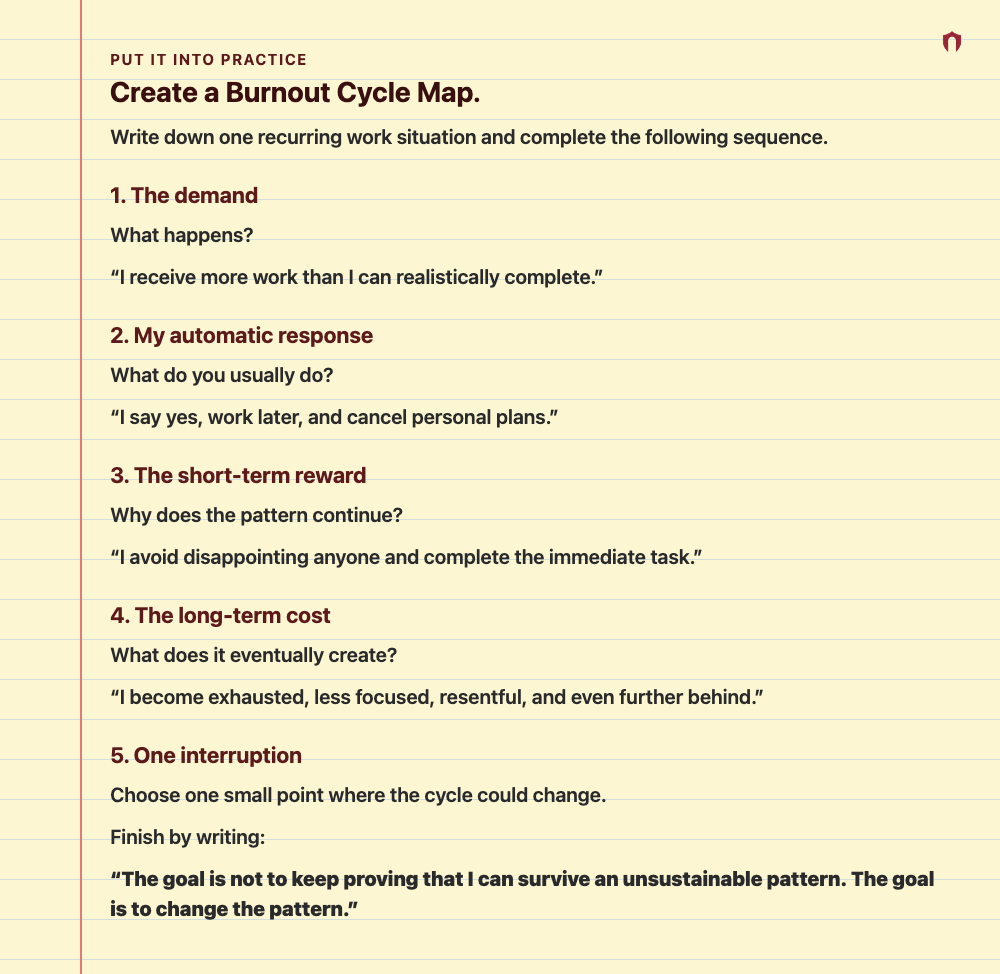
“You can’t do a good job if your job is all you do.” — Katie Thurmes
Recovery Begins With Acknowledging the Problem
Many people remain burned out because they continue minimizing what is happening.
They tell themselves:
“Other people have it worse.”
“I should be able to handle this.”
“This is just part of being successful.”
“I’ll recover when things calm down.”
Acknowledging burnout may feel uncomfortable because it can force difficult questions about work, boundaries, identity, or change.
But ignoring depletion does not make it disappear. Burnout is information. It may be telling you that:
Rest Is Necessary, but Rest Alone May Not Be Enough
Burnout depletes physical, cognitive, and emotional resources.
Recovery therefore requires genuine periods of reduced demand.
This may involve:
However, rest becomes limited when the person returns to the same system without any meaningful changes.
Imagine repeatedly draining a battery faster than it can recharge. Charging it may help initially, but the same pattern will eventually deplete it again.
The question is not only:
“How can I rest more?”
It’s also:
“What keeps draining me faster than I can recover?”
Recovery requires attention to both sides of the equation.
Rebuild Boundaries
Boundaries protect time, energy, attention, and emotional capacity.
They may involve:
People who benefited from your lack of boundaries may resist them at first. But setting a boundary is not evidence that you don’t care or aren’t committed. It may be what allows you to continue caring without becoming depleted.
The important question is whether availability is occasional and chosen, or constant and expected.
Reconnect With Meaning (Without Using Meaning to Justify Harm)
Meaningful work can protect against burnout, but it can also be used to excuse exploitation.
People in healthcare, education, therapy, nonprofit work, athletics, leadership, parenting, and caregiving may accept unsustainable demands because the work matters deeply.
They may think:
“People depend on me.”
“The ends justify me struggling.”
“If I step back, someone else will suffer.”
Purpose can help people endure difficulty. But purpose shouldn’t require endless self-abandonment.
Ask:
Sometimes recovery involves reconnecting with the original meaning of the work. Other times, it requires accepting that the current role or environment no longer allows that meaning to exist.
Rebuild a Life Outside Productivity
Burnout becomes more powerful when work is the primary source of identity, achievement, connection, and value.
If work is the only thing that matters to you, and work isn’t going well, it feels like life isn’t going well.
Recovery includes rebuilding areas of life that don’t depend on professional performance.
This might involve:
These activities are not distractions from or in replacement of productivity. They help create a life in which productivity is only one part of who you are.
You don’t need to become highly accomplished in your hobbies. Turning every activity meant for recovery into another goal can recreate the same pressure in a different setting. Some activities should exist simply because they make life feel larger and fuller.
Professional Support
Burnout may improve through workplace changes, rest, boundaries, and social support. Professional care may also be valuable, especially when symptoms are persistent or affecting several areas of life.
Support may include:
Therapy
Therapy can help address perfectionism, people-pleasing, guilt, anxiety, depression, identity, boundaries, and coping behaviors.
Coaching or professional consultation
This may help with workload systems, communication, leadership challenges, delegation, career planning, or role transitions.
Medical evaluation
Fatigue, concentration problems, sleep changes, and low motivation may also be affected by medical conditions, medication, sleep disorders, or other health concerns.
Workplace resources
Depending on the organization, support may include employee assistance programs, occupational health, human resources, paid leave, or other accommodations.
Seeking help for burnout doesn’t mean you can’t handle normal stress and pressure in life, it means that the current situation has become important enough that it deserves your attention and effort to resolve.
Preventing Burnout From Returning
Feeling better is great, but the patterns that led to burnout in the first place may remain. As energy returns, many people gradually resume the same habits that contributed to burnout.
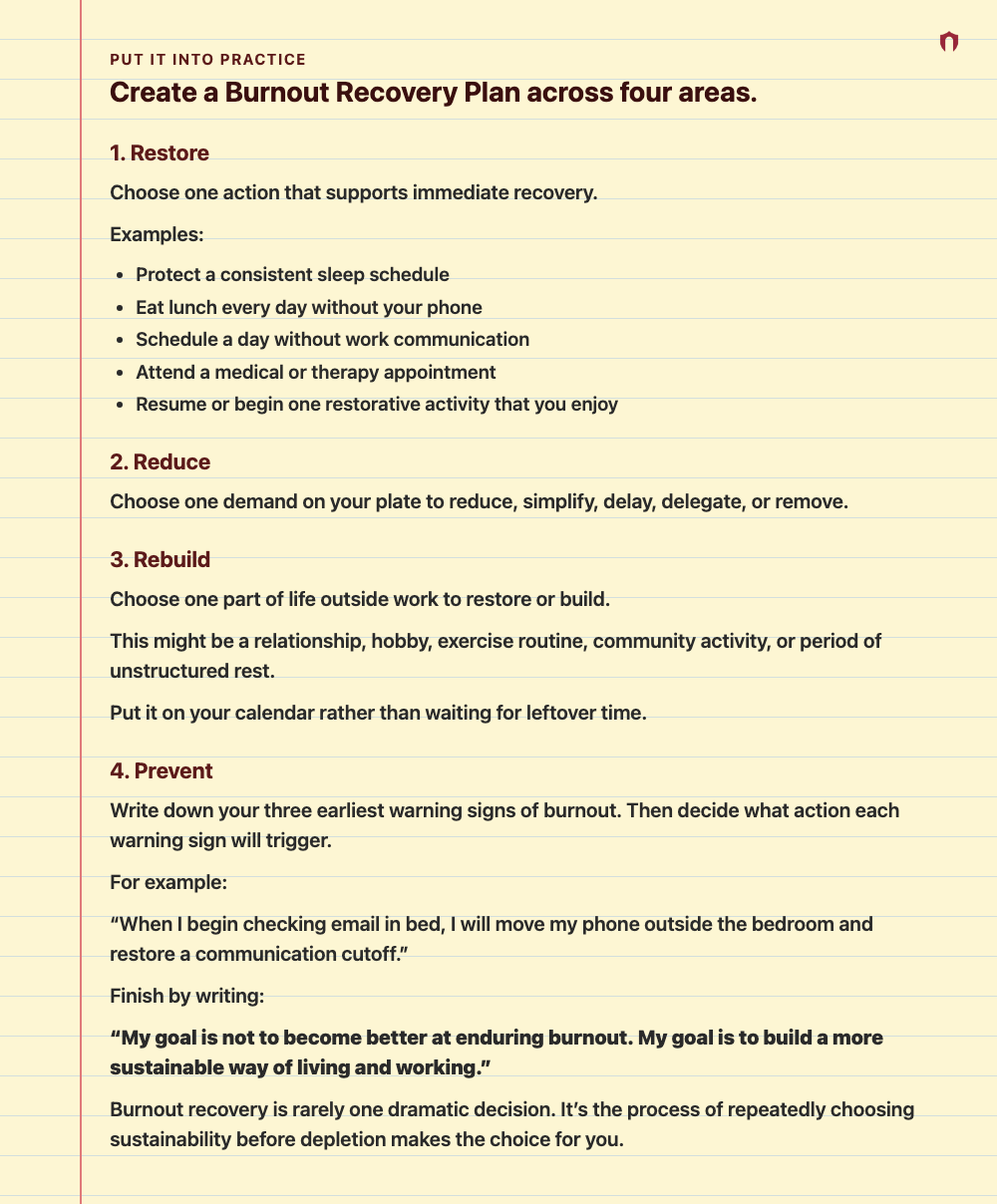
Prevention requires noticing early warning signs and responding sooner. A prevention plan should answer:
You don’t need to wait until you collapse from exhaustion to justify making an adjustment.
Early intervention is not overreacting. It’s maintenance.
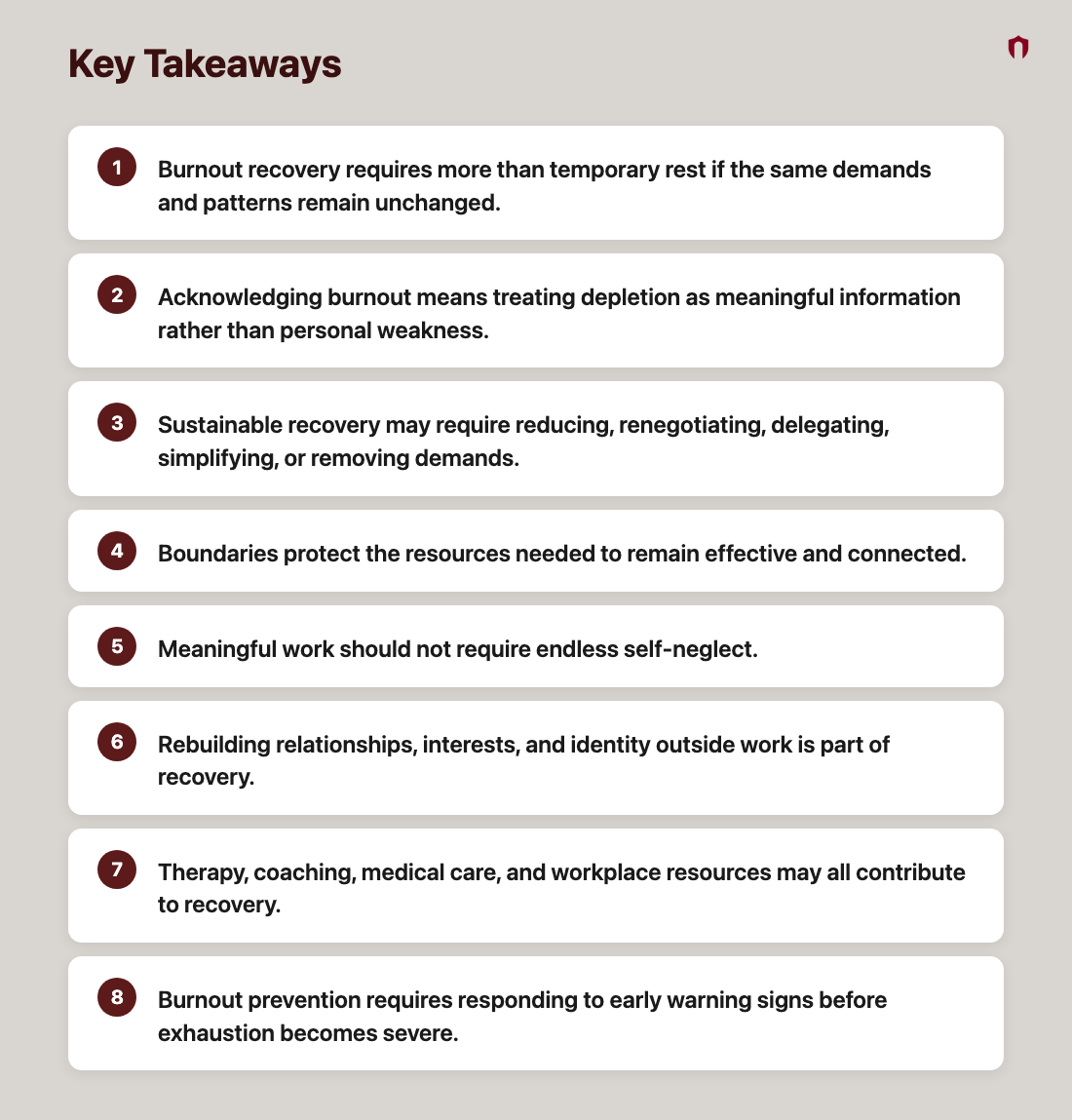
Key Takeaways
🧠 Your Mental Playbook
One Thing to Remember
Recovery is not becoming rested enough to return to the same unsustainable pattern. Recovery is changing the pattern.
Time away may restore some energy, but lasting recovery requires examining what repeatedly drains that energy and what prevents it from being restored.
You deserve a life that doesn’t require constant recovery from it.
Reflect
Consider what genuine recovery would require from you and your environment.
Ask yourself:
Which demands currently need to be reduced, renegotiated, delegated, or removed?
Which boundary would protect the most energy?
What part of my work still feels meaningful?
What parts of my identity have been neglected outside work?
Which early warning signs should I respond to sooner in the future?
Put It Into Practice
“Rest is not idleness, and to lie sometimes on the grass under trees on a summer’s day… is by no means a waste of time.” — John Lubbock
Work one-on-one with Zack to build a plan tailored to your situation.