
Learn about the psychology of money, how finances affect us, the emotional impact of job loss, and rebuild your agency.
A personal welcome and overview of this playbook from Zack.
Money is rarely just money.
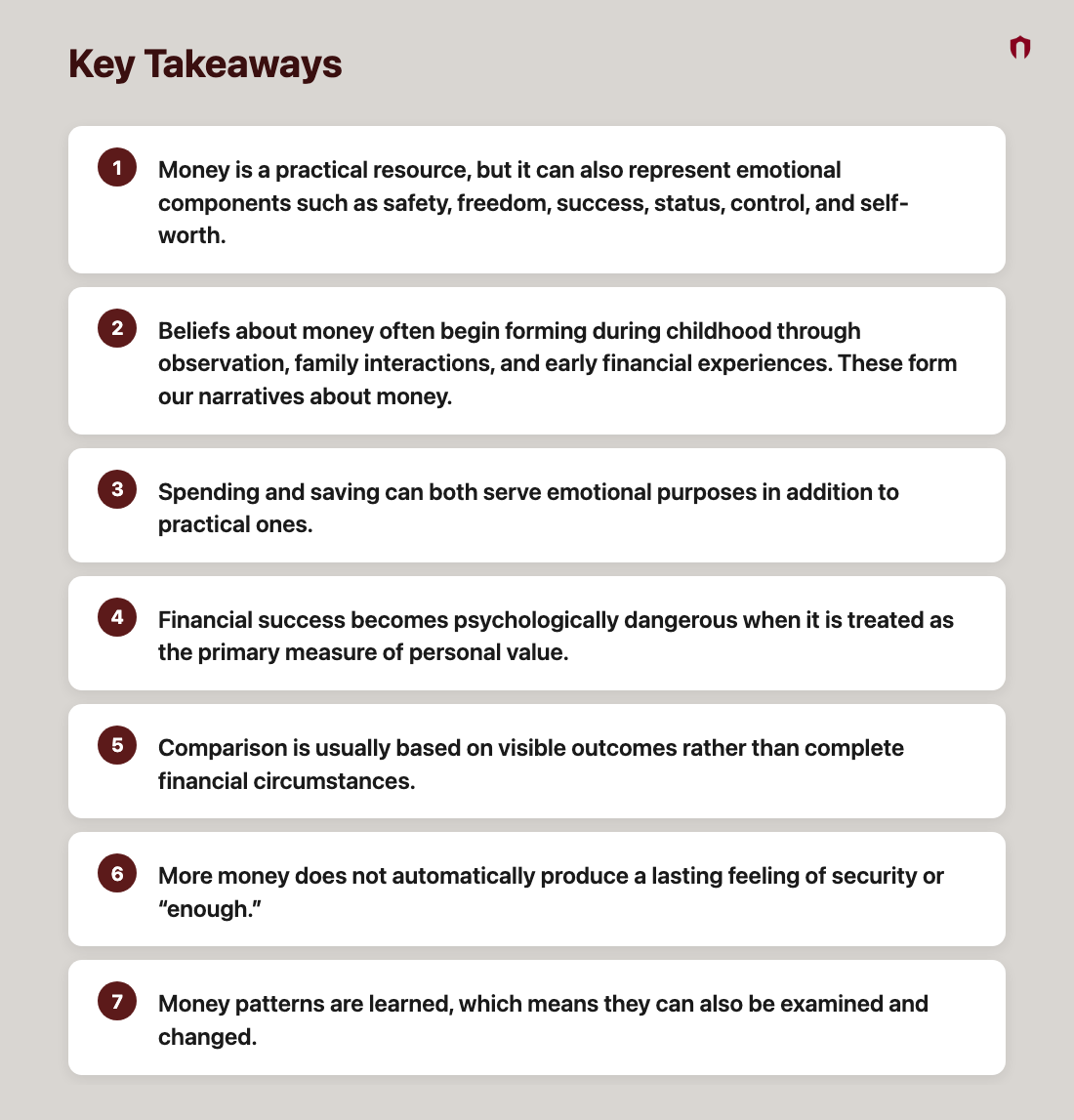
On the surface, it is a practical tool used to pay bills, purchase necessities, access experiences, and prepare for the future. Psychologically, however, money can represent much more:
This helps explain why conversations about money can become emotionally intense so quickly. A disagreement about spending may actually be a disagreement about safety. Anxiety about savings may reflect a deeper fear of dependence. The pursuit of a higher income may be connected not only to comfort, but also to identity, recognition, or the desire to prove something.
People with similar incomes can have completely different emotional relationships with money. One may feel secure and confident, while the other constantly worries that everything could disappear. One may view money as something to enjoy, while another sees it primarily as protection against an uncertain future.
These differences do not develop randomly.
Our beliefs about money are influenced by childhood experiences, family messages, culture, socioeconomic conditions, past hardships, personality, and the financial decisions we have made throughout life.
Understanding the psychology of money is not about determining whether someone is a “spender” or a “saver.” It is about identifying the deeper beliefs and emotional needs that influence financial behavior.
Before we can effectively manage financial stress, it helps to understand what money means to us in the first place.
Your Financial Story Begins Early
Most people begin developing beliefs about money long before they earn any themselves. As children, we observe how adults talk about, use, avoid, and react to money.
You may have grown up in a home where money was openly discussed and managed calmly. You may have seen adults budget, save, plan, and explain financial decisions in appropriate or inappropriate ways. You may have grown up hearing frequent arguments about bills, debt, spending, or income. Perhaps money was rarely discussed at all.
You may have learned that asking questions about finances was unwelcomed, embarrassing, or disrespectful. You may have sensed that something was wrong without understanding exactly what it was.
Common childhood experiences might include:
Children form conclusions from these experiences. They may learn:
“Money can disappear at any time.”
“Money causes conflict.”
“The person who earns the money has the power.”
“We cannot trust people with money.”
“Having expensive things proves that you are successful.”
“Good people sacrifice everything for their families.”
These messages continue influencing financial behavior decades later, even when a person’s circumstances have changed.
Money Narratives
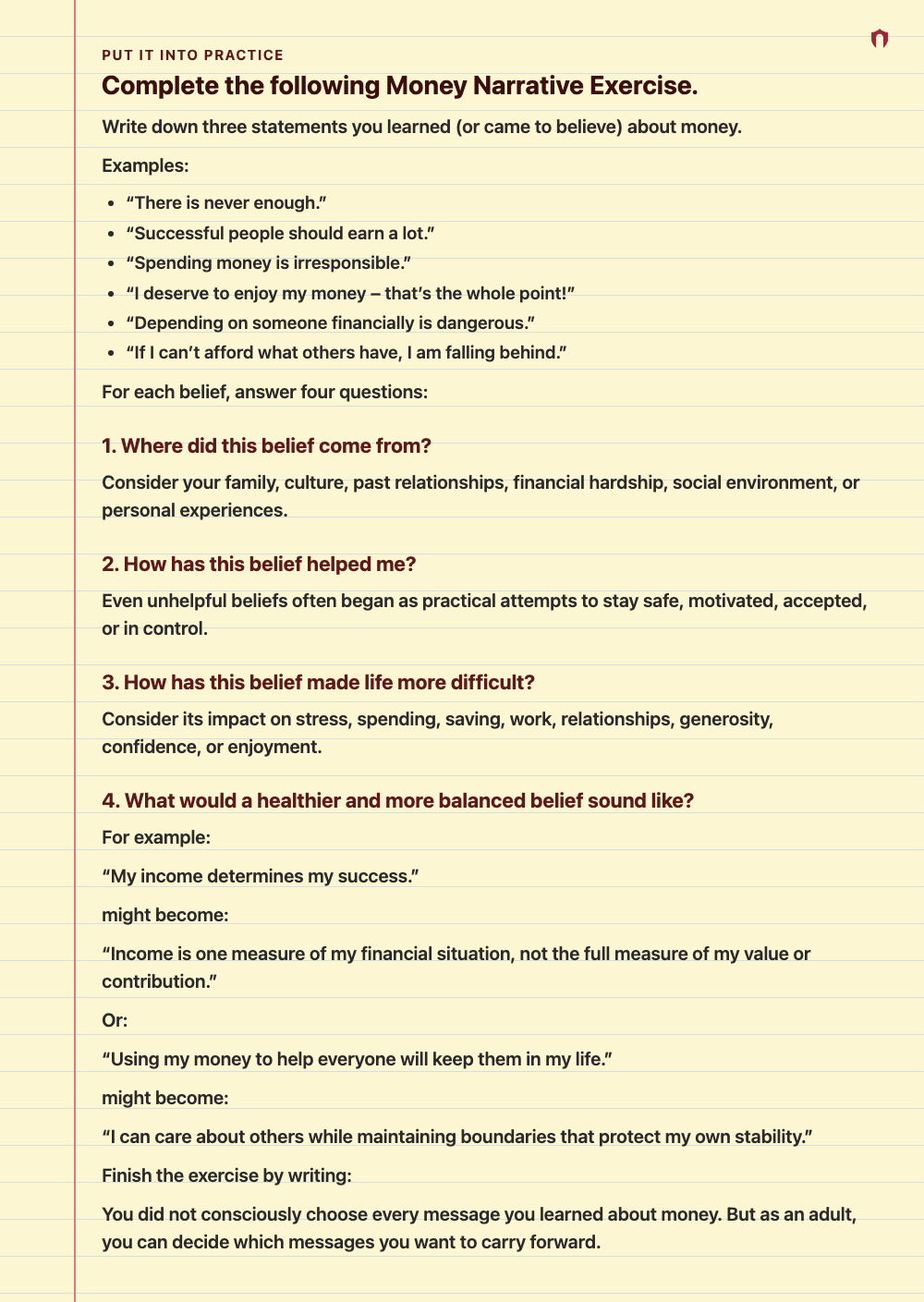
Deeply held beliefs about money create the narrative in which your brain thinks about finances. A money narrative is an assumption or story about what money means and how someone should behave with it. These beliefs often operate automatically, without being consciously examined.
Examples include:
Money scripts are not necessarily irrational. They often developed for understandable reasons. Someone who grew up with financial instability may become highly focused on saving because savings represent protection and safety.
Someone who felt deprived as a child may spend more as an adult because spending represents freedom.
Someone who watched money create power imbalances may become intensely independent and uncomfortable relying on anyone else.
There’s not necessarily a right or wrong way to think about and view money. Like most topics in the Mental Fitness Lounge, it’s not whether your beliefs are correct or incorrect, it’s whether they’re helpful or hurtful to your functioning.
What we want to consider (again, for many topics, not just finances) is that a belief developed early on in life may continue controlling your behavior even when it no longer serves you.
Money as Safety
We often correlate money with safety. Savings may mean protection from emergencies. Stable income may mean freedom from the fear of losing housing, healthcare, or basic necessities. Financial independence may mean never having to rely on someone who could disappoint, control, or abandon you.
Keeping in mind our brain’s constant strive for certainty, and security, the pursuit of financial safety can lead to healthy behaviors such as planning, saving, and living within one’s means. But when the desire for financial security becomes too much, it may feel like you can never have enough money, and potential issues could be looked at as more likely or inevitable than they are in reality.
In this instance, you may avoid spending even when the expense is reasonable and affordable.
You may struggle to enjoy what you have built because your attention remains fixed on everything that could go wrong.
We don’t want to be careless about the future, but we need to recognize when responsible preparation has turned into an endless attempt to eliminate all uncertainty, which of course is a losing battle.
No amount of money can guarantee that nothing difficult will ever happen. Financial security matters, but complete certainty is not available at any income level.
Money as Freedom and Independence
Money may also represent freedom.
It can provide the ability to:
For someone who has experienced dependence or control, earning your own money may feel deeply empowering. But for others, an intense need for financial independence may also make healthy interdependence difficult.
You may resist accepting assistance even when it would be appropriate.
You may feel ashamed of needing support from a spouse, parent, friend, or community resource.
You may believe that relying on anyone automatically makes you weak or vulnerable.
Independence is valuable, but healthy relationships often involve periods of mutual support. At different points in life, people may give more than they receive or receive more than they give. Accepting help temporarily does not erase your competence or independence.
Money as Success and Status
Modern culture often treats money as evidence of success. Income, homes, clothing, travel, cars, job titles, and other visible signs of wealth may be used to measure whether someone is “doing well.”
This can make financial achievement highly motivating. Earning more money may reflect real effort, discipline, education, risk, sacrifice, or professional accomplishment.
The problem arises when financial success becomes the primary measure of personal value. Someone may begin to believe:
“If I earn more, I matter more.”
“If other people are ahead of me, I am failing.”
“If I cannot maintain this lifestyle, people will respect me less.”
“My accomplishments only count if they produce money.”
This can create a moving target. A particular income once felt like success. After reaching it, the standard changes. A larger home, better car, higher title, or more impressive lifestyle becomes necessary to maintain the same feeling of achievement.
This is sometimes referred to as lifestyle inflation, but the psychological pattern is broader than spending. The person’s expectations and identity expand alongside their income. Achievement may produce temporary satisfaction, but the sense of being “enough” always remains out of reach.
The Difference Between Net Worth and Self-Worth
One of the most damaging financial beliefs is that a person’s economic value reflects their human value. This may happen when people define themselves primarily through their income, career status, job title, credit score, portfolio amount, property owned, and ability to provide for others.
When finances are going well, this connection may appear harmless. But the danger becomes clearer when circumstances change.
A layoff may feel like a personal rejection.
Debt may feel like evidence of incompetence.
Needing help may feel humiliating.
Earning less than a partner may create shame (we’ll address this more later in the Playbook).
Retirement may lead someone to question their purpose or relevance.
Financial circumstances can provide meaningful information about a person’s situation. But they don’t provide a complete measure of that person. Your financial condition may reflect some of your decisions, but it also reflects things out of your control, like opportunity, education, family circumstances, health, geography, economic conditions, discrimination, timing, luck, and countless other variables.
Accountability matters, but so does context. You are responsible for addressing what is within your control, but your financial circumstances do not summarize your intelligence, character, contribution, or potential.
Spending Money as an Emotional Experience
People do not always spend money because they need or even consciously want the item being purchased. Spending can produce an emotional experience. It may provide excitement, relief, comfort, reward, confidence, status, connection, or escape.
After a stressful day, buying something may feel like an act of self-care.
After feeling powerless, making a purchase may restore a temporary sense of choice.
After feeling insecure, wearing or owning something impressive may increase confidence.
Spending may also become connected to identity:
“I’m someone who enjoys life.”
“I deserve this after everything I do.”
“This is how I show people I care.”
“This proves I am successful.”
None of these motivations make a purchase automatically unhealthy, but problems arise when spending repeatedly becomes the main strategy for managing difficult emotions.
The emotional reward is often brief, while the financial consequences last longer.
This can create a cycle:
Stress → Spending → Temporary relief → Guilt or financial pressure → More stress
We want to have some enjoyment in spending. After all, we only live one life, and money could be the engine that unlocks the ability to have the experiences we want and deserve. But it’s helpful to consider what need a purchase is attempting to meet.
Saving Money as an Emotional Experience
Saving is generally viewed as responsible behavior, and often it is. It can provide stability, flexibility, and protection.
However, saving can also become emotionally driven. Someone may accumulate money not only because they have a plan, but because saving reduces their anxiety. Watching an account balance increase may create reassurance. Spending any amount may then feel threatening, even when the expense is planned, necessary, or aligned with the person’s values.
This may lead someone to:
Saving and spending are both tools. Neither is automatically healthy or unhealthy.
Money and Control
Money can provide a genuine sense of control. Having resources creates options, and options can reduce vulnerability. However, the relationship between money and control can become complicated.
Some may use money as leverage:
This is not financial responsibility. In fact, it can become more like financial abuse.
Healthy financial control means having clarity, participation, boundaries, and choices.
Money as Love and Generosity
Money can also become someone’s way of expressing love.
People may communicate affection by:
Generosity can be deeply meaningful, but it can also become complicated when it’s driven by guilt, fear, obligation, or the need for approval.
A person may believe:
“If I love them, I have to help.”
“If I say no, they will think I am selfish.”
“My value to others comes from what I provide.”
“People will leave if I stop paying for things.”
In these instances, giving to others may quietly create resentment, financial instability, or unhealthy dependence.
Support is healthiest when it is offered intentionally rather than under emotional pressure. Caring about another person does not require agreeing to every financial request.
A discussed boundary can protect both generosity and the relationship itself.
Money as a Tool for Comparison
People naturally evaluate themselves in relation to others. Money is a commonly used way to make comparisons, yet also tends to create a deeply inaccurate conclusion. While someone’s checking account balance or net worth may be an objective number, the whole context of their financial situation is often hidden and complex.
You may see:
Comparisons are always distorted when we look at outcomes without also accounting for circumstances.
Two people of the same age may have completely different:
Someone else’s visible financial milestone is a poor indicator of what their life is actually like, making it a terrible target for you to base your comparison off of.
There will almost always be someone who earns more, owns more, or appears further ahead.
A more useful measure is whether your financial choices are becoming more aligned with your own needs, values, responsibilities, and goals.
The Myth of “Enough”
You may believe you’ll finally feel secure when you reach a particular financial milestone.
“I’ll relax when I earn six figures.”
“I’ll feel successful when I own a home.”
“I’ll stop worrying once I pay off this debt.”
“I’ll feel safe when I have a certain amount saved.”
Specific financial goals can be useful and worthwhile. However, the feeling of “enough” doesn’t arrive automatically when the number is reached. In fact, the more likely outcome is that the target for success will move.
New responsibilities may emerge. You may become afraid of losing what you have accumulated. Your social environment may change, creating new comparison points.
Changing Your Relationship With Money
Like many of our views, your beliefs about money likely developed early, but that doesn’t mean that they are fixed.
Change begins with awareness. You can learn to recognize:
Money will always carry emotion because it affects important parts of life. Creating an intentional, thoughtful relationship with it is important over time.
Key Takeaways
🧠 Your Mental Playbook
One Thing to Remember
While it’s important to manage your finances well, you also must manage the meaning you’ve attached to money, and the relationship you have with it.
Money may represent safety, success, freedom, love, control, or self-worth. When you understand what money means to you, your financial behaviors become easier to understand.
While money will always have an emotional component to it, you need to reduce the amount of unexamined beliefs that make financial decisions for you.
Reflect
Take a moment to explore your personal financial story.
Ask yourself:
What messages about money did I hear growing up?
How did the adults around me handle financial stress?
Was money discussed openly, emotionally, or not at all?
What does having money represent to me?
What does not having enough money make me fear?
When I feel stressed, am I more likely to spend, save, avoid, control, or give?
Do I ever use money to seek approval, comfort, status, or relief?
What financial belief have I carried that may no longer serve me?
These questions are not intended to blame yourself or your family. We develop financial beliefs based on the environment and information available to us at the time. Understanding where a pattern came from gives you the opportunity to decide whether you want to continue it.
Put It Into Practice
“Money is a terrible master but an excellent servant.” — P. T. Barnum
Remembering information from the Anxiety playbook, we experience anxiety when something is important to us, we don’t know what the outcome will be, and we feel like we don’t have control over the situation. Losing your job and dealing with the financial insecurity that follows hits on all three triggers.
Financial stress is a challenging situation because while you’re anxious (and therefore your judgment and emotional control may be impaired) it requires immediate real-life action. In other words, we’re attempting to solve an important problem while we’re at an emotional disadvantage to do so.
Even when someone has savings, severance, unemployment benefits, or support from family, not knowing how long unemployment will last can keep the nervous system in a heightened state of alert.
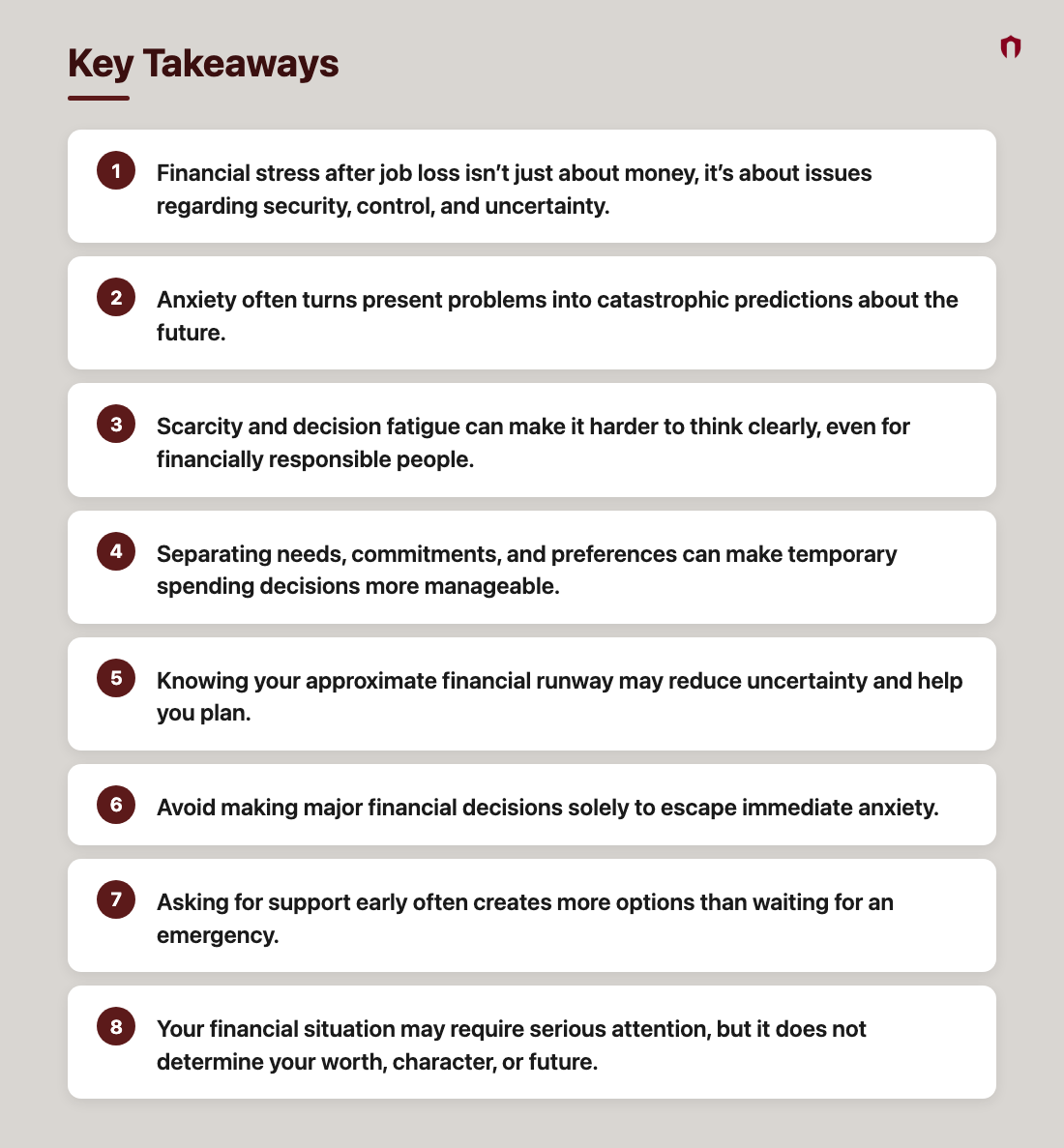
Financial stress after job loss is therefore not simply about the amount of money in a bank account. It is also about the fear of losing control.
Why Financial Stress Feels So Threatening
Money is connected to nearly every area of life. It influences where we live, what we eat, how we access healthcare, what activities we can participate in, and how much freedom we feel we have. It may also affect whether we can support children, partners, parents, or other family members.
When income is disrupted, the brain may begin scanning for everything that could go wrong:
“What if I can’t make rent?”
“What if I lose my insurance?”
“What if I have to move?”
“What if I disappoint my family?”
“What if I never earn what I used to?”
“Will I be paying off this debt forever?”
This response is partly protective. Your brain is trying to identify risks and prepare you to respond. However, while anxiety may help us recognize genuine concerns, it can also begin producing worst-case scenarios faster than we can realistically solve them. A temporary financial disruption can start to feel like permanent ruin. The distinction between a financial problem and a financial catastrophe may become difficult to maintain when anxiety is high.
The Difference Between a Problem and a Prediction
After losing a job, you may have legitimate financial problems that need attention.
For example:
These are real problems. However, anxiety often turns those problems into predictions:
“I’m going to lose everything.”
“I’ll never recover financially.”
“No one will hire me.”
“I’m going to be a burden forever.”
A problem describes what is happening now, a prediction claims to know what will happen next. That distinction matters because people often respond emotionally to the imagined future as though it is inevitable. The body enters a state of panic not only because of the current financial disruption, but because of every possible outcome the mind has attached to it.
I’m not suggesting you dismiss legitimate concerns or force yourself to “think positively.” The idea is to separate what is currently true from what fear is predicting.
Instead of saying:
“I’m going to lose everything.”
Try:
“My income has changed, and the next right step that’s in my control is to make a short-term financial plan.”
The second statement does not minimize the problem. It makes the problem more specific, and specific problems are easier to address than general fears.
Scarcity Mindset
Financial stress can create what can be described as a scarcity mindset.
When people feel that an essential resource (money, food, time, etc.) is limited, the brain naturally focuses more attention on that resource. When money feels scarce, financial concerns may occupy a significant amount of mental space.
You may find yourself repeatedly:
This heightened focus can be productive if needed in the short term. It could motivate you to review expenses, apply for benefits, or seek new work. But prolonged scarcity can narrow your attention so much that it becomes harder to think clearly, plan effectively, and consider long-term options.
Survival mode takes up a lot of mental bandwidth. And believing that the world is ending and that you’ll never recover from financial difficulty tells your brain that survival mode is necessary.
In short, what we’re trying to avoid is financial stress hijacking your cognitive and emotional resources that would normally be available for rational decision-making.
Financial Stress and Decision Fatigue
Job loss often creates an immediate series of decisions:
Which expenses should I reduce?
Should I use my savings?
Should I accept the first available job?
Should I withdraw money from a retirement account?
Should I move?
Should I ask someone for help?
Should I cancel insurance or subscriptions?
Should I change my career entirely?
Each decision may feel high stakes, especially when the future is uncertain. Over time, this can lead to decision fatigue - the mental exhaustion that comes from making too many choices under pressure.
When decision fatigue develops, people may respond in several ways:
Financial decisions after job loss rarely come with complete certainty. We can’t and don’t need to predict the future perfectly. All we can do is make the best decision possible with the information that’s available to us at the time.
A good short-term decision may eventually need to be adjusted. Psychological flexibility and the willingness to have an adaptable plan as information grows and changes is critical to all situations, particularly financial difficulties.
The Urge to Solve Everything Immediately
Financial stress often creates urgency. You may feel as though every problem must be solved today:
You need a new job immediately.
You need to replace your full salary immediately.
You need to know exactly how long unemployment will last.
You need to know whether your career will recover.
You need to restore financial stability before you can relax.
Again, some issues may genuinely require quick action, so the sense of urgency can be productive. However, the pressure to solve your entire future immediately can increase panic and lead to poor decisions. It’s also an unrealistic expectation, leading to failure and the negative thoughts that come with that.
Recovery is usually better approached in stages.
For example:
Immediate priorities
In other words, stop digging.
Short-term priorities
Longer-term priorities
Breaking the problem into stages reduces the feeling that everything must be solved at once.
Shame and Financial Stress
Money is not just practical, it’s often deeply emotional. Many cultures connect financial success with responsibility, competence, independence, and personal worth. Because of this, losing income can create shame that goes far beyond the numbers.
You may feel embarrassed that you can’t spend as freely as before, and the people around you know it.
You may avoid telling people that you lost your job to avoid the judgment or sympathy.
You may feel guilty if a partner or family member temporarily takes on more financial responsibility.
You may compare yourself with friends who appear more professionally or financially stable.
You may even interpret needing help as evidence that you have failed.
But experiencing financial difficulty after losing a job or incurring an unexpected debt is not a moral failure. A change in employment does not erase your work ethic, intelligence, accomplishments, or ability to contribute. It just means that your financial circumstances have changed and may require temporary adjustments.
Needing support during a difficult period does not make you irresponsible. Human beings regularly depend on one another during illness, grief, parenthood, relocation, career changes, and other major life transitions.
Job loss is no different.
Focus on the Financial Runway
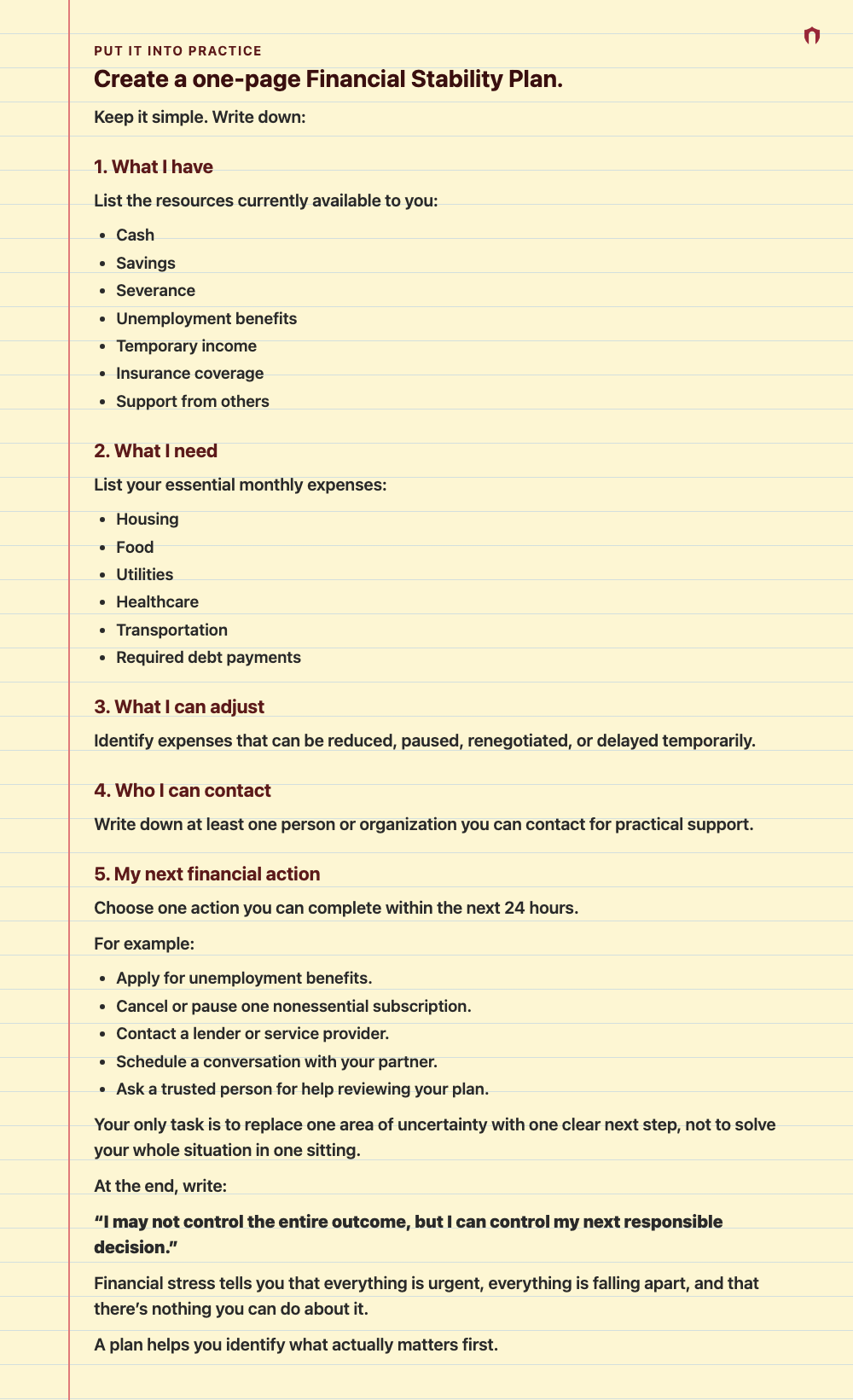
A helpful way to approach financial uncertainty is to think in terms of your financial runway. Using the analogy of an airplane landing, the pilot knows how long of a runway it has to land the plane. When the runway is getting shorter and shorter (your finances are running lower and lower), more immediate action is necessary. Your runway is the amount of time your current resources may support your essential expenses while you determine what comes next.
The purpose of estimating your runway is not to frighten you. It is to replace vague uncertainty with clearer information.
You don’t need a perfect projection. Even a basic estimate can transform:
“I have no idea what’s going to happen.”
into:
“At my current essential spending level, I have approximately this much time to make adjustments.”
Clarity does not eliminate stress, but it often reduces uncertainty. And remember, one of the main 3 triggers for anxiety is lack of predictability. Identifying what your runway is can reduce anxiety that comes from lack of clarity.
Needs, Commitments, and Preferences
When reducing expenses, it can help to divide spending into three categories.
Needs
These are expenses connected to basic safety and functioning:
Commitments
These are obligations that may not be basic survival needs but still have legal, financial, or relational consequences:
Preferences
These are valuable or enjoyable but potentially adjustable in the short term:
This framework is not intended to shame anyone for enjoying life. Nor does it mean that every nonessential expense must be removed. It creates a hierarchy.
When people are highly anxious, they sometimes make reductions randomly. Categorizing expenses can help direct attention toward decisions that meaningfully extend financial stability.
Avoiding Financial Self-Punishment
After job loss, some people move from responsible adjustment into self-punishment. They may believe they no longer deserve anything enjoyable because they are not earning money. They may refuse every social invitation, eliminate small activities that support their mental health and well-being, and feel guilty spending any amount on themselves.
Responsible financial changes may be necessary, but total deprivation can increase depression, isolation, and hopelessness - especially if unemployment lasts longer than expected.
Whenever possible, a temporary financial plan should preserve some low-cost sources of well-being:
The goal is to reduce unnecessary spending, not to remove every source of meaning or enjoyment from life. A sustainable plan is going to be more effective than an extreme one.
The Danger of Panic-Driven Decisions
Financial fear can create pressure to take drastic action for immediate relief.
Examples might include:
Some difficult decisions may eventually be necessary, but panic reduces your ability to evaluate tradeoffs. Before making a major financial decision, pause and ask:
Relief and resolution are not always the same thing.
Ask for Help Early
Don’t wait until a financial (or any) situation becomes an emergency before reaching out for assistance. Shame may lead you to hide the problem, ignore correspondence, or pretend that everything is manageable.
Earlier communication (like seeking medical advice right when you notice something is wrong) often creates more options.
The exact resources or professionals to reach out to will differ by your situation and location. However, the general principle is consistent: A financial problem is usually easier to address before it becomes a financial emergency.
Asking for support is not surrendering control. It’s actually taking control by using the resources available to protect yourself and the people who depend on you.
Protecting Your Mental Health
Financial stress can affect nearly every part of psychological functioning.
Struggling with your mental health due to financial difficulty will often make it more difficult to solve the problem. A person who is sleeping poorly and experiencing constant anxiety will likely find it harder to manage money, apply for jobs, and make sound decisions.
Mental health support is not a luxury unrelated to the financial problem. It may improve your ability to respond to that problem effectively.
Helpful strategies may include:
You deserve periods of the day when you are not actively solving unemployment. Constant worry is not the same as productive planning.
Communicating With a Partner or Family
Job loss rarely affects only one person. Partners and family members may also feel anxious about finances, roles, responsibilities, or the future. When these fears remain unspoken, they may emerge as criticism, defensiveness, withdrawal, or conflict.
Healthy communication may involve discussing:
Financial transparency is important, but discussing money constantly can become emotionally exhausting. Some couples benefit from scheduling specific financial check-ins rather than allowing the topic to dominate every conversation (this is a great strategy with any difficult topic).
You are still partners, family members, and human beings, not merely people managing a crisis.
When Financial Stress Becomes a Mental Health Emergency
Financial concerns can become so overwhelming that a person begins to feel trapped or hopeless. In fact, people who describe their financial situation as “hopeless” or report large amounts of debt are more likely to experience suicidal ideations.
Seek immediate support if financial stress contributes to:
Financial situations can change, even when they feel impossible in the moment. Your income, debt, job status, or bank balance does not determine the value of your life.
In the United States, you can call or text 988 to reach the Suicide & Crisis Lifeline. If there is immediate danger, call emergency services or go to the nearest emergency department.
Moving From Panic to a Plan
The goal of managing financial stress is not to eliminate every concern immediately, it’s to move gradually from:
Uncertainty → Clarity
Panic → Focusing on Priority Hierarchy
Helplessness → Action
Shame → Support
You may not be able to restore your previous income today, and you may not know exactly when you’ll feel financially secure again, but you can gather information, identify priorities, make temporary adjustments, and take one responsible step at a time.
Financial stability is rarely rebuilt through one perfect decision, it’s rebuilt through a series of reasonable decisions made consistently over time.
Key Takeaways
🧠 Your Mental Playbook
One Thing to Remember
Financial stress becomes more manageable when you turn panic and uncertainty into a well-informed plan with support from others.
You may not be able to control exactly when you will find another job or what unexpected costs may arise, but you can identify what’s true today, determine what needs attention first, and take one reasonable action at a time.
Having an informed plan reminds your brain that you are not powerless.
Reflect
Take a moment to consider your current relationship with financial stress.
Ask yourself:
Which of my financial concerns are current problems, and which are predictions about the future?
Am I avoiding my finances, or checking them so frequently that it increases my anxiety?
What expenses are genuine needs, important commitments, and adjustable preferences?
Is shame preventing me from asking for support or discussing the situation honestly?
Try to answer these questions without judging yourself.
Put It Into Practice
“Start where you are. Use what you have. Do what you can.” — Arthur Ashe
Everyone’s Financial Story is Different
Every person enters a relationship with a different history of experiences and beliefs about money. One person may have grown up in a household where bills created constant anxiety, so saving may therefore represent protection and stability.
Another may have grown up in a home where money was available but rarely enjoyed, so spending on meaningful experiences may represent freedom and quality of life.
One person may believe that supporting relatives is a basic family responsibility. Another may believe that adults should generally be financially independent.
Neither perspective is inherently right or wrong. The problem begins when people assume that their own approach is “obviously” reasonable and the other person’s approach reflects irresponsibility, selfishness, or control.
Financial behavior often makes more sense when we understand the history behind it.
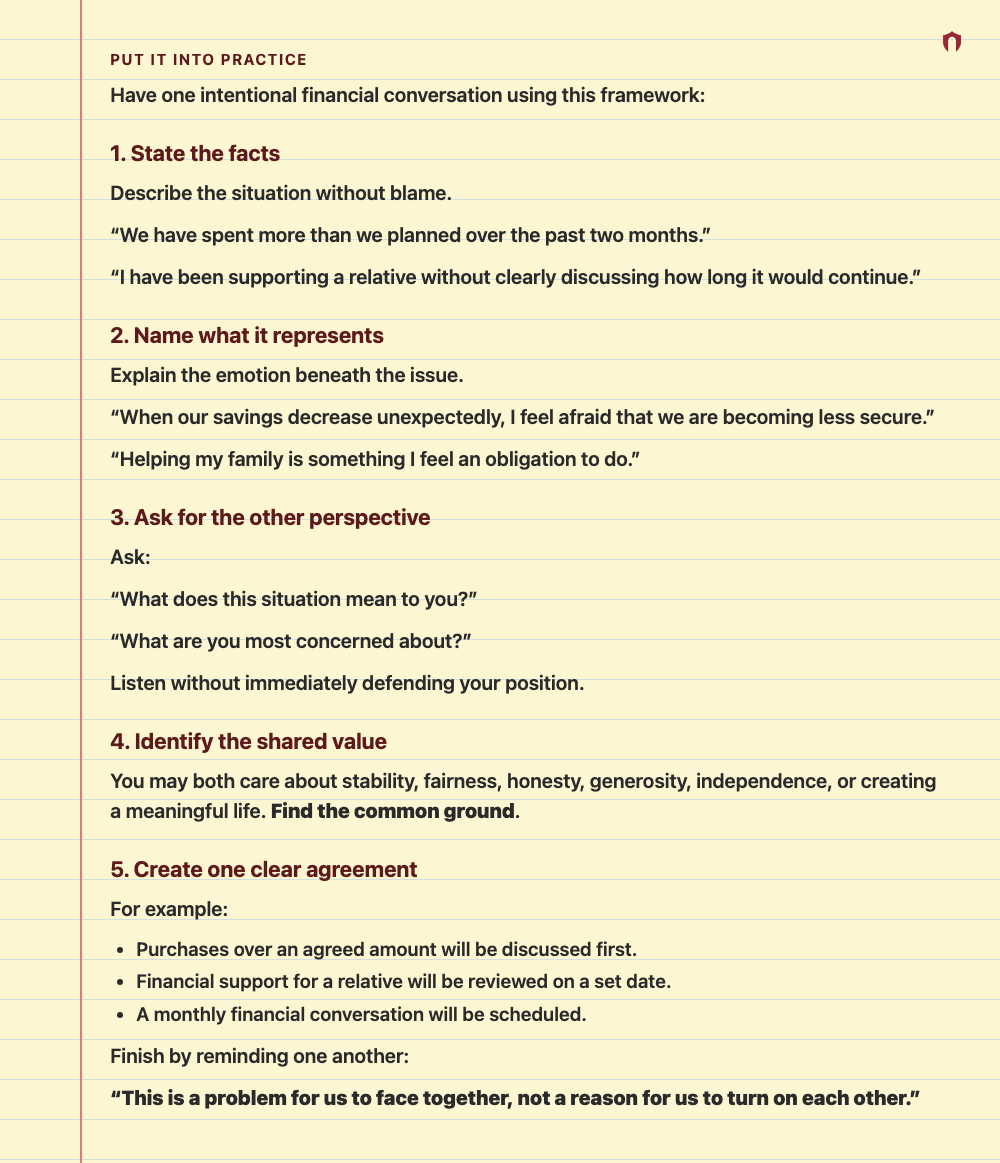
When you and your partner are discussing money, helpful questions to further understanding could be:
Understanding another person’s financial story doesn’t mean agreeing with every choice or belief. It just allows each person to respond with greater curiosity and less judgment.
When Money Becomes a Symbol
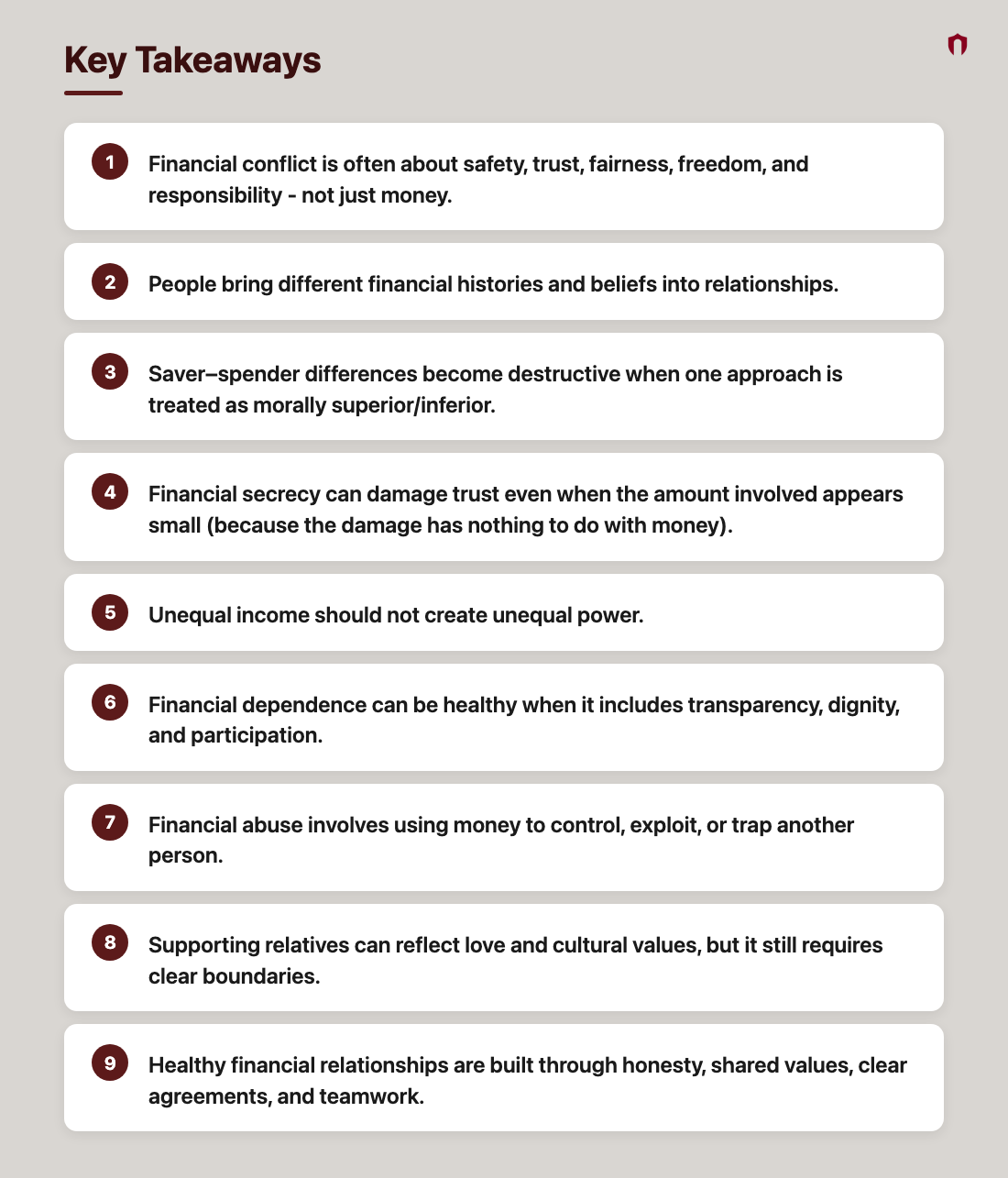
Financial conflicts are rarely only about numbers.
Imagine that one partner makes a purchase without discussing it. That person may think:
“It wasn’t very expensive. Why is this such a big issue?”
The other person may experience the purchase as:
“You made a decision that affects both of us without considering me.”
The conflict is no longer only about the item or about money at all. It’s about respect, trust, and shared responsibility.
Similarly, one person may become upset when their partner gives money to a relative. Underneath the disagreement may be questions such as:
When a financial disagreement feels unusually intense, ask:
“What does this situation represent to each of us?”
The emotional meaning may be more important than the amount of money itself.
The Saver–Spender Cycle
Some couples describe their financial labels as “savers” and “spenders.”
These labels can be useful, but they also oversimplify the issue.
The saver may be trying to create:
The spender may be trying to create:
Every bullet point in both categories is seemingly positive. Problems in relationships develop when either person treats their preference as morally superior.
The saver may describe every unnecessary purchase as irresponsible. The spender may dismiss every financial concern as controlling or overly anxious.
Couples must create a system that provides enough security for one person and enough flexibility for the other. Healthy compromise might include shared savings goals, agreed spending limits, and some personal money that each person can use without criticism or permission.
Financial Communication
Again, your ability and willingness to discuss money is likely rooted in how you were raised and the examples your parents set.
Some grew up in homes where finances were secret. Others watched financial conversations turn into criticism, fear, or conflict. As adults, they may avoid discussing money until a problem becomes urgent.
Healthy financial communication involves more than sharing account balances. It includes discussing:
Healthy communication sounds like:
“I feel anxious when I don’t understand where we stand.”
“I want us to enjoy our money, but I also need to feel prepared.”
“Helping my family matters to me, but I understand that it affects both of us.”
Unhealthy communication often includes blame, secrecy, lecturing, keeping score, or using past mistakes as weapons.
Conflict in relationships is not inherently bad. With something as important and emotional as money can be, it’s important to create an environment that is safe to have disagreements, leading to honesty and productive dialogue.
Financial Secrecy and Trust
People sometimes hide financial information because they fear judgment, conflict, or loss of independence.
Not every private purchase or separate account is dishonest. People can reasonably agree to maintain individual accounts or personal spending money. The question is whether someone is intentionally hiding information that affects another person or the shared financial future of the relationship.
Financial secrecy can cause significant damage because, again, the violation is not actually about money. It creates the belief:
“I cannot trust you to tell me the truth.”
Repair requires more than an apology. It often involves full disclosure, accountability, clearer agreements, and consistent transparency over time.
Understanding why someone hid the information may be important, but it does not erase the impact.
Unequal Income, Dependence, and Power
Many relationships involve unequal incomes. One person may earn more because of their profession, opportunities, work hours, health, caregiving responsibility, education, or a huge range of other factors.
Unequal income does not need to create an unequal relationship. Problems arise when the higher earner begins to believe:
“I make more, so I should have more control.”
The lower earner may begin to feel:
“I need permission because this is not really my money.”
This becomes especially complicated when one person contributes through unpaid labor such as childcare, household management, caregiving, or supporting the other person’s career. Income is one form of contribution, but it’s far from the only one.
Healthy relationships recognize both financial and nonfinancial contributions. They also ensure that both adults understand important financial information and have an appropriate voice in decisions that affect them.
Financial dependence may occur during parenthood, illness, unemployment, education, disability, or career transition. Receiving support during one stage of life does not make someone less capable or valuable.
Healthy dependence includes transparency and shared understanding. Unhealthy dependence involves fear, exclusion, or control.
Financial Abuse in Relationships
Financial disagreements are normal, but abuse is not. Financial abuse involves using money or access to resources to control, exploit, intimidate, or trap another person.
Examples include:
The defining issue is not budgeting or accountability. It is coercive control.
Someone experiencing financial abuse may need confidential support from a domestic violence organization, therapist, legal advocate, or trusted person. Confronting an abusive partner without a safety plan may increase risk.
Job Loss and Income Changes
Job loss, reduced hours, or a major decrease in income can affect an entire household.
The person who lost income may experience:
Their partner or family may experience:
Both experiences can be valid at the same time.
Conflict often develops because comments are interpreted through stress and insecurity.
“Did you apply anywhere today?”
may be heard as:
“You are not trying hard enough.”
“I need a break from talking about jobs.”
may be heard as:
“I don’t care that you are carrying this burden.”
Clear expectations can reduce misunderstanding. Families may need to discuss spending changes, household responsibilities, job-search expectations, emotional support, and how often progress will be reviewed.
The person who lost work needs compassion. The person carrying additional pressure needs assurance and a plan.
Divorce and Separation
Divorce and separation create emotional and financial disruption at the same time. A person may be grieving the relationship while also facing decisions about housing, shared debt, dividing assets, child support, insurance, and retirement accounts (just to name a few).
Financial concerns may intensify anger, fear, and conflict. Money or property may also carry symbolic meaning.
A house may represent security. A retirement account may represent years of sacrifice. A possession may represent the life the couple built together.
During intense grief or anger, people may make financial decisions primarily to punish, escape, or gain control. Legal, financial, and mental health professionals can help separate emotional meaning from long-term decision-making.
Divorce may require rebuilding both an emotional life and a financial life. Neither can be rebuilt all at once, or without appropriate support.
Supporting Relatives Financially
Many people feel responsible for providing money to assist aging parents, adult children, siblings, or other relatives experiencing illness, unemployment, debt, or housing instability.
In some families and cultures, this support is a central responsibility rather than an optional act of generosity. Helping can be meaningful, but it may also create guilt, resentment, ongoing dependence, and pressure to hide personal financial struggles.
The central question is often:
How do I care for people I love without sacrificing my own stability?
Helpful questions include:
Setting financial boundaries, like any other boundary-setting in relationships, feels difficult at first, but provides a healthy understanding and shared respect in the relationship moving forward.
Building Shared Financial Values
People in healthy relationships do not need identical financial personalities, but they need a willingness to discuss and decide on financial matters together.
Important conversations may include:
A healthy financial partnership doesn’t require constant agreement, but both parties need to be able to express concerns, admit mistakes, set boundaries, and make decisions.
The relationship should remain more important than winning a financial argument.
Key Takeaways
🧠 Your Mental Playbook
One Thing to Remember
The problem is rarely just about money, it’s what the money represents between you in that moment.
A financial disagreement may represent fear, trust, fairness, freedom, power, appreciation, or security. You cannot resolve every money conflict by focusing only on the numbers.
Sometimes the most important question is:
“What does this situation mean to each of us?”
Reflect
Think about one relationship in which money has created tension.
Ask yourself:
What financial issue appears on the surface?
What does it represent to me emotionally?
What might it represent to the other person?
Do I tend to avoid, control, criticize, hide, rescue, or keep score?
Is there information I have been afraid or ashamed to share?
Am I supporting someone because I choose to, or because I feel unable to say no?
What conversation, boundary, or agreement could make this relationship healthier?
Put It Into Practice
“The hardest part of a job search isn’t always the waiting. It’s resisting the urge to turn uncertainty or rejection into a judgment about yourself.” — Zack Etter/Mental Fitness Lounge
Work one-on-one with Zack to build a plan tailored to your situation.