
Understand addiction, explore recovery pathways, and build tools for lasting change.
A personal welcome and overview of this playbook from Zack.
Introduction
Addiction is often misunderstood as a failure of willpower. People may look at someone whose substance use is causing obvious harm and wonder:
“Why don’t they just stop?”
The person experiencing the addiction may ask themselves the same question. They recognize that the behavior is harming their health, relationships, finances, career, and self-respect. They may sincerely promise to change, stop temporarily, and then find themselves returning to the same pattern.
This can create shame and confusion:
“Why do I keep doing something I know is hurting me?”
“Why can’t I control this anymore?”
Addiction isn’t intentional. It may begin with curiosity, recreation, social connection, pain relief, increased confidence, better focus, emotional escape, or the desire to feel different for a while.
At first, the substance or behavior may appear to work. It may reduce anxiety, numb painful memories, create excitement, relieve loneliness, increase energy, or make social situations easier. The brain learns that this experience provides a fast and reliable change in emotional state.
But over time, what began as a source of pleasure or relief can become increasingly necessary, automatic, and difficult to control.
Addiction is now understood as a treatable health condition shaped by interactions in brain processes, genetics, environment, development, and life experiences.
It’s not simply a moral failure or lack of character.
What Is Addiction?
Addiction is when a person repeatedly uses a substance or engages in a behavior despite predictable and consistent harm, and experiences increasing difficulty controlling it.
It may involve:
Not every person who uses a substance develops an addiction, and not every unhealthy decision means someone has a disorder.
The concern is the broader pattern: the behavior becomes increasingly difficult to regulate and continues even as its costs become clear.
Clinical substance-use disorders exist on a spectrum. They can be mild, moderate, or severe depending on the number of symptoms and the severity of their impact, rather than being divided neatly into “addicted” or “not addicted.”
You don’t need to reach complete collapse before a pattern deserves attention.
Addiction Often Begins as an Attempted Solution
Many addictive patterns initially served a logical purpose.
A substance or behavior may help someone:
This doesn’t mean everyone who uses substances is secretly traumatized or self-medicating. Some begin through experimentation, social influence, celebration, habit, or pleasure.
Repeated use becomes more understandable when we ask:
“What was this accomplishing for the person initially?”
rather than just:
“Why would they make such a bad choice?”
The initial effect may have been genuinely helpful in the short term.
The problem is that short-term relief can reinforce a behavior even when its long-term consequences become harmful.
This leads to one of the most important ideas in understanding addiction:
Addiction often begins as an attempted solution before it becomes a problem of its own.
The solution gradually changes the problem it was meant to solve.
The Cycle of Reinforcement
The idea of “reinforcement” is that behavior becomes more likely to repeat when it produces a rewarding result.
There are two major ways this can happen.
Positive Reinforcement
Positive reinforcement occurs when the behavior rewards the person by adding a desirable experience.
For example, in a completely typical way, someone might go to work (the behavior) because they make money doing so (the positive reinforcement). If it weren’t for getting a paycheck, you’d be less likely to show up for work, right?
A person may use a substance and feel:
The brain learns:
“Do that again to feel good.”
Negative Reinforcement
Negative reinforcement occurs when the behavior removes or reduces an unpleasant experience.
A person may use and feel temporary relief from:
The brain learns:
“Do that again to stop feeling bad.”
This distinction helps explain why addiction can continue even after the original pleasure has faded. At first, the person may use primarily to feel good. Later, they may use primarily to avoid feeling bad.
The Addiction Cycle
Although every person’s experience is different, addictive patterns often follow a recognizable cycle:
Trigger → Craving → Use or behavior → Temporary pleasure or relief → Consequences → Distress → New trigger
A trigger may be just about anything – a person, place, emotion, sensation, memory, boredom, money, lack of money, certain relationships, etc.
The trigger activates anticipation. The person begins imagining the relief or reward that the substance may provide. This creates craving and narrows attention toward immediate use.
Afterward, the person may experience temporary relief followed by guilt, financial problems, health effects, shame, embarrassment, increase in anxiety or depression, etc.
Those consequences create additional emotional distress, and that distress then becomes the next trigger.
How the Brain Learns the Pattern
The brain is designed to learn from rewarding experiences.
Natural rewards such as food, connection, achievement, and sex help reinforce behaviors important to life and survival.
Addictive substances can strongly engage the brain systems involved in reward, motivation, learning, and memory. With repetition, the brain becomes increasingly attentive to the substance and to the people, places, and emotions associated with it.
This learning can make cues feel really powerful. A neighborhood, song, smell, payday, argument, or social group may trigger intense desire even after someone has decided to stop.
The person may intellectually understand the consequences while experiencing a strong learned expectation:
“This will make me feel better right now.”
In these instances addiction creates a conflict between immediate reward and long-term values.
Someone can value family, health, honesty, and stability while repeatedly choosing the behavior that threatens them. This doesn’t mean those values have disappeared, it means immediate cravings and learned patterns have temporarily overpowered them.
Craving
Craving is a strong desire or urge to use. It can be triggered by withdrawal, stress, a memory, availability, social cues, or anticipation of reward. It can feel physical, emotional, mental, automatic, urgent, and overwhelming.
Cravings narrow your attention. Someone with a craving may only be able to focus on obtaining relief, while consequences that mattered earlier become less emotionally powerful.
They may think:
“Just this once.”
“I’ll deal with the consequences tomorrow.”
“I need this.”
Craving is one recognized symptom of substance-use disorders, but having a craving doesn’t mean you are powerless against it. Urges rise, change, and eventually pass. Recovery involves learning how to respond during the period when the craving feels most convincing.
Genetics and Family History
Addiction can run in families, but this doesn’t mean there is one “addiction gene.”
Genetics can affect:
Family influence is also environmental. Children may learn:
A family history can increase risk, but it doesn’t make addiction inevitable.
Stress, Trauma, and Emotional Pain
Substance use may become especially reinforcing when it provides rapid relief from distress.
Someone living with trauma, anxiety, depression, grief, shame, chronic stress, or loneliness may discover that a substance or behavior changes their internal state faster than healthier strategies do.
Therapy, relationships, sleep, exercise, and gradual coping skills take time. A substance can produce a noticeable effect within minutes.
Over time, the person may have fewer opportunities to learn how to tolerate emotions, seek support, solve problems, or regulate distress in other ways.
Even though addiction can create serious harm, its effectiveness to deal with distress in the short term can make it a dominant coping strategy.
Mental health conditions and substance-use disorders can also interact in both directions: emotional difficulties may contribute to substance use, while substances can create or worsen psychiatric symptoms.
Adolescence and Early Exposure
Adolescence is a period of significant brain development, identity formation, experimentation, and increased sensitivity to reward and peer influence.
Early substance use doesn’t guarantee addiction, but exposure during childhood or adolescence can increase later risk, particularly when combined with trauma, family history, easy access, or other vulnerabilities.
Young people also tend to underestimate or not care much about long-term consequences because the immediate social or emotional reward feels more important.
Because of this, unlike common school programs, prevention is most effective when it goes beyond fear-based warnings.
Young people benefit from:
Awareness and connection make honest conversations more possible.
Tolerance
Tolerance means needing more of the substance - or a stronger form of the behavior - to achieve an effect that once occurred with less.
The person may notice:
An increase in tolerance leads to escalation, and is therefore an important warning sign.
Tolerance and addiction are related, but not always the same thing. For example, some people develop physiological tolerance to prescribed medication even when taking it appropriately. Addiction involves the larger pattern of impaired control, craving, continued use despite harm, and disruption of functioning.
Physical Dependence and Withdrawal
Physical dependence occurs when the body adapts to the repeated presence of a substance. When use is reduced or stopped after someone has become dependent on it, withdrawal symptoms begin.
Depending on the substance, symptoms can include:
Withdrawal can powerfully reinforce continued use through negative reinforcement (using gets rid of the sickness).
Similar to tolerance, physical dependence and addiction can overlap, but they’re not always the same thing. Someone can become physically dependent on certain prescribed medications without compulsively misusing them. Someone can also experience serious addictive behavior without obvious physical withdrawal (gambling is a common example).
Suddenly stopping heavy or prolonged use of alcohol or certain sedative medications can be dangerous and may require medical supervision. Severe alcohol withdrawal can include seizures, and people concerned about withdrawal should seek medical guidance rather than assuming they can safely stop alone.
Loss of Control
One of the clearest signs that a pattern is taking hold is the growing gap between intention and behavior.
The person may:
They may still have moments of control, which can make the problem more confusing.
Someone may abstain for several days or weeks and conclude:
“I’m fine now.”
But the more meaningful question is what happens across time.
Can the person reliably control the pattern? Can they stop without repeatedly returning? Can they maintain limits without constant struggle? Has the substance become more influential than they can fight back against?
Recognizing the Warning Signs
Addiction doesn’t always look dramatic, especially when the substance or behavior is one that’s used or engaged with during typical life (food, sex, exercise, drinking).
Early warning signs may include:
One sign alone may not establish addiction. But the concern is the pattern of increasing priority, reduced control, and continued behavior despite predictable harm.
Why Shame Makes Addiction Stronger
Shame may seem like it should motivate change.
Often, it does the opposite. When people believe:
“I am weak.”
“I’m hurting everyone.”
“I ruin everything.”
they may become more likely to hide, isolate, avoid treatment, and return to the substance for relief from the shame itself.
This doesn’t mean removing accountability is a good strategy either. Addiction can lead to serious harm, and recovery requires honesty, responsibility, repair, and changed behavior.
But accountability says:
“My behavior has caused harm, and I need to do what’s in my power to address it.”
Shame says:
“I am the harm, and I am beyond help.”
One supports change, the other encourages escape.
Key Takeaways
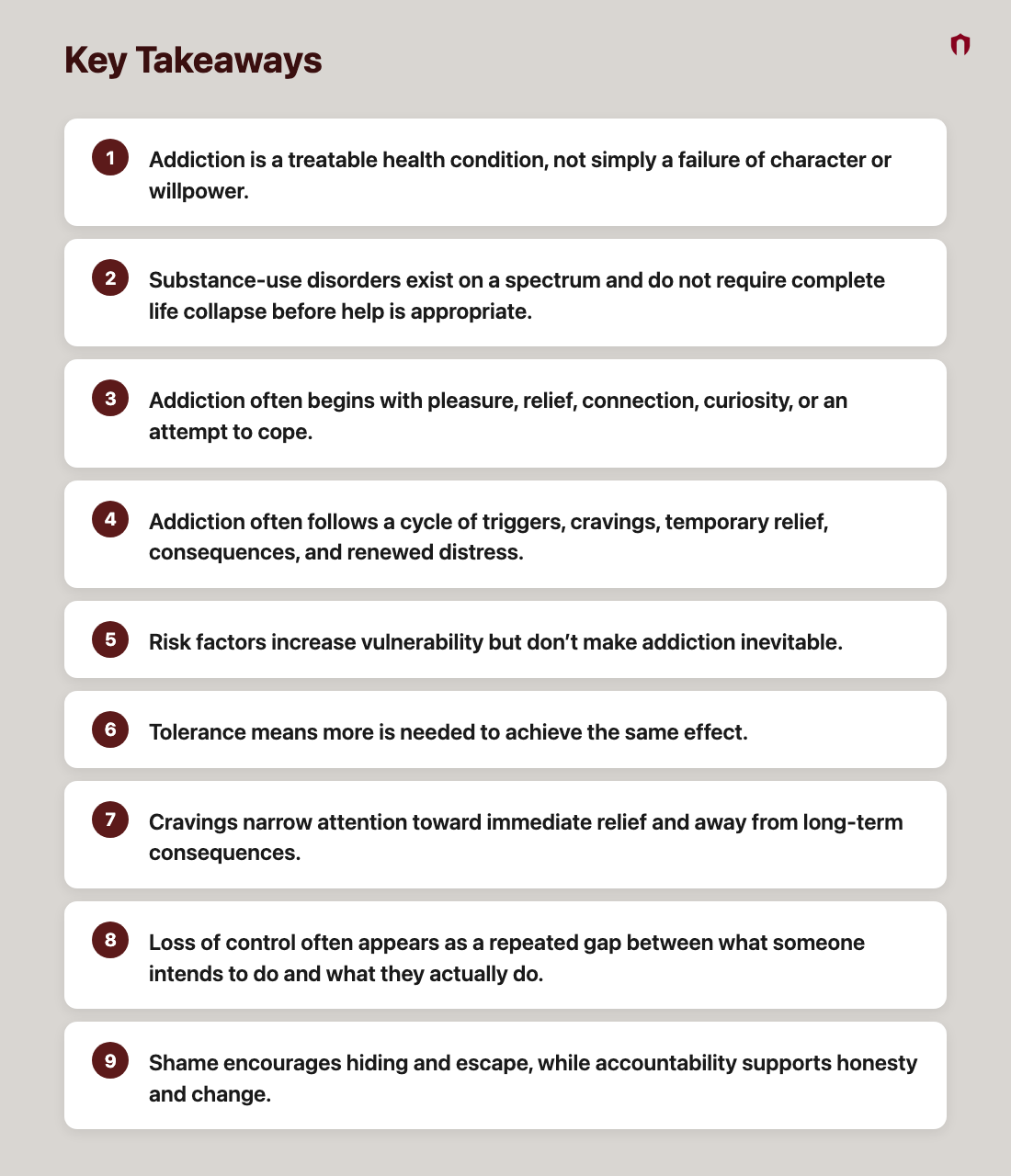
🧠 Your Mental Playbook
One Thing to Remember
Addiction isn’t calculated by the amount someone uses. It’s revealed by the growing distance between what they intend to do and what they feel able to control.
Reflect
Consider the role a substance or repetitive behavior may be serving.
Ask yourself:
When I started, was I seeking pleasure, relief, confidence, energy, numbness, or belonging?
Which emotions or situations most often trigger the urge?
Have I needed more over time to achieve the same effect?
Have I created rules and then broken them?
What parts of life receive less time or attention because of this pattern?
Am I hiding the full extent of the behavior?
Do I respond to setbacks with accountability, or with shame that drives me back toward escape?
Put It Into Practice
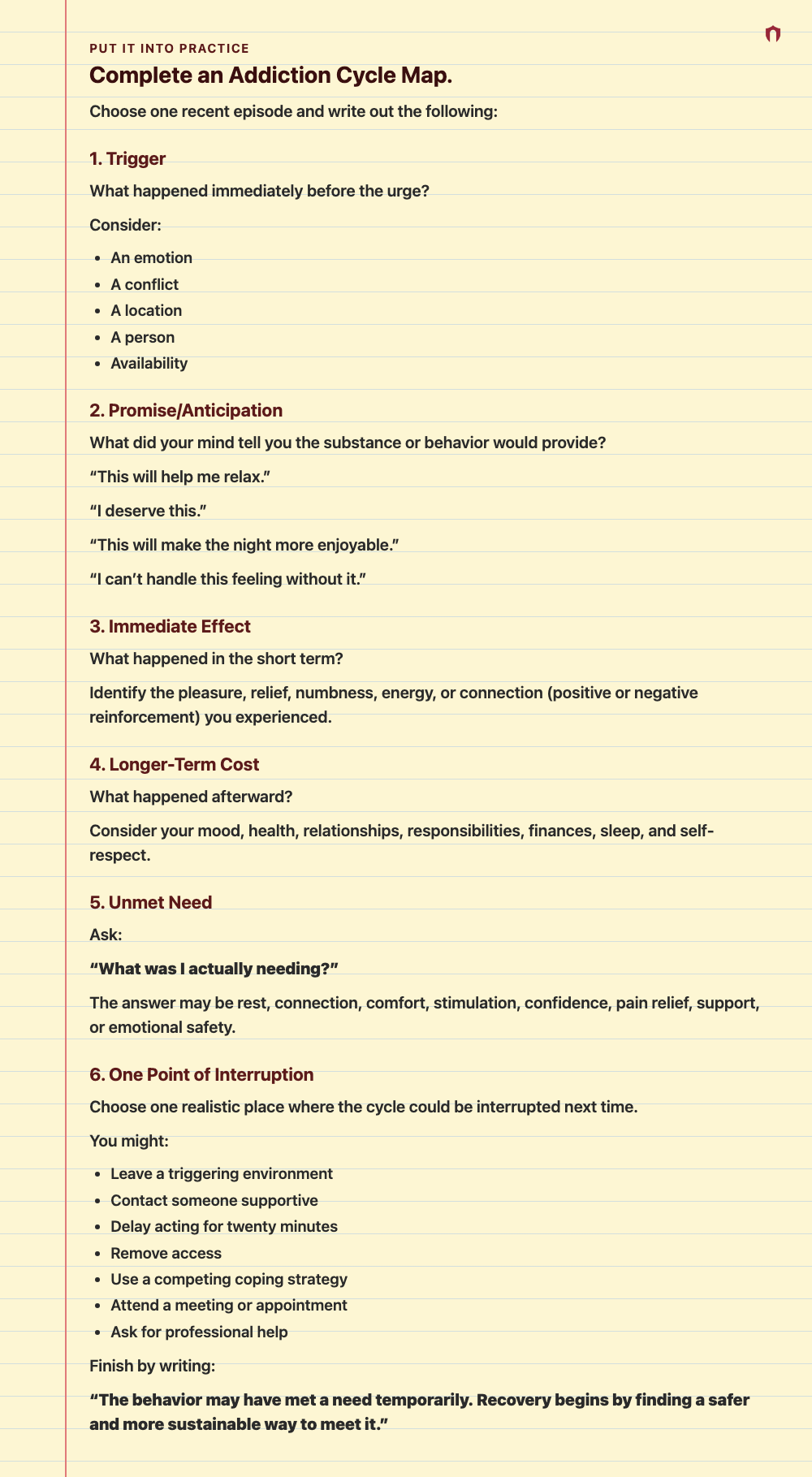
“The first step toward getting somewhere is to decide that you are not going to stay where you are.” — J. P. Morgan
Introduction
Addiction rarely affects only one part of a person’s life.
A substance may initially be used to change a feeling, solve a problem, or make an experience easier. Over time, however, the pattern can begin influencing:
These changes don’t happen in exactly the same way for everyone. The effects depend on factors such as the substance/behavior involved, amount and frequency of use, length of the pattern, age, physical and mental health, and whether multiple addictions are involved.
Some consequences are immediately visible. Others accumulate gradually. A person may continue functioning outwardly while privately experiencing cravings, anxiety, discomfort, conflict, shame, and secrecy.
The consequences may appear disconnected:
“I’m not sleeping because I’m stressed.”
“I’m falling behind because I can’t focus.”
“I’m using because everything feels so difficult.”
But the addiction likely is contributing to the very distress the person is trying to escape.
How Addiction Changes the Brain
The brain is constantly learning which experiences are important.
Normally, rewarding experiences such as food, connection, accomplishment, and intimacy reinforce behaviors that support survival and well-being.
Addictive substances can strongly activate systems involved in reward, motivation, learning, and memory. With repeated exposure, the brain may assign unusually high importance to the substance and to the people, places, emotions, and routines associated with it.
This can change what captures attention. The person may begin thinking frequently about:
Other rewards begin to feel less motivating by comparison. Activities that once provided satisfaction like relationships, hobbies, exercise, work, or ordinary relaxation now feel flat or require more effort.
This doesn’t mean the person no longer values those parts of life, it means the brain has learned to prioritize a faster and more powerful source of reward or relief.
Immediate Reward Versus Long-Term Consequences
Addiction can create a conflict between what feels urgent now and what matters over time.
The person may deeply value:
Yet when a craving becomes intense, immediate relief may feel more emotionally important than consequences that will occur later.
The person may think:
“I know this is hurting me, but I need to get through tonight.”
“I’ll deal with everything tomorrow.”
“One more time won’t matter.”
This isn’t simply a lack of knowledge or an indictment on their character. Many with addiction understand the consequences extremely well. The difficulty is translating that understanding into behavior while reward, craving, distress, and habit are competing for control.
The result is a painful gap between values and actions. That gap often produces shame, which can create even more desire to escape.
Motivation and Loss of Interest
As addiction becomes more central, motivation may shift. The person may have less energy or interest in activities that don’t provide immediate relief or reward.
They may stop:
Loved ones may interpret this as laziness or selfishness. Often, the issue isn’t that all values and interests have disappeared. The addiction has increasingly captured attention, time, energy, and motivation.
Life gradually (sometimes quickly) becomes smaller.
Emotional Regulation
When substances become the primary way someone changes how they feel, emotional regulation may become more difficult without them.
Instead of learning to:
the person may repeatedly use the fastest available strategy.
Over time, ordinary stress can begin to feel less manageable.
The person may think:
“I can’t relax without it.”
“I can’t sleep without it.”
“I can’t socialize without it.”
“I can’t handle this feeling sober.”
This belief can become self-reinforcing. The less someone practices responding to distress without the substance, the less confident they’ll feel in their ability to do so.
Because of this, recovery involves more than removing the substance. It requires rebuilding the skills and confidence needed to experience emotions without immediately escaping them.
Sleep and Energy
Sleep is frequently disrupted by addiction.
A substance may initially help someone fall asleep, remain awake, or feel more energetic. But over time, normal sleep rhythms become increasingly disturbed.
The person may experience:
Poor sleep affects mood, concentration, impulse control, appetite, and stress tolerance.
This creates another cycle:
Use → disrupted sleep → exhaustion and distress → more use to function or escape
What appears to solve the immediate sleep or energy problem may gradually make the overall pattern worse.
Appetite, Nutrition, and Self-Care
Addiction can interfere with basic physical care.
The person may:
Some substances suppress appetite. Others increase it or contribute to binge eating. Intoxication and withdrawal may also affect nausea, digestion, and the ability to prepare meals.
As self-care declines, physical discomfort can increase. That discomfort then just becomes another reason to use.
Relationships and Trust
Addiction can damage relationships even when the person doesn’t intend to hurt anyone.
Common patterns include:
Loved ones may become what the addicted person perceives to be overbearing or judgmental. Their partner may monitor behavior, search for substances, check finances, or attempt to determine whether they are telling the truth.
Both sides become trapped:
Use creates secrecy. Secrecy creates mistrust. Mistrust creates conflict. Conflict creates more desire to escape.
Addiction may accurately explain why someone is acting the way they are, but the label doesn’t erase the impact on others.
Recovery includes rebuilding trust through consistent behavior over time, not just through promises or apologies.
Family Roles and Overfunctioning
Addiction can reorganize an entire family. Other people may begin compensating for the person’s difficulties.
They may:
These actions often come from love and fear. But repeatedly protecting someone from every consequence can unintentionally enable the pattern to continue.
Family members may also neglect their own health, relationships, financial and emotional needs while trying to manage the addiction.
The problem no longer affects only the person using. Everyone begins adapting around it. Support for families may be important even when the person with the addiction is not yet willing to seek help.
Secrecy, Shame, and Isolation
As consequences increase, people often become more secretive.
They may hide:
Secrecy protects the addiction from interruption and protects the person from immediate shame.
But secrecy creates isolation, and isolation makes it easier for the pattern to continue.
The person may begin believing:
“No one would understand.”
“I have ruined everything.”
“I need to fix this before anyone finds out.”
That belief delays support.
Accountability requires honesty, but honesty becomes more possible when the person believes change is still available. Shame says there’s no point in trying because the person is fundamentally broken.
Recovery begins from a different premise:
Harm has occurred, but the person is still capable of responsibility, treatment, repair, and change.
Addiction and Identity
As addiction occupies more of life, the person’s identity may begin shrinking around it.
They may stop seeing themselves as:
Instead, they may define themselves entirely by their worst behavior.
“This is just who I am.”
That belief can become dangerous because people are less likely to fight for a future they no longer believe they deserve. Recovery involves separating identity from behavior.
Recovery Is Still Possible
The brain and body can adapt in harmful directions, but they also have the capacity for healing.
The same ability of the brain to learn and change contributes both to addiction and to recovery.
The timeline of recovery differs for everyone. When clients ask me how long it’ll take to kick the substance or behavior, my response is typically “it takes what it takes.”
Some changes occur quickly. Others take months or longer. Some consequences incurred may require ongoing treatment or may not be completely reversible. But the presence of damage doesn’t mean change is impossible.
Understanding the effects of addiction shouldn’t be used to create fear or hopelessness, it should clarify why support, treatment, and sustained change matter.
Key Takeaways
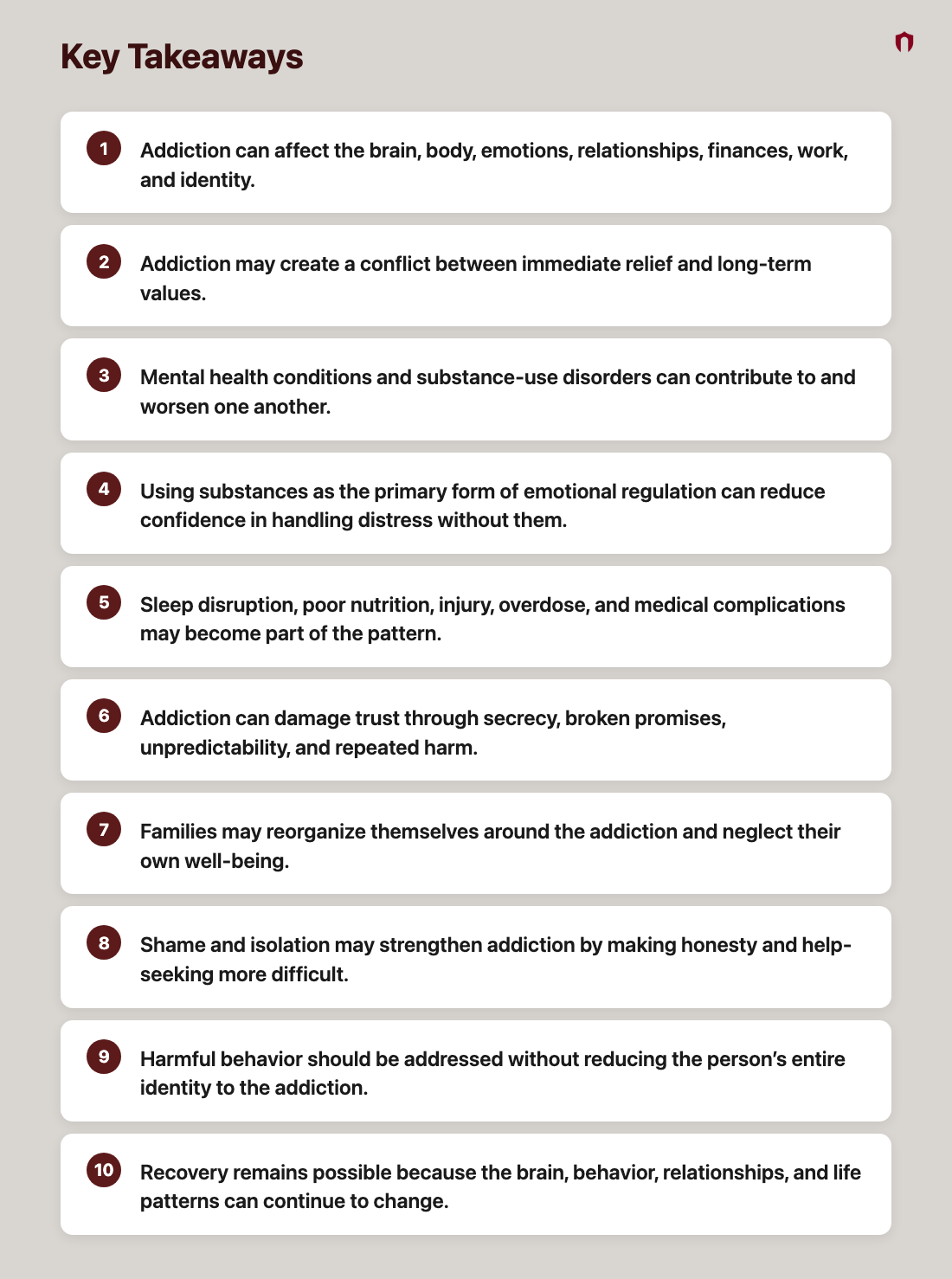
🧠 Your Mental Playbook
One Thing to Remember
Addiction convinces you that the relief it provides is more important than the life it is costing you.
That belief becomes stronger when consequences create more pain, and the same substance is used to escape that pain.
Breaking the cycle begins by seeing both sides clearly:
What does this give me right now?
and:
What is it gradually taking from me?
Reflect
Consider how the pattern may be affecting different areas of life.
Ask yourself:
Have activities that once mattered become less rewarding?
What emotions become stronger before, during, or after use?
What promises have I repeatedly made and broken?
Who has been affected by my secrecy, absence, or unpredictability?
What parts of my identity have become smaller?
Do I use the consequences of addiction as reasons to continue using?
What might begin returning to my life if this pattern changed?
Honest reflection is not meant to create humiliation, it’s meant to reveal the full cost of the cycle.
Put It Into Practice
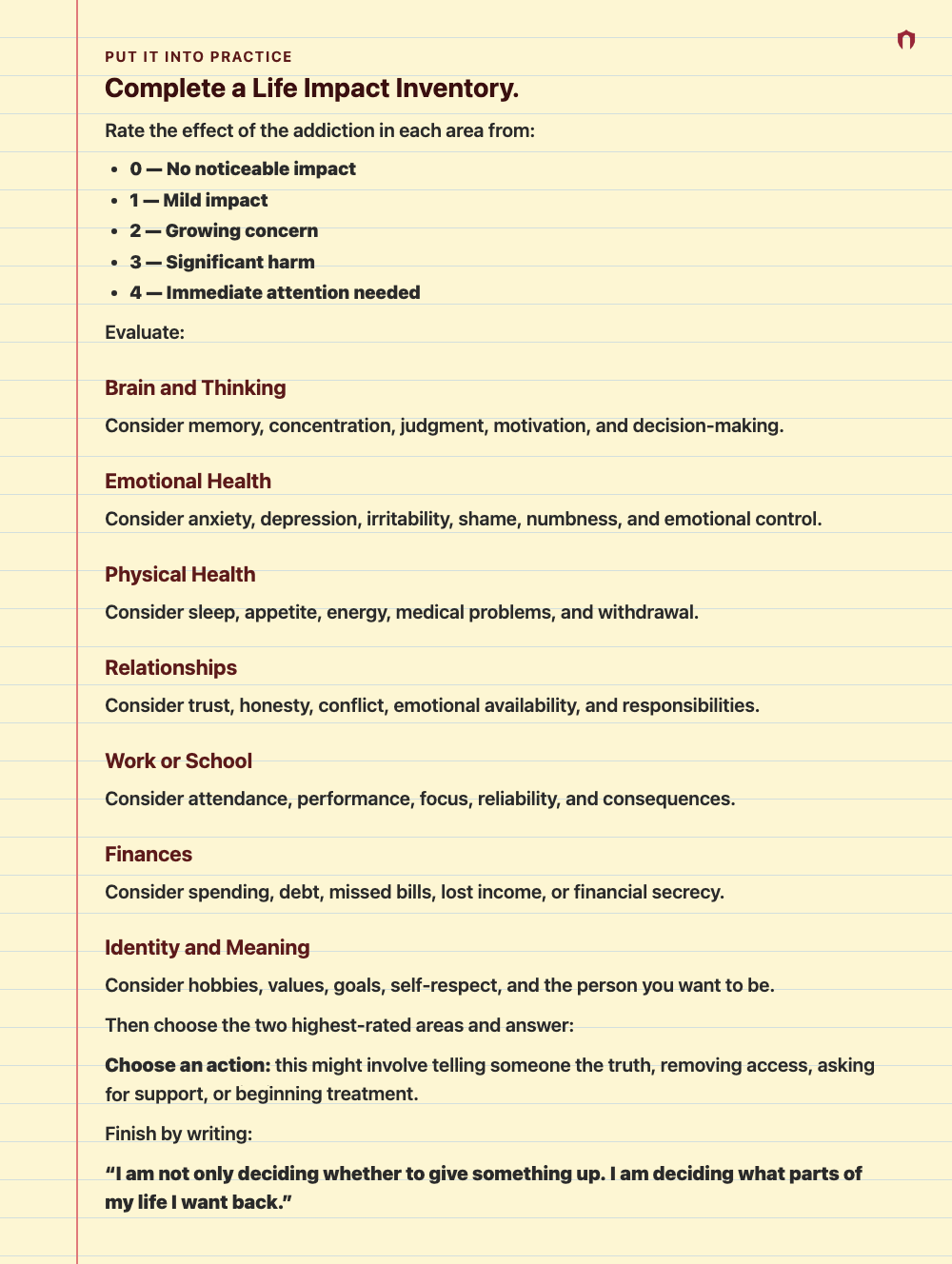
“You are not only walking away from what harmed you. You are walking back toward the parts of yourself you lost along the way.” — Zack Etter/Mental Fitness Lounge
Introduction
When people hear the word addiction, they often picture the most visible and severe forms of substance use. They may imagine someone who has lost a job, damaged relationships, experienced legal consequences, or become physically dependent on alcohol or drugs.
Those experiences are real, but they don’t represent every form or stage of addiction.
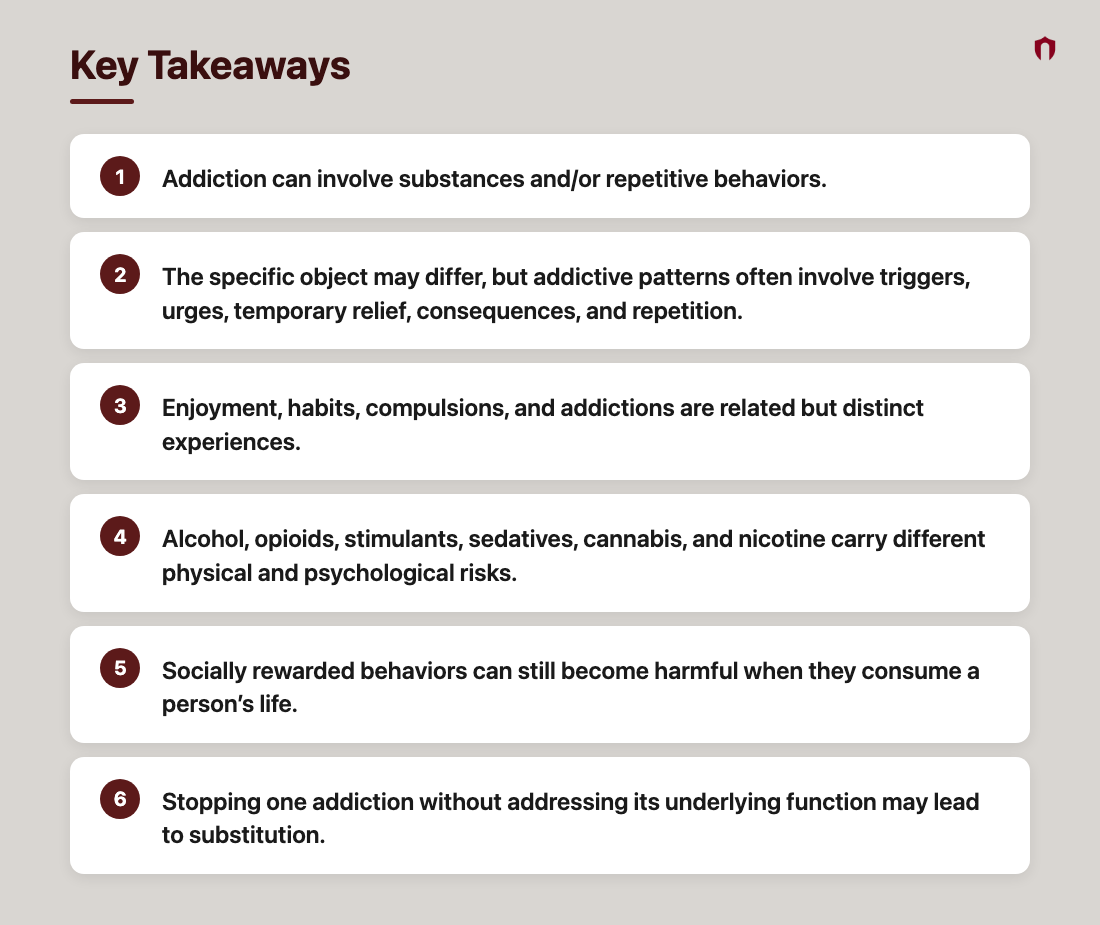
Addiction can involve substances like alcohol, nicotine, opioids, stimulants, cannabis, or sedatives. It can also involve behaviors that repeatedly provide excitement, escape, relief, or validation.
The specific substance or activity may change or vary, but many addictive patterns share a similar cycle:
Trigger → Craving or urge → Behavior → Temporary reward or relief → Consequences → Distress → Repetition
One person may drink to quiet anxiety. Another may gamble to escape boredom and experience excitement. Someone else may repeatedly turn to pornography, shopping, gaming, food, work, or social media when they feel lonely, inadequate, or overwhelmed.
Not every pleasurable, frequent, or unhealthy behavior is an addiction.
People can drink without having alcohol addiction. They can exercise intensely, play video games regularly, enjoy sex often, shop, work hard, or use social media even in excess without losing control.
The concern isn’t simply the behavior or how often it occurs, it’s whether it has become increasingly difficult to control, continues despite meaningful harm, and gradually takes priority over health, responsibilities, relationships, or personal values.
Understanding the many faces of addiction helps move the conversation beyond stereotypes and toward the underlying pattern.
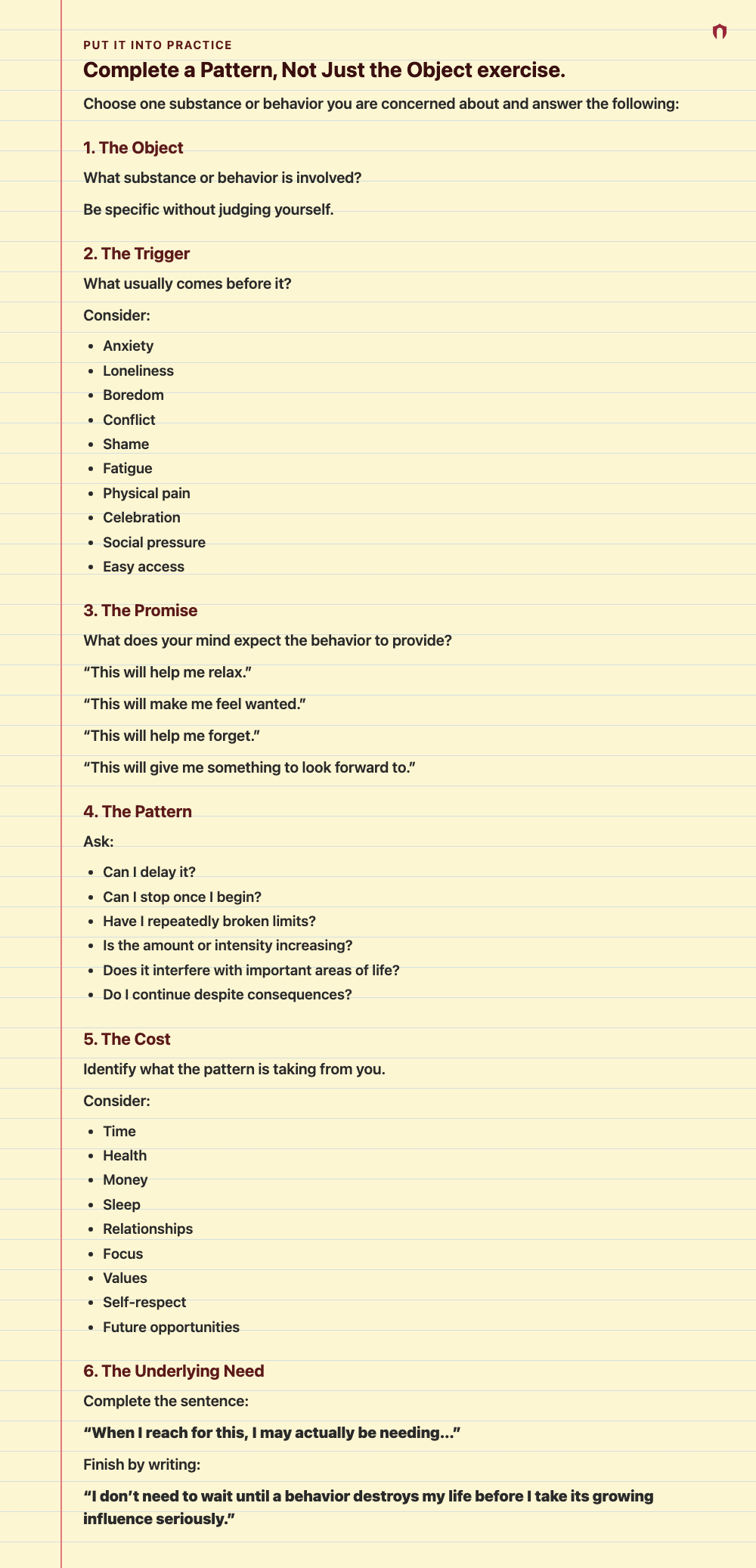
Looking Beyond the Object of Addiction
It’s easy to focus entirely on what someone is using or doing, but that information doesn’t tell the whole story.
Two people may engage in the same behavior with very different relationships to it.
One person may drink and experience no meaningful loss of control or harm. Another may drink less frequently but repeatedly become unable to stop once they begin, make dangerous decisions, or damage important relationships.
One person may spend many hours playing a game because it’s a meaningful hobby and social outlet. Another may continue playing despite severe sleep deprivation, failing responsibilities, declining health, and repeated unsuccessful attempts to reduce their use.
The object matters because different substances and behaviors carry different risks, but addiction is more about the relationship a person develops with that object.
A helpful question is:
“Has this become something I choose, or something my life is increasingly organized around?”
The Difference Between Enjoyment, Habit, Compulsion, and Addiction
These terms are sometimes used interchangeably, but they describe different experiences.
Enjoyment
An enjoyable activity creates pleasure, relaxation, enjoyable stimulation, or connection without causing significant harm or controlling the person’s life.
You can enjoy something when you can stop, delay, or choose not to participate without distress.
Habit
A habit is a behavior repeated often enough to become relatively automatic.
Habits can be healthy, neutral, or unhealthy. Someone may automatically check their phone when they wake up, snack late at night, or pour a drink after work because the behavior has become associated with a routine.
A habit is difficult to change, but difficulty alone doesn’t make it an addiction.
Compulsion
A compulsion is a strong urge to perform an action, often to reduce discomfort, anxiety, or internal pressure.
The person doesn’t always experience the behavior as pleasurable, but they may engage in it because not doing so feels uncomfortable or stressful.
Compulsions can occur in several psychological conditions (such as Obsessive Compulsive Disorder) and are not automatically addictions.
Addiction
Addiction involves a persistent pattern of diminished control, craving or pre-occupation, increasing priority, and continued behavior despite significant and consistent harm.
The behavior may still produce pleasure while engaging in it, but it will increasingly be used to avoid distress, withdrawal, emptiness, or discomfort. The relationship with the substance/behavior and broader pattern are the important characteristics.
Substance Addictions
Substances differ in how they affect the brain and body, how quickly dependence can develop, and what risks they carry from a physical and mental health standpoint.
A person could also use multiple substances, either at the same time or for different purposes.
For example, someone may use a stimulant for energy, alcohol to socialize, and a sedating substance to sleep or relax.
This can create overlapping cycles where one substance is used to manage the negative effects of another.
Alcohol
Society makes it incredibly difficult for someone to separate themselves from alcohol. People drink for positive, non-addiction-related reasons all the time. It may be associated with:
Because alcohol use is common, it’s sometimes difficult to tell how someone’s drinking compares to others. Keeping in mind that addiction is more about the relationship with and patterns regarding the substance than it is about the quantity of use, people may compare themselves only with those who drink more severely.
They may think:
“I don’t drink every day.”
“I only drink socially.”
“I still go to work.”
The concern isn’t just how many drinks someone has or even how often they drink.
Warning signs that drinking may develop into a substance use issue include:
Alcohol withdrawal can be medically dangerous for some people after heavy or prolonged use. Stopping suddenly should not automatically be assumed to be safe. If you believe you have a drinking problem, seek medical consultation on best practices to stop using.
Opioids
Opioids include prescription pain medications, heroin, and fentanyl.
Some may initially use them for pain relief or pleasure, but repeated use creates tolerance, physical dependence, withdrawal, and intense cravings.
Opioid addiction can become especially dangerous because they almost all come with the risk of dramatically slowed or stopped breathing.
Risk increases when:
Often with opioids, a person eventually may use because of negative reinforcement - less to experience pleasure and more to avoid withdrawal. This can create the feeling that the substance is required simply to function.
Arguably the most dangerous situation in all of addiction is when a regular opioid user takes a break from using, loses their tolerance, and then returns to using the same amount as they were previously accustomed to. This is common, and leads to a significant amount of deaths by overdose.
Stimulants
Stimulants include cocaine, methamphetamine, misused prescription stimulant medication, and caffeine.
They may temporarily create:
These effects can make stimulants especially appealing to people who feel depressed, insecure, socially anxious, or pressured to perform.
Repeated or heavy use may contribute to:
Sedatives and Anti-Anxiety Medications
Medications that reduce anxiety or promote sleep can create dependence and misuse when taken outside of the medical guidance or over long periods of time.
Over time, you need more to experience the same relief.
Withdrawal from sedating medications can be medically dangerous, especially after heavy or prolonged use. A medically supervised plan may be necessary.
Just because a substance was originally prescribed doesn’t make misuse impossible.
At the same time, physical dependence on a prescribed medication is not automatically addiction. As always, the larger pattern of control, craving, misuse, and harm needs to be considered.
Cannabis
One of the most controversial substances in modern history is cannabis. Some believe it’s a harmless stress reducer, creative aid, or a sleep/diet/exercise helper. Some think it stokes complacency, laziness, anxiety, paranoia, and psychosis. Some think the government has historically prohibited it as part of race and class wars, some think the government recently lifting regulations against it is doing so to make people more hapless and compliant.
The truth is probably somewhere in the middle, but in terms of cannabis as it relates to addiction, both things are true at once: many are able to use cannabis without becoming addicted, but a large number of people meet the criteria for addiction without knowing or admitting so.
In-line with addiction, frequent cannabis users experience increasing difficulty in controlling the pattern. This may include:
Because cannabis is often perceived as natural or less dangerous than other substances, people may dismiss signs that their relationship with it has become unhealthy.
It’s true that the risk of bodily harm and significant physical health consequences is lower with marijuana than with other substances, but the long-term mental ramifications are a bit of a question mark, and the consequences of addiction go well beyond physical harm.
Nicotine
Nicotine addiction can develop through cigarettes, cigars, vapes, oral pouches, or other nicotine delivery systems.
Nicotine can create a rapid cycle of craving and relief.
The person might believe nicotine calms anxiety, but part of that relief is coming from temporarily reducing withdrawal discomfort created by previous nicotine use.
The cycle may become:
Craving or irritability → Nicotine → Brief relief → Falling nicotine level → New craving
Because nicotine use may be woven into daily routines, it can become linked with:
This combination of chemical dependence and learned routine can make stopping difficult even when the person strongly wants to change.
Gambling Addiction
Gambling is currently one of the fastest growing addictions. It’s been two-hand-shoved into society with the implementation of ease and accessibility with smart phones, legalization, and marketing efforts in media. Gambling is also one of the clearest examples of an addiction that does not require consuming a substance.
The reward comes from uncertainty, risk, anticipation, a distraction from life’s stressors, and the possibility of winning.
Early wins can create powerful memories and unrealistic expectations about future success. Losses may then produce the urge to “chase” - continuing to gamble in an attempt to win back money.
It may sound illogical, but for someone who’s addicted to gambling, winning or losing doesn’t really matter.
The cycle may become:
Excitement → Bet → Win or loss → Strong emotion → Increased urge to continue regardless of the outcome
Warning signs may include:
The harm is not only financial. Gambling addiction can create secrecy, anxiety, depression, broken trust, and a constant emotional swing between hope and despair.
Gaming and Digital Reinforcement
Gaming can provide enjoyment, mastery, competition, and meaningful social connection.
Frequent gaming is not automatically addiction, but again concern grows when it becomes difficult to control, takes priority over other areas of life, and continues despite significant consequences.
Possible warning signs include:
Many games are designed around repeated rewards, achievement systems, social obligations, and unpredictable outcomes. These features can make continued play especially compelling. These represent some of the most challenging experiences to pull away from.
Pornography and Compulsive Sexual Behavior
Pornography and compulsive sexual behavior are similar to food, exercise, or other addictions where some engagement may be healthy and typical, but excessive use and a poor relationship with the activity can wreak havoc.
Similar to gambling, the rise of technology, social media, and availability has led to more and more issues with pornography and compulsive sexual behavior. Porn is easily accessible for anyone with the internet, which these days includes children and teenagers. Compulsive sexual behavior is easier than ever to partake in with the prevalence of dating apps and online communities.
A strong desire doesn’t necessarily mean a lack of control. Concern arises when sexual behavior becomes a pattern that’s difficult to regulate, requires higher volume or intensity to provide the same pleasure, and continues despite serious consequences.
While there are perfectly normal ways to engage in sex and masturbation, a person may also use sexual stimulation to:
Warning signs may include:
The ease of accessibility and the typical expectation of healthy sexual engagement makes ceasing pornography and compulsive sexual behaviors extremely challenging.
Shopping and Spending
Shopping and spending can provide excitement, relief, identity, or a sense of control. The anticipation of buying something may briefly improve mood.
But for some people, spending becomes a repetitive response to sadness, stress, insecurity, boredom, loneliness, or the need for status.
The relief may fade quickly, leaving:
The person may then shop again to escape the feelings created by previous spending.
Not all impulsive purchasing is addiction, but an increasingly uncontrollable cycle deserves attention.
Food and Eating-Related Compulsions
Food is different from substances that can be avoided because eating is necessary for life.
People may develop patterns involving:
These experiences may reflect eating disorders or other psychological and medical concerns rather than just being understood through addiction models alone. The distinction matters because treatment needs may differ.
The main concern would be repeated loss of control, distress, health effects, and a cycle in which food becomes the primary method of managing emotions.
People experiencing these patterns deserve appropriate care rather than moral judgment about discipline or body size.
Work, Exercise, and Social Approval
Some potentially addictive patterns are socially rewarded.
A person who works constantly may be praised as ambitious. Someone who exercises excessively may be considered disciplined and subsequently attractive. Someone who is always available to work may be seen as committed and successful.
This can make harm more difficult to recognize.
Work
Work may become an escape from emotions, relationships, insecurity, fear of failure, and the belief that someone’s worth is tied to their achievement.
The person may neglect health and relationships while receiving praise for productivity.
Exercise
Exercise is generally beneficial, but it can become rigid or compulsive when someone continues despite injury, illness, exhaustion, or significant life disruption.
The person may experience intense guilt or anxiety when unable to exercise.
Social Media
Social media can provide connection, entertainment, information, validation, and opportunity.
But it becomes problematic when someone repeatedly sacrifices sleep, concentration, relationships, or their mental health while feeling increasing difficulty to disengage.
The pattern may be reinforced by unpredictable rewards like a DM, like, praise, outrage, argument, comparison, and social inclusion.
The type of reward when it comes to scrolling short-form content appears to be one of the most addictive we’ve ever seen. It’s both unpredictable and inevitable at the same time. The user doesn’t know when they’ll get the dopamine they’re searching for, or what type of content or entertainment will provide it, but they know it’s coming. All they have to do is scroll again. And again. And again.
Key Takeaways
🧠 Your Mental Playbook
One Thing to Remember
The object of addiction may change, but the underlying promise is often the same: “This will make me feel better right now.”
That promise may involve pleasure, relief, confidence, escape, numbness, control, or belonging.
Reflect
Consider your understanding of addiction and the assumptions you may carry.
Ask yourself:
Which behaviors do I dismiss because they are legal or socially accepted?
Do I confuse frequency with addiction?
What behaviors become most appealing when I feel stressed, lonely, ashamed, or bored?
Can I choose when to engage and when to stop?
Have I repeatedly tried to set limits and broken them?
Has one behavior replaced another without changing the underlying cycle?
Is the behavior adding to my life, or gradually becoming the structure around which my life is organized?
Put It Into Practice
“The many faces of addiction can change its disguise but the processes and effects are largely the same regardless of how it pops up. Recovery begins when you recognize the pattern beneath it.” — Zack Etter/Mental Fitness Lounge
Introduction
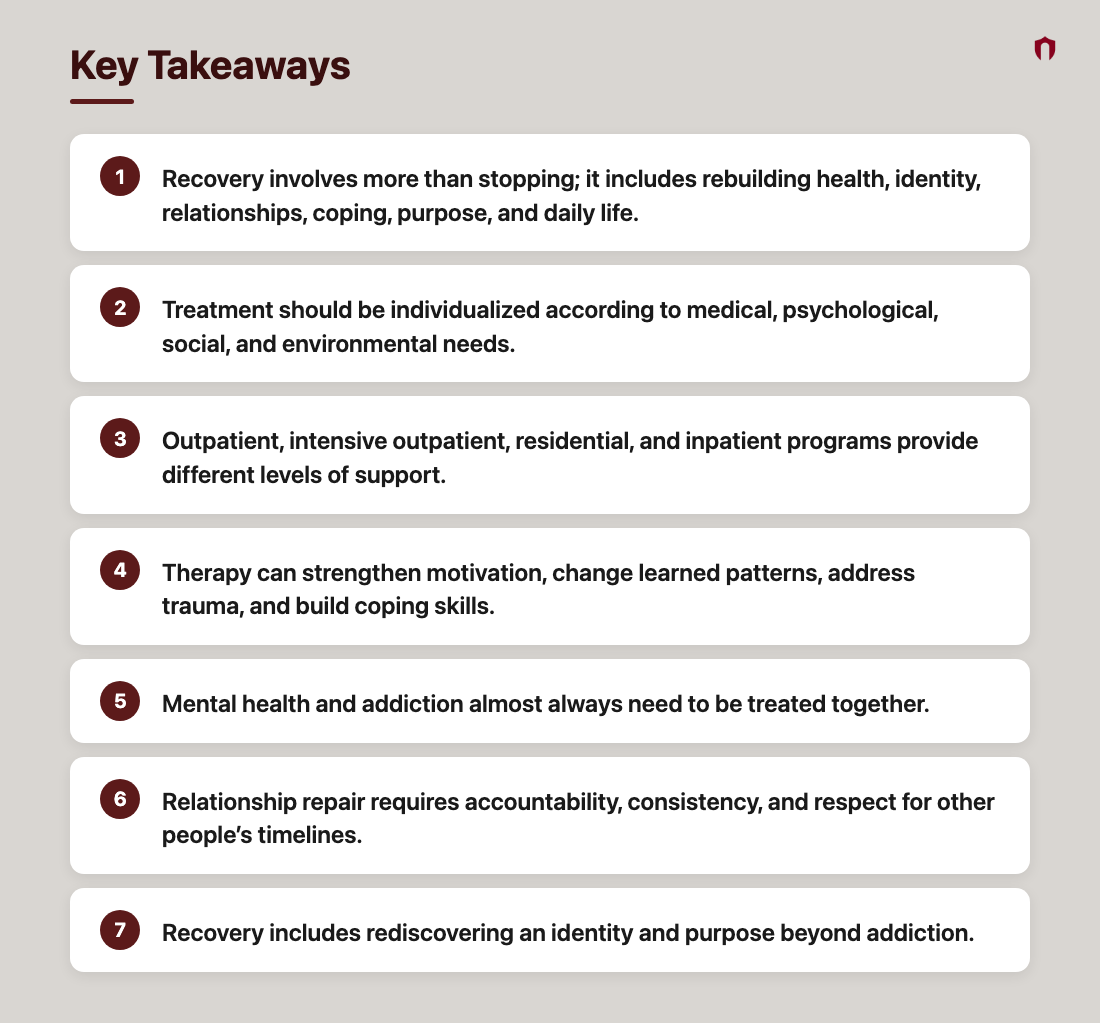
Recovery is typically seen as, of course, stopping the use or engagement in the substance/behavior. That is an important part of it - but not the whole process.
Addiction may have become connected to relief, routine, relationships, identity, sleep, confidence, pain management, or the ability to tolerate difficult emotions. Simply removing it would leave a significant space behind that needs to be addressed through recovery.
A person may stop using and then discover:
Recovery therefore requires more than subtraction.
It also involves rebuilding:
There is no single recovery pathway that works for everyone. Effective recovery can include medical care, medication, therapy, structured treatment, peer and family support, harm reduction practices, community, or a combination of approaches. Recovery is a highly personal process, and treatment should be matched to the individual’s needs rather than treated as one standard program for every person.
Recovery Is a Process
Change may begin with a powerful decision:
“I can’t continue living this way.”
That decision matters, but motivation can change from day to day.
Someone may feel completely positive that they’re done with the substance in the morning and then experience intense cravings that evening. They may sincerely want recovery while also missing the relief, excitement, or escape the addiction provided.
Two things can be true at once:
“I know this is harming me.”
and:
“Part of me still wants what it gives me.”
Recovery involves repeatedly choosing long-term well-being while learning how to respond to the part that still seeks immediate relief.
Recovery is built through repeated actions, not one permanent moment of motivation.
Start With an Honest Assessment
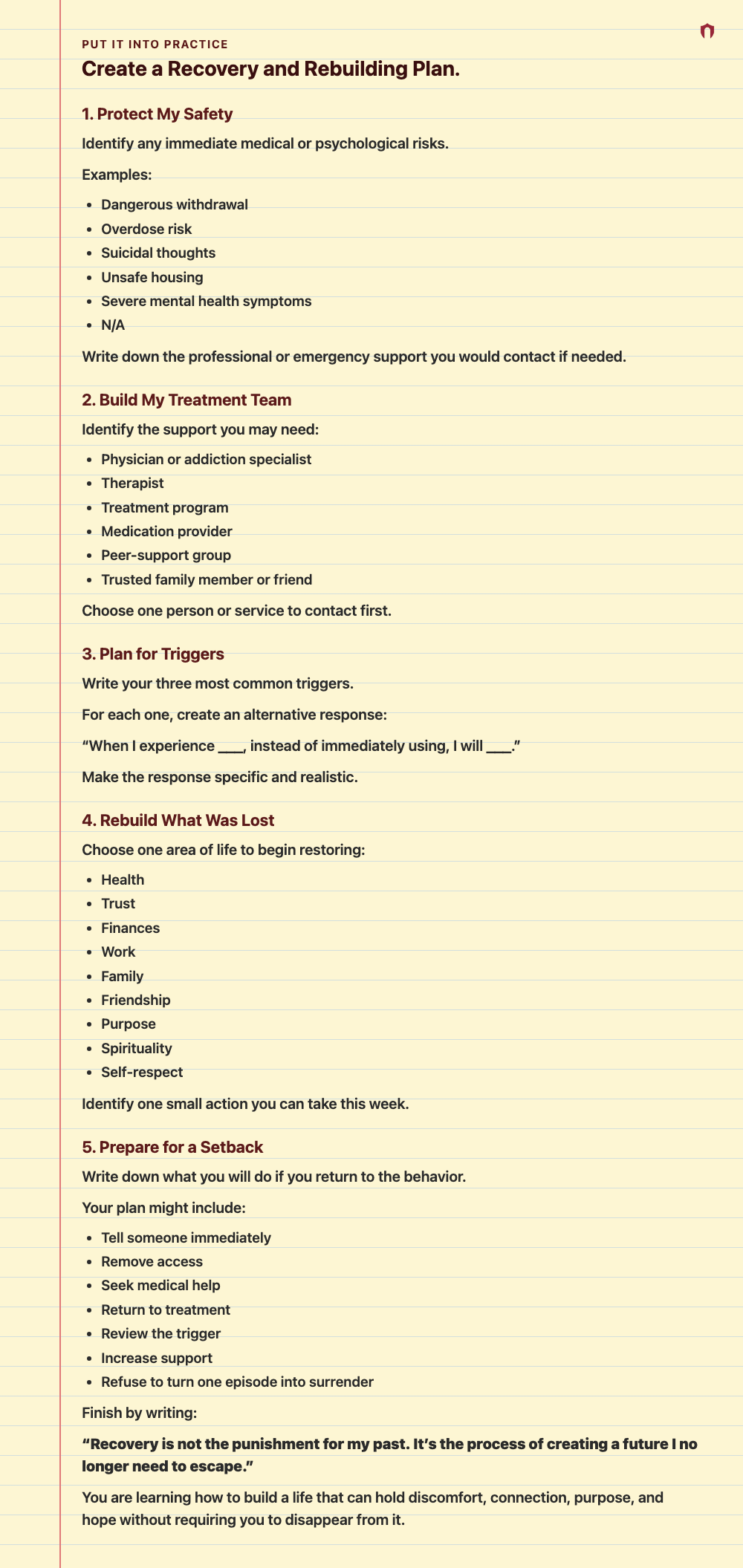
Before choosing treatment, it’s important to understand your pattern clearly.
An assessment may explore:
The appropriate level of care depends on the whole person, not only the substance involved. Addiction specialists may consider medical needs, emotional and behavioral conditions, readiness for change, relapse risk, and the person’s living environment when recommending treatment.
Withdrawal Management and Medical Safety
Some substances can cause uncomfortable withdrawal. Others can cause dangerous or life-threatening complications.
Withdrawal management - or detox - is the process of helping a person stop or reduce substance use as safely as possible.
It may involve:
For example, heavy or prolonged alcohol use can produce dangerous withdrawal, including seizures and other severe complications. A person with possible alcohol dependence should seek medical guidance rather than automatically stopping abruptly without support.
Withdrawal management is not the same as complete addiction treatment. It helps someone move through the initial physical transition. It doesn’t by itself address triggers, relationships, coping, trauma, mental health, or the conditions that may lead back to use.
Detox can open the door, but ongoing recovery work helps the person remain on the other side of it.
Levels of Treatment
Treatment can occur at different levels of intensity.
Outpatient Treatment
A person lives at home and attends scheduled appointments for therapy, medication, groups, or medical support.
This may be most appropriate when the person is medically stable, has enough support, and can remain reasonably safe between sessions.
Intensive Outpatient or Partial Hospitalization
These programs provide more frequent and structured treatment while allowing the person to return home outside program hours.
They may include multiple therapy groups, individual sessions, medication support, education, and recovery planning each week.
Residential Treatment
A person lives in a structured treatment environment for a period of time.
Residential care may be helpful when someone needs separation from a high-risk environment, intensive support, or time to stabilize routines and build recovery skills.
Inpatient or Medically Managed Care
This level may be required when there are serious medical, psychiatric, withdrawal, or safety concerns that require continuous care.
Treatment intensity should be based on need, not on the belief that one setting is inherently better for everyone. Outpatient, residential, and inpatient options serve different purposes, and the right level will likely change over time.
The goal is often to progressively decrease the level of care needed (which is true for any physical or mental health issue).
Medication Can Be Part of Recovery
Medication is sometimes misunderstood as replacing one addiction with another, but that isn’t really an accurate representation of how it’s used in treatment.
Approved medications can reduce cravings, ease withdrawal, block or reduce the effects of certain substances, and help people remain stable enough to engage in recovery. Medication should be combined with counseling, behavioral treatment, and recovery support as part of a whole-person approach.
Medication decisions should be made with a qualified healthcare professional based on:
Recovery should be measured by improved health, stability, functioning, safety, and quality of life, even if someone may need medication to achieve it.
Therapy and Behavioral Treatment
Addiction affects behavior, thinking, emotions, relationships, and learned responses.
Therapy can help someone understand and change those patterns.
Motivational Approaches
Motivational Interviewing (MI) and related approaches help people explore their patterns without humiliation or confrontation.
Using MI, the therapist helps the client examine:
Motivation is strengthened by helping the person connect recovery with their own values—not simply by telling them what they should do.
Cognitive Behavioral Therapy
Cognitive behavioral therapy can help identify relationships among:
A person can learn to challenge thoughts such as:
“I can’t handle this feeling.”
“One more time won’t matter.”
“I already failed, so I might as well continue.”
The goal is not to eliminate every craving, it’s to build more effective responses when cravings occur.
Trauma-Informed Treatment
For some people, addiction is closely connected to trauma.
Trauma-informed care focuses on safety, trust, choice, collaboration, and avoiding unnecessary retraumatization.
The goal is to help the client understand how past experiences may influence present triggers, emotional regulation, relationships, and use.
Evidence-based treatment may include behavioral therapies, medication, or a combination of the two, depending on the disorder and the person’s needs.
Treat Mental Health and Addiction Together
Addiction likely occurs alongside common and uncommon mental health issues, causing them to interact and intensify each other.
Someone may use to manage anxiety, while the substance later makes anxiety worse. They may use to sleep, while repeated use disrupts sleep further. They may use to numb trauma, while the consequences create additional trauma and shame.
Treating only the addiction without addressing mental health leaves major triggers unchanged.
Treating only the mental health symptoms while ignoring substance use also limits progress, since addiction becomes a problem of its own.
Integrated care addresses both rather than requiring one problem to disappear before the other deserves attention.
Abstinence and Harm Reduction
Recovery goals may differ. For some people, complete abstinence is the safest and most realistic goal, especially when any return to use predictably leads to loss of control or serious danger.
Others may begin with harm-reduction goals. Harm reduction means focusing on reducing death, disease, injury, and other serious consequences even when the person is not ready or able to stop completely.
It may include:
Harm reduction is not approval of dangerous use. It recognizes that protecting life and health creates more opportunities for future recovery.
The most appropriate goal depends on the behavior, level of risk, personal history, and the person’s values and readiness.
“What approach is most likely to reduce harm and help this person build lasting change?”
Peer Support and Community
Addiction often grows in secrecy and isolation.
Recovery is strengthened by connection.
Peer-support groups may provide:
Peer support can help people remain engaged in recovery and reduce isolation, but it’s not necessarily a replacement for medical or psychological treatment when those services are needed.
Recovery Plan Content
Recovery requires learning how to respond to triggers without automatically returning to the addictive pattern.
A recovery plan may include:
Cravings often feel like commands. They’re not – they are experiences. They may rise, intensify, and eventually change without being acted upon.
Each time someone survives a craving without returning to the old pattern, they create confidence:
“This urge is powerful, but it does not make the decision for me.”
Understanding Setbacks and Recurrence
A return to use can be dangerous and should be taken seriously. But it doesn’t automatically mean that recovery has failed.
A setback may reveal:
The most harmful response is often:
“I ruined everything, so there is no point continuing.”
This turns one episode into a full return to the previous pattern.
A more useful response is:
This approach treats relapse as information requiring action rather than as a final judgment about the person.
Repairing Relationships
Recovery and sustained abstinence don’t automatically restore trust.
Loved ones may have experienced:
The person in recovery may want forgiveness quickly because they finally feel ready to change.
Others may need time.
Repair often requires:
An apology is important, but a new pattern is more convincing.
Recovery may also involve family therapy, couples counseling, or support for loved ones who have organized their lives around managing the addiction.
Rebuilding Identity and Purpose
Addiction can shrink a person’s identity. Life may become organized around obtaining, using, hiding, recovering, or managing consequences.
When the addiction is removed, the person may ask:
“Who am I now?”
Recovery creates space to rediscover:
This rebuilding should not become another form of perfectionism. A recovering addict doesn’t need to immediately become exceptionally productive, inspirational, or successful to prove that recovery is worthwhile.
An ordinary, stable life may represent extraordinary progress. A life shaped by accountability, self-awareness, support, and a clearer understanding of what makes it all meaningful.
Build a Life That Supports Recovery
Recovery becomes more sustainable when daily life supports it.
Protective routines may include:
Routine can feel boring compared with the intensity of addiction, but predictability helps stabilize the nervous system and reduces the number of moments where triggers drive impulsive decisions.
Key Takeaways
🧠 Your Mental Playbook
One Thing to Remember
Recovery is not just removing the addiction. It’s building a life where the addiction is no longer your best available source of relief, connection, or hope.
Stopping creates space. Recovery is what you build inside that space.
Reflect
Consider what recovery would need to include beyond stopping.
Ask yourself:
What need has the addiction been meeting?
What level of treatment may be appropriate?
Which mental health concerns also need support?
What situations create the greatest risk of returning?
Which relationships or environments make recovery harder?
What trust needs to be rebuilt?
What parts of my identity have been lost or neglected?
“What support, treatment, and life changes would make strength easier to access?”
Put It Into Practice
“Recovery is not about becoming someone else. It’s about returning to the parts of yourself addiction made harder to reach.” — Zack Etter/Mental Fitness Lounge
Work one-on-one with Zack to build a plan tailored to your situation.