
Understand why motivation fades — and how to rebuild it from the inside out.
A personal welcome and overview of this playbook from Zack.
Introduction
For a topic so widely discussed, motivation is very misunderstood. Many think motivation reflects passion, commitment, character, or work ethic.
They think:
“If I really cared, I would feel motivated.”
“If this goal mattered enough, I would want to work on it.”
“Motivated people don’t have to force themselves to do something.”
This creates unnecessary shame. Motivation isn’t a permanent personality trait. It’s a temporary psychological state that changes with energy, mood, stress, confidence, rewards, and circumstances.
You can genuinely care about a goal and still not feel like acting on it. You can be a driven, hard-working person and simply not “have it” some days.
Humans are naturally drawn toward immediate comfort and reward, and many meaningful goals require effort now for benefits that may not appear until much later. Because of this, good habits, long-term goals, and difficult tasks are inherently difficult to get motivated for.
Throughout the Mental Fitness Lounge, you will repeatedly see one central principle:
Action often creates motivation - not the other way around.
This Playbook will not repeat that idea in every section. Instead, it will help you understand why motivation disappears and what your low motivation may be telling you.
Bad Habits are So Much Easier
Long-term goals often involve delayed rewards.
You may need to:
Meanwhile, vices and distractions offer immediate rewards.
Your phone, television, food, entertainment, and other forms of escape can improve how you feel within seconds.
This creates a natural conflict:
The meaningful choice often rewards you later. The easier choice rewards you now.
Knowing what to do doesn’t automatically make the delayed reward feel emotionally powerful enough in the moment. The immediate option is visible and certain. The future benefit may feel distant and abstract.
This is why people can sincerely want a result while repeatedly avoiding the actions required to get it.
Your Brain Wants to Conserve Energy
There are 3 basic functions of human behavior: seeking something we want, avoiding something we don’t want, and conserving energy.
Complex tasks that would demand motivation also require attention, uncertainty, planning, frustration tolerance, and the possibility of failure. Your brain naturally notices these costs, and when the task feels too difficult or overwhelming, creates resistance.
You may suddenly feel drawn toward:
Avoidance isn’t always conscious – it can appear as a sudden loss of interest, fatigue, or the belief that now is not the right time.
Not every action should be forced, but resistance isn’t reliable evidence that the task is wrong or impossible.
Motivation Loves Certainty
Motivation increases when people know:
It often falls when the goal is vague.
Compare:
“I need to get my life together.”
with:
“I will spend fifteen minutes responding to emails today.”
The first goal is emotionally heavy and difficult to begin.
The second provides a clear action that can be done immediately.
A vague goal requires the brain to make several decisions before any work begins. That extra mental effort creates procrastination.
Sometimes low motivation isn’t a desire problem, it’s a clarity problem.
Starting Feels Harder Than Continuing
The beginning of a task contains the greatest amount of psychological friction.
Before starting, you might be imagining the entire project:
Once you begin, attention shifts from imagining the task to doing it. That’s why people sometimes avoid something for hours and then discover it was manageable once started.
“Sometimes that mountain you’ve been climbing is just a grain of sand. And what you’ve been out there searching for forever, is in your hands.” – Carrie Underwood
Progress Creates Motivation
Motivation grows when effort produces visible evidence of progress.
Set yourself up for success. Small wins can create:
The opposite also occurs.
When people work without seeing progress, motivation may decline.
They may begin thinking:
“What is the point?”
“Am I wasting my time?”
This is especially common with goals that produce slow or invisible results. In these instances, progress needs to be measured through behavior rather than immediate outcomes.
For example:
When the only acceptable reward is the final result, motivation must survive a long period without reinforcement.
Recognizing smaller evidence of progress makes the process easier to continue.
Motivation Is Not a Requirement
One of the most limiting beliefs is:
“I need to feel motivated before I can act.”
You do not.
Obviously you’d prefer to feel motivated, but action is possible even in the presence of boredom, resistance, uncertainty, or low energy.
For example, if you just ate a 5-course meal, and then I put a plate of food in front of you – you might not want to eat it. It’d be helpful to be hungry. But you literally can eat it if you had to.
Separate two different statements:
“I don’t feel motivated.”
and:
“I am unable to take any action.”
They are not the same. Motivation can help action, but it’s not necessary.
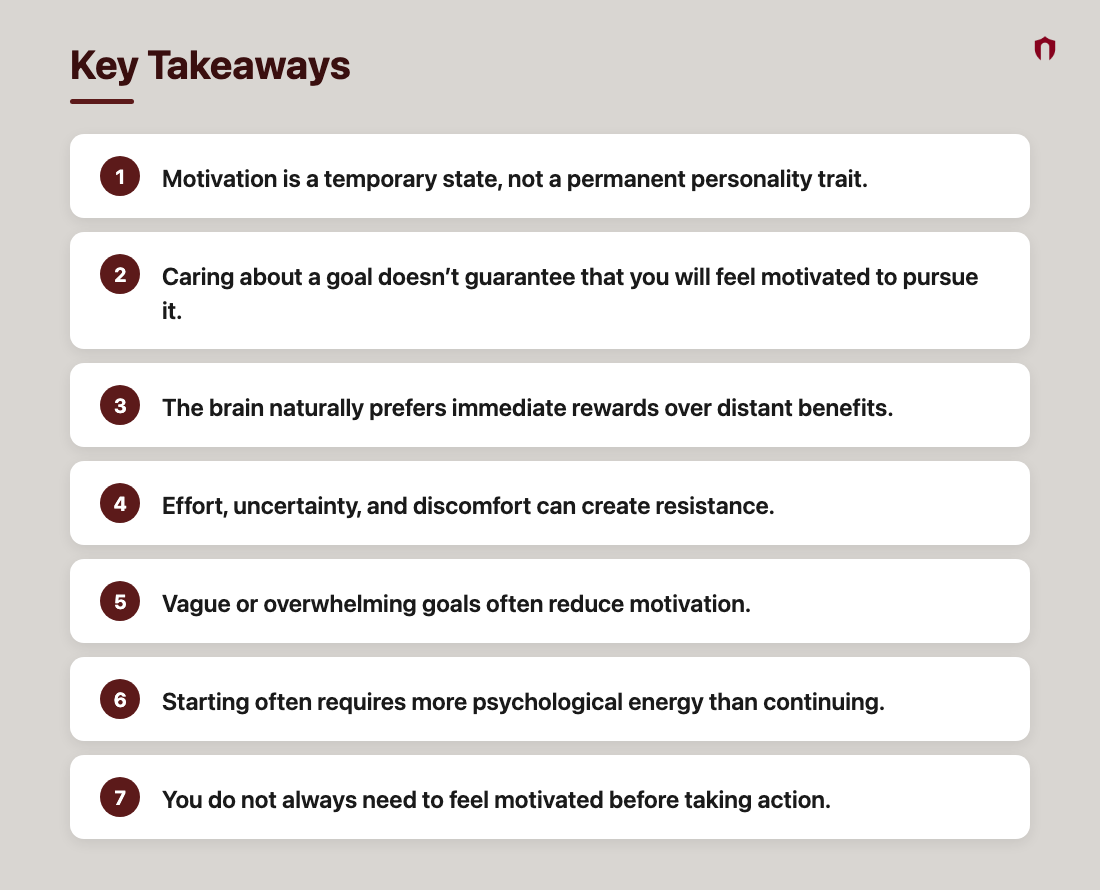
Key Takeaways
🧠 Your Mental Playbook
One Thing to Remember
Motivation isn’t something you either have or lack. It rises and falls based on how your mind experiences the task in front of you.
When a task feels overwhelming, unclear, unrewarding, or likely to end in failure, motivation drops.
That doesn’t mean you’re lazy or incapable. It means something about the task, the timing, or your current state may need to change.
Reflect
Choose one goal you’ve been avoiding.
Ask yourself:
Is the reward immediate or far away?
Is the task clear, or does it require several decisions?
Am I imagining the entire project instead of the next action?
What easier reward usually pulls me away?
Have I been waiting to feel motivated before beginning?
What evidence of progress could I track?
Low motivation becomes easier to understand when you identify what your mind is moving away from—and what it is moving toward instead.
Put It Into Practice
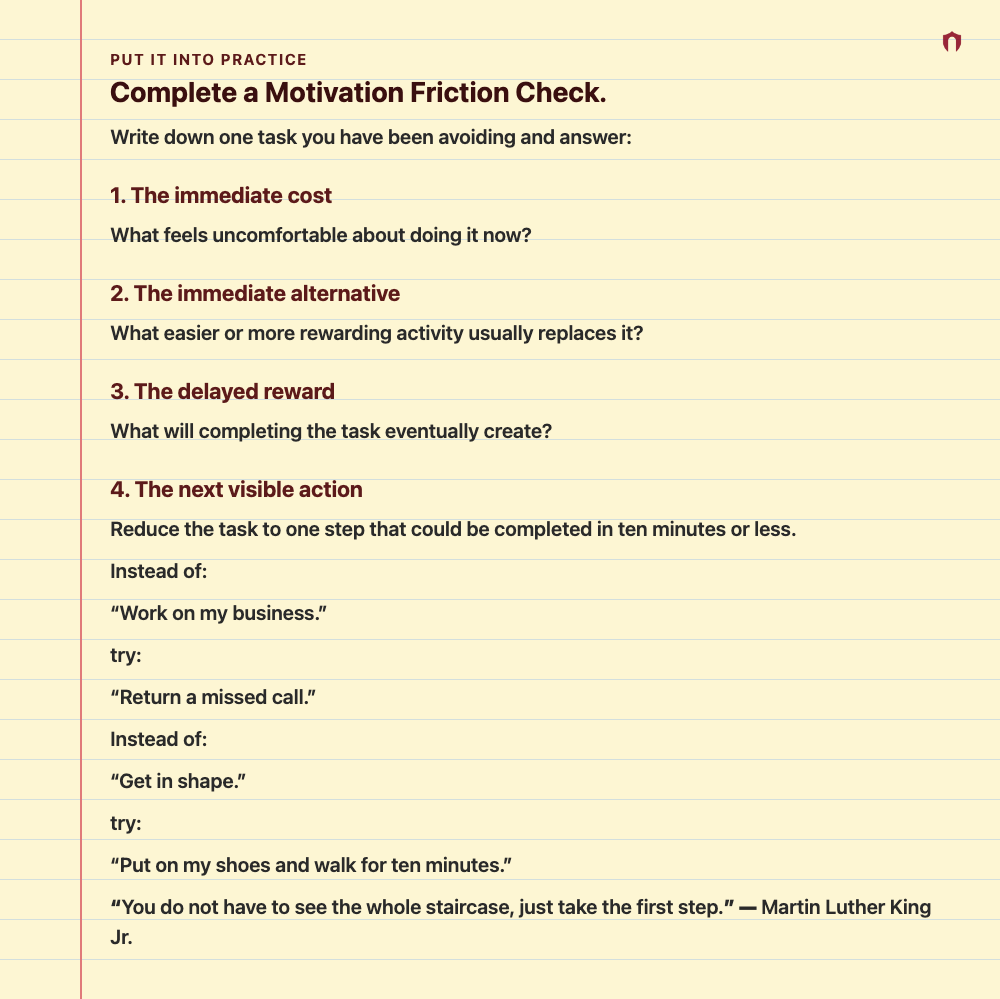
“Motivation can be useful, but it’s not necessary to do the things you’re committed to doing.” — Zack Etter/Mental Fitness Lounge
Introduction
Sometimes low motivation isn’t the problem, it’s a signal.
Low motivation can reflect exhaustion, fear, confusion, discouragement, poor mental health, or a goal that no longer fits your values.
This is why the answer isn’t always:
“Try harder.”
Before forcing yourself forward, it can help to ask:
“What might my lack of motivation be telling me?”
Low motivation is information to investigate—not automatically an instruction to quit.
You May Be Exhausted
Motivation requires energy.
When you are physically or emotionally depleted, even simple responsibilities can feel unusually demanding.
You may need to examine:
Sometimes what looks like laziness is actually burnout - a body and mind operating with limited resources. (See Burnout Playbook).
Rest won’t solve every motivation problem, but constantly demanding more effort from an exhausted system may make the problem worse.
You May Be Overwhelmed
A task becomes harder to begin when it feels too large, vague, or complicated.
You might not lack motivation for the goal itself, but you could lack a clear entry point.
For example:
“Fix my finances.”
“Get healthy.”
“Start a business.”
“Turn my life around.”
These goals contain dozens of hidden decisions. Feeling overwhelmed creates avoidance because your mind can’t easily identify correlated rewards to actions in the short term.
The solution may be less about increasing desire and more about reducing complexity.
Ask:
“What is the next specific action I can take right now?”
You May Fear Failure
Avoidance can protect you from finding out whether you’ll succeed or fail. Hope and possibility may feel more exciting and inspiring than actually doing the work and getting an unpredictable result.
As long as you don’t fully try, you can tell yourself:
“I could have done it if I really committed.”
Trying creates the possibility of disappointment, criticism, embarrassment, or evidence that progress may take longer than expected.
Low motivation may therefore be fear in a less obvious form.
You May Be Afraid of What Success Requires
Success almost always leads to more work. Achieving a goal may bring:
Part of you may want the outcome while another part fears the life attached to it. Success may represent both opportunity and uncertainty.
Lack of motivation in this instance may be self-sabotage disguised as “I’ll do it later” or “I don’t feel like it.”
You May Be Trapped by Perfectionism
Perfectionism can make starting feel dangerous or extremely overwhelming.
You may believe the work must be:
When the standard feels impossible, avoidance becomes emotionally safer than producing something imperfect.
This could feel like low motivation, but the deeper message may be:
“Not doing it at all is better than doing it poorly.”
Progress requires permission to create an incomplete first attempt.
You May Be Discouraged
Repeated effort without visible progress can weaken motivation.
You may begin thinking:
“Nothing I do makes a difference.”
This can happen when:
You might care deeply but no longer expect your effort to work. In this case, rebuilding motivation may require tangible short-term goals, clearer feedback, or evidence that progress is still possible.
The Goal May Not Be Yours
Some goals are inherited rather than chosen, or landed on for more external reasons.
You may be pursuing something because:
It’s difficult to sustain motivation for a life you don’t genuinely want.
There’s a difference between tolerating an unpleasant responsibility and building your identity around a goal that belongs primarily to someone else.
Ask:
“Would I still want this if no one were watching?”
You May Have Lost Connection to the Reason
A goal can become detached from the reason it originally mattered.
Exercise becomes a number on a scale.
Education becomes a grade.
Work becomes a list of tasks.
Saving becomes deprivation.
When the process feels disconnected from meaning, motivation fades. In this instance, reconnect the action to what it protects or creates:
You don’t need to feel inspired every day, but it helps to have frequent reminders about what the effort is for.
Your Environment May Be Working Against You
Motivation is affected by surroundings.
A goal becomes harder when:
People blame themselves for failing in an environment designed around distraction, convenience, or chaos.
Personal responsibility still matters, but changing the environment could be more effective than repeatedly demanding greater willpower.
Low Motivation May Reflect a Mental or Physical Health Concern
Persistent low motivation can sometimes occur alongside:
The important consideration is whether motivation is low only for one difficult goal or across many areas of life.
Significant changes in energy, interest, or functioning should not automatically be dismissed as poor discipline.
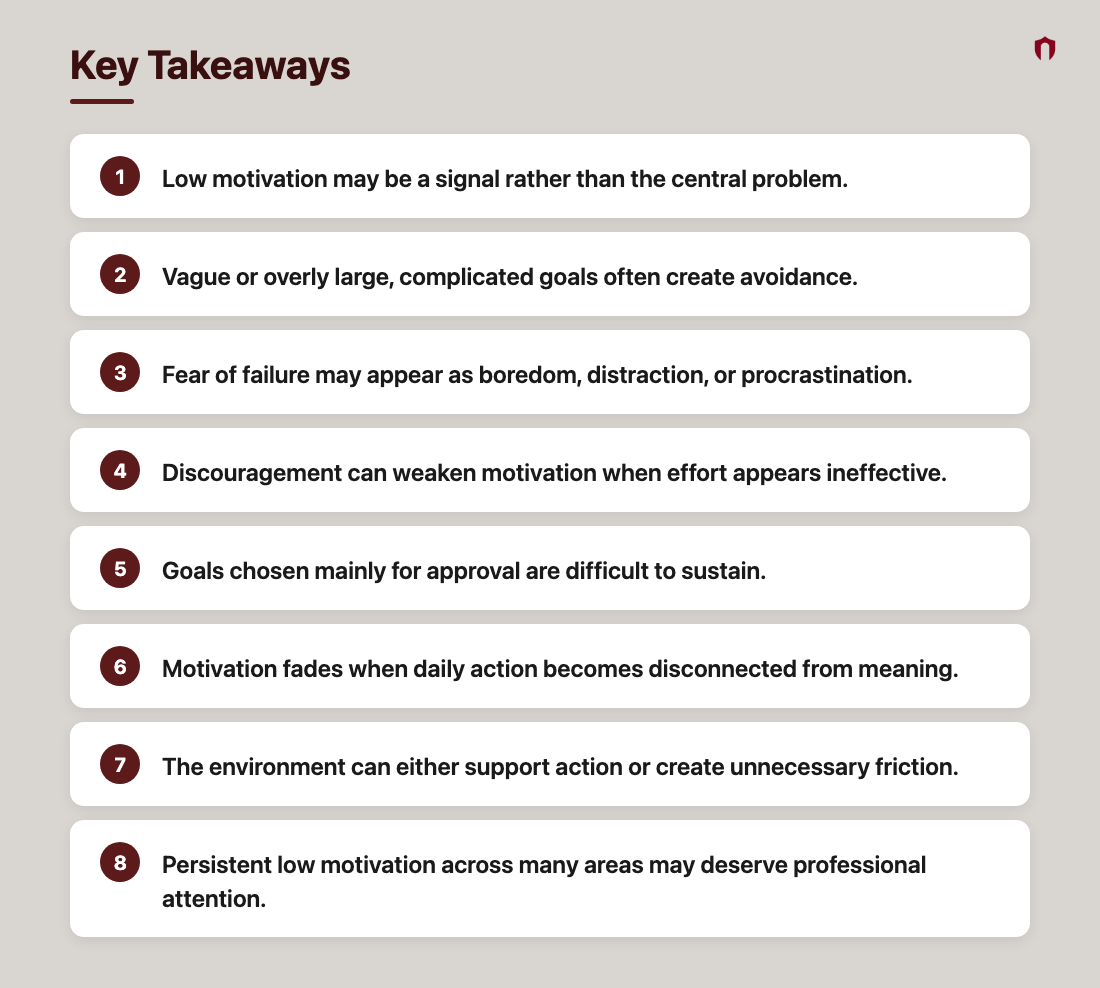
Key Takeaways
🧠 Your Mental Playbook
One Thing to Remember
Low motivation may not mean you need a different goal. It may mean you need a different way of approaching it.
Before giving up, consider whether the task needs to become clearer, smaller, more supported, or less tied to perfection.
Reflect
Choose one area where motivation has been low.
Ask yourself:
Is the goal too large, long term, or unclear?
What might change if I succeed?
Am I demanding perfection before I begin?
Have repeated setbacks made me feel hopeless?
Is this goal genuinely mine?
Is my environment supporting or undermining me?
Put It Into Practice
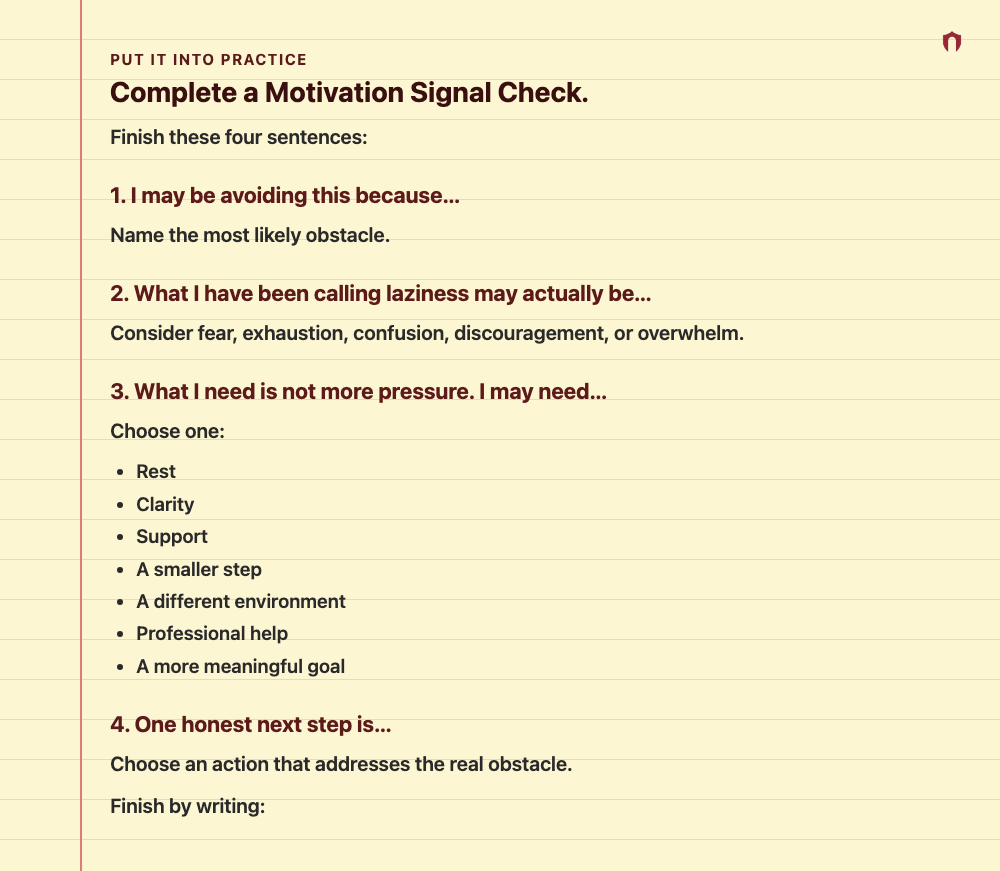
“What looks like resistance may be a message. The work is learning how to read it.” — Zack Etter/Mental Fitness Lounge
Introduction
Motivation is treated as something you either have or don’t have.
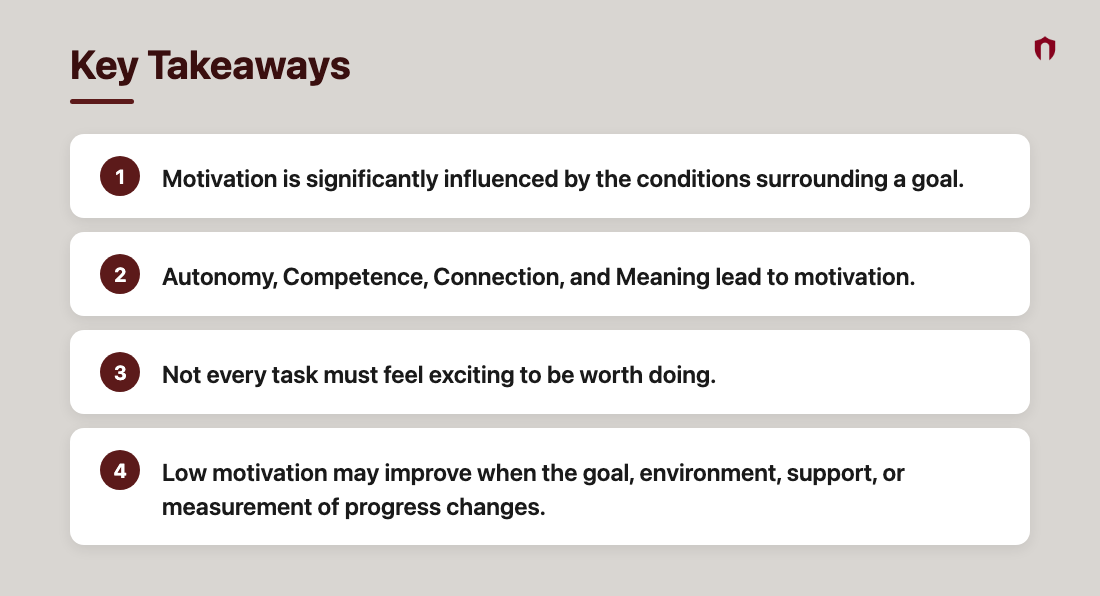
But motivation is strongly influenced by the conditions surrounding a goal.
You’re more likely to engage when:
Instead of only asking:
“How can I force myself to feel more motivated?”
it may be more useful to ask:
“What does my motivation need that it’s not currently receiving?”
Four important needs to examine are autonomy, competence, connection, and meaning.
Autonomy: “Do I Have Ownership and Freedom of Choice?”
Autonomy means experiencing some degree of choice and ownership.
People often lose motivation when they feel controlled by:
Not every responsibility is optional. Work, bills, health needs, and family obligations may still require action.
But even within an obligation, there may be choices involving:
Compare:
“I have to exercise because I hate how I look.”
with:
“I want to exercise because I’d like to have more energy and better health.”
The desired behavior may be the same, but the second statement creates greater ownership.
Competence: “Do I Believe I Can Make Progress or be Successful?”
Motivation grows when people believe their effort will produce improvement.
It falls when a task feels:
Repeated setbacks can weaken confidence. A person may stop trying not because the goal no longer matters, but because they no longer expect effort to work.
Competence grows through evidence.
That evidence may come from:
A useful question is:
“What version of this goal would allow me to experience a small win?”
Small wins are not meaningless. They help rebuild the expectation that action can lead somewhere.
Connection: “Who or What Am I Connected To?”
We are social creatures. Motivation is easier to sustain when people feel supported by, connected with, or valued by others.
Connection may involve:
Isolation can make difficult goals feel heavier and less purposeful.
Someone might understand what to do but struggle to continue without feedback, support, or a sense that anyone notices.
Helpful connection might mean:
Support can’t replace personal responsibility, but personal responsibility doesn’t require doing everything alone.
Meaning: “Why Does This Matter?”
Motivation becomes fragile when action feels disconnected from a meaningful reason.
You don’t need to feel passionate about every task. Some responsibilities are simply necessary. But even an unpleasant task may serve something important: The task itself may not inspire you, but the result of it might.
For example:
Having a strong sense of meaning and purpose won’t eliminate resistance, but it’ll give you a reason to move through it.
A helpful question is:
“What becomes possible if I continue?”
Diagnose Before You Demand
When motivation is low, identify which condition may be missing.
Ask:
Is autonomy missing?
Does this feel forced, controlled, or driven mainly by external motivation?
Is competence missing?
Does the task feel too difficult, vague, or unlikely to produce progress?
Is connection missing?
Do you feel isolated, unsupported, or disconnected from who benefits?
Is meaning missing?
Have you lost sight of why the effort matters, or does the goal no longer fit your values?
Key Takeaways
🧠 Your Mental Playbook
One Thing to Remember
Motivation grows when you feel that the goal is yours, progress is possible, support is available, and the effort matters.
You don’t need all four conditions to be perfect. Strengthening even one can make the next step easier to take.
Reflect
Choose a goal that you’re experiencing low motivation for.
Ask yourself:
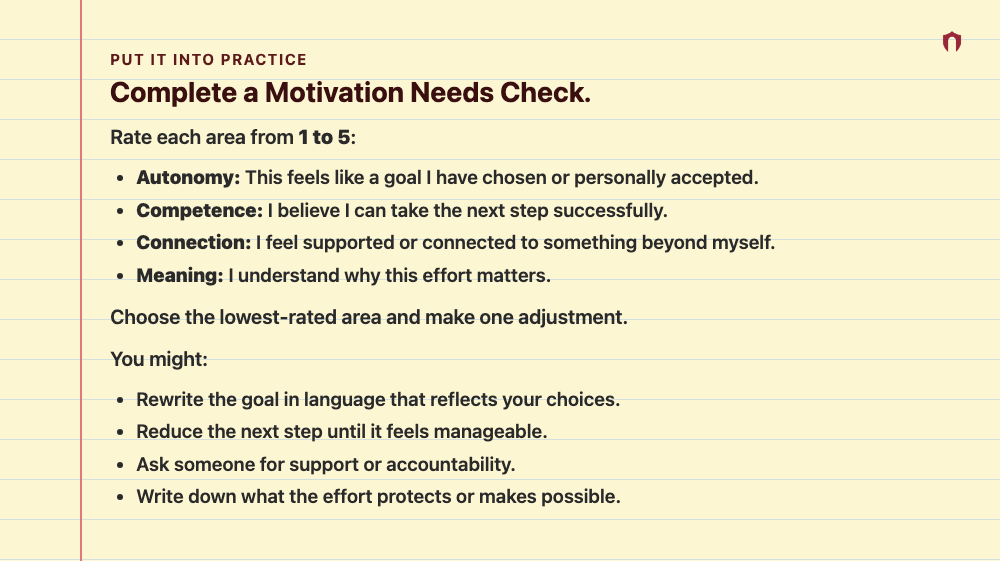
Autonomy: How much ownership and choice do I feel over this goal?
Competence: Do I believe I can make progress?
Connection: Who supports me or benefits from my effort?
Meaning: What important outcome does this action serve?
Identify which need is weakest. That missing condition may be more useful to address than simply telling yourself to try harder.
Put It Into Practice
“Motivation is not only found within you. It is also shaped by what surrounds you.” — Zack Etter/Mental Fitness Lounge
Work one-on-one with Zack to build a plan tailored to your situation.